Sometimes I find myself running a very long way away from the Pennine Way. Not at all Spine related but as I was privileged enough to find myself running the first ever ultra race to be staged in Uzbekistan I thought it was worth a few words…however I don’t really do a few words so we are starting with an introduction to Uzbekistan…
When global Limits announced a race in Uzbekistan, it raised a lot of questions. The first one being, where is Uzbekistan? Central Asia, it was part of the Soviet Union until independence in 1991. It is also one of only two double-landlocked countries in the world (i.e. you have to pass through at least two other countries to reach the sea in any direction). For future pub quizzes, the other is Lichtenstein. Uzbekistan has a population of 36 million, of whom 96% are Muslim.

In 327 BC, Macedonian ruler Alexander the Great conquered the Persian Empire provinces of Sogdiana and Bactria, which contained the territories of modern Uzbekistan. He built (well, had built, it’s unlikely he did all the work himself) the Fortress of Nur, located in Nurota, Uzbekistan, around 2300 years ago. The fortress was built to defend the settled lands from nomadic invaders to the north. This would be the finish line of the race.
Samarkand (our first destination in Uzbekistan) was on the Silk Road, a network of Asian trade routes active from the second century BCE until the mid-15th century, and grew rich from trade.
Timur, also known as Tamerlane ), was a Turco-Mongol conqueror who founded the Timurid Empire in the 14th Century. Its capital was Samarkand, which became a centre of science under the rule of Ulugh Beg, giving birth to the Timurid Renaissance.

The first question everyone asked when I said I was going to Uzbekistan was, is it safe? There is a slight tendency to assume that any country that ends in -stan is a bit dodgy. We were assured it was by Global Limits, and as they had actually been there to plan the race, we took their word for it. How do we get there? Fly with Turkish airlines via Istanbul. Actually, getting there wasn’t too much of a problem, getting back was more challenging due to several flight cancellations and changes. There were other issues with leaving the country too but more on those much later.
So anyway, we signed up. Then Sharon noticed one of the days was 40 miles and possibly wished she hadn’t. This race was slightly different to other Global Limits adventures in that there were about 100 people signed up for it, compared to the 50 or so the races usually had. This was due to the speed people were signing up, 100 places were booked in 100 hours!
As is usual with these kinds of adventures, I signed up first and then had a look to see what it was I’d actually signed up for. I knew the headlines, 230km over six days, but what about elevation, and how was the distance divided across the six days?
It looked like it would be a race of two halves. The first three days were to be spent in the mountains, with some serious elevation gain on the first day, followed by two days that were predominantly downhill. The fourth day was the previously mentioned 40-mile stage, which would see us leave the mountains and move onto the hot and dusty plains of Uzbekistan. Day five looked similar but a bit shorter, and the last day was the traditional ‘short’ (~11 miles) leg to the finish – the previously mentioned fortress of Alexander the Great at Nur.
Getting to Uzbekistan was fairly straightforward, we flew from Gatwick and changed at Istanbul. We met Marilena – a multi-day legend from Venezuela – at Istanbul. For any future travellers do NOT simply ask for a glass of wine at the airport – unless you think the equivalent of £75 for three glasses of wine and a bottle of water is reasonable!
Immigration and customs went without a hitch, and we were met by Stefan, the race director, outside the airport and put on a coach to transfer to the hotel. Due to the time shift and flight times, we had kind of missed a night and arrived at the hotel at about 8:30am, too early to check in but in plenty of time for our 9 ‘o’ clock city tour. We met various people we knew and that were on the tour with us, having lost a night’s sleep at this point I find it hard to remember who was on the tour with us. One I definitely remember was Hannisze. She is the partner of Argy, a super-talented Greek runner I notionally raced against at the Way of Legends, and a brilliant photographer, so I knew we would have some great race photos.
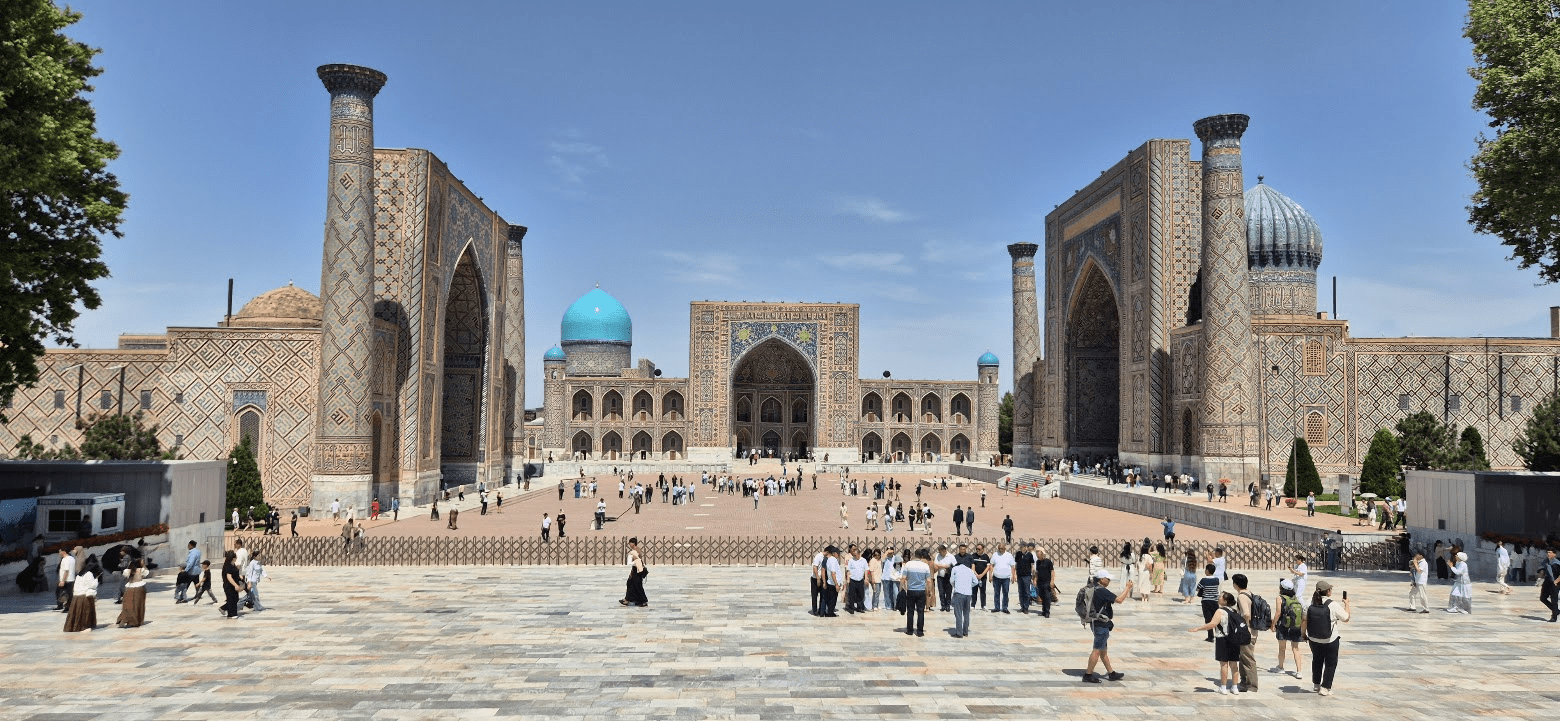
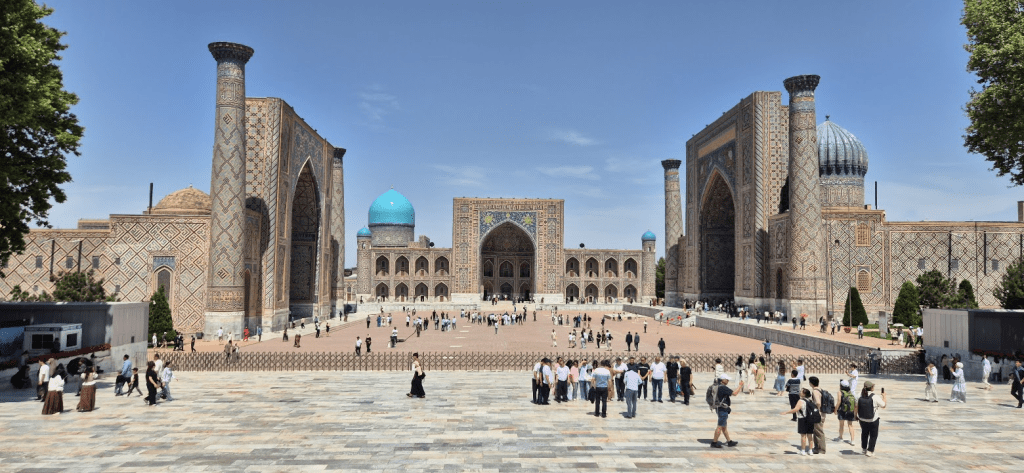
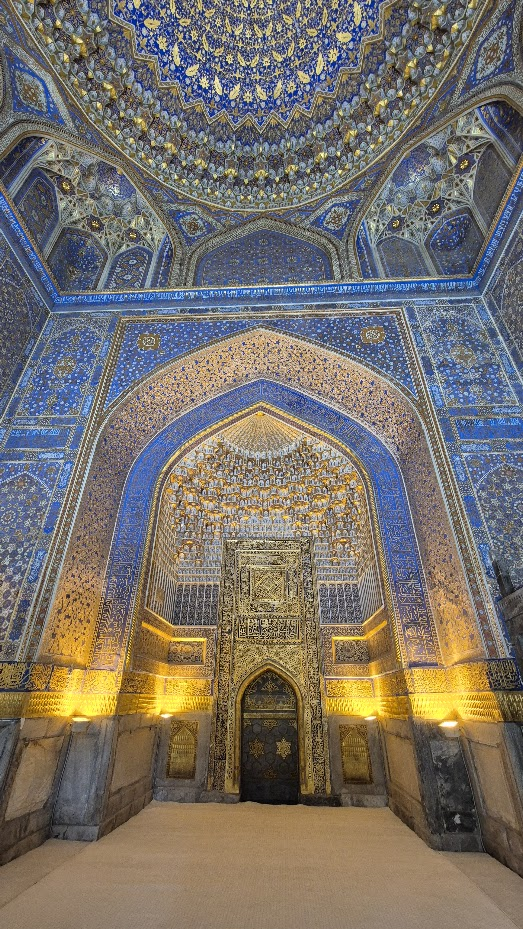
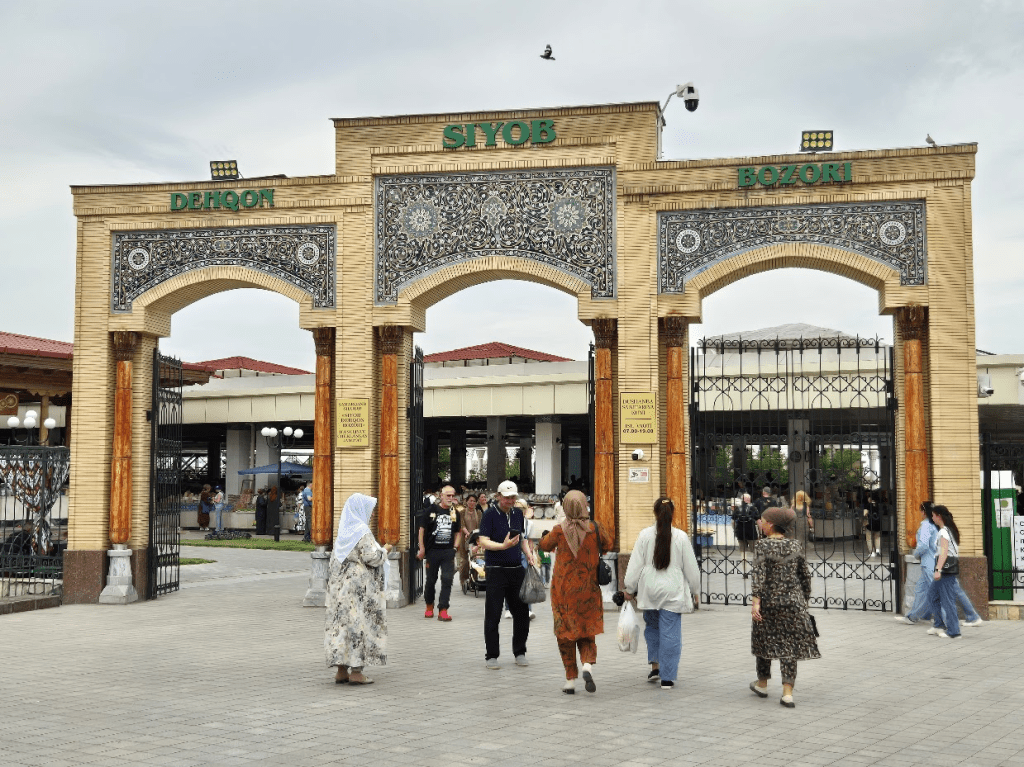
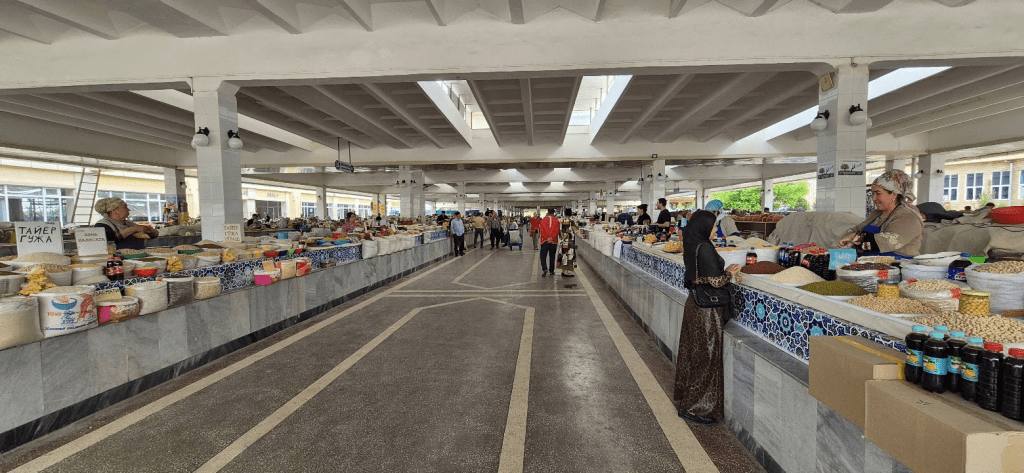
I won’t go into details of the city tour, just to say it was really worth doing and Uzbekistan has some stunning architecture, I’ll let the pictures do the talking. Whilst the Mosques, Madrassas and Mausoleums were very impressive, possibly the most significant site for me, as an engineer was the observatory of Ulugh Beg, built in 1428.



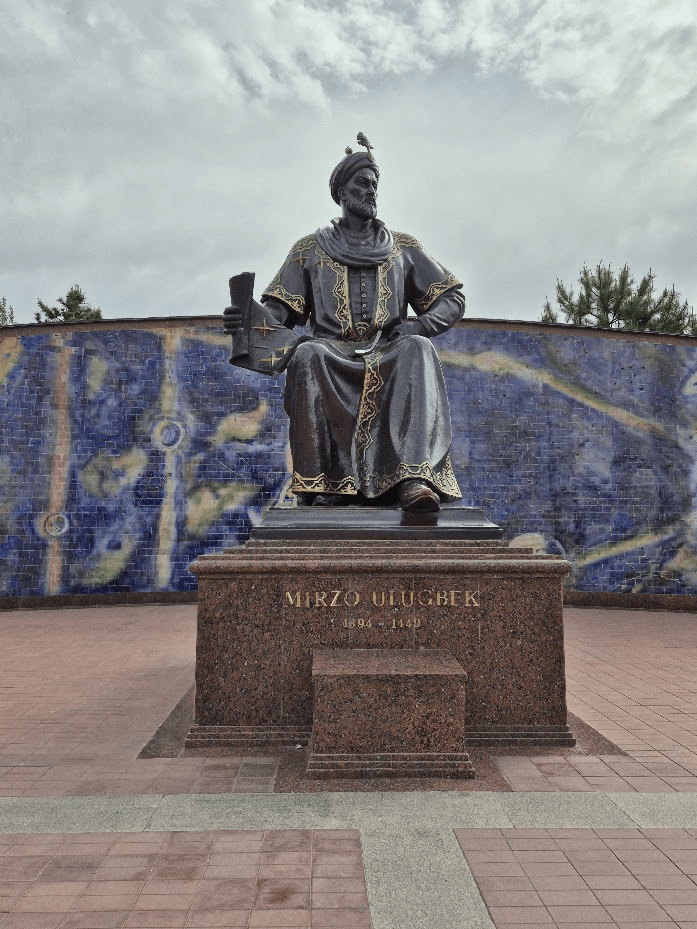

Lacking telescopes to work with, he built a huge sextant, the so-called Fakhri sextant. It had a radius of about 36 meters and the optical separability of 180″ (seconds of arc). The Fakhri sextant was the largest instrument at the observatory. There were many other astronomical instruments located at the observatory, but the Fakhri sextant is the most well-known instrument there. The purpose of the Fakhri sextant was to measure the transit altitudes of the stars. This was a measurement of the maximum altitude above the horizon of the stars. Unfortunately only the lower portion remains. The observatory was the most pervasive and well-known observatory throughout the Islamic world. With the instruments located in the observatory in Samarkand, Ulugh Beg composed a star catalogue consisting of 1018 stars. In 1437, Ulugh Beg determined the length of the sidereal year as 365.2570370 days or 365days 6hours 10minutes 8seconds (an error of +58 seconds).
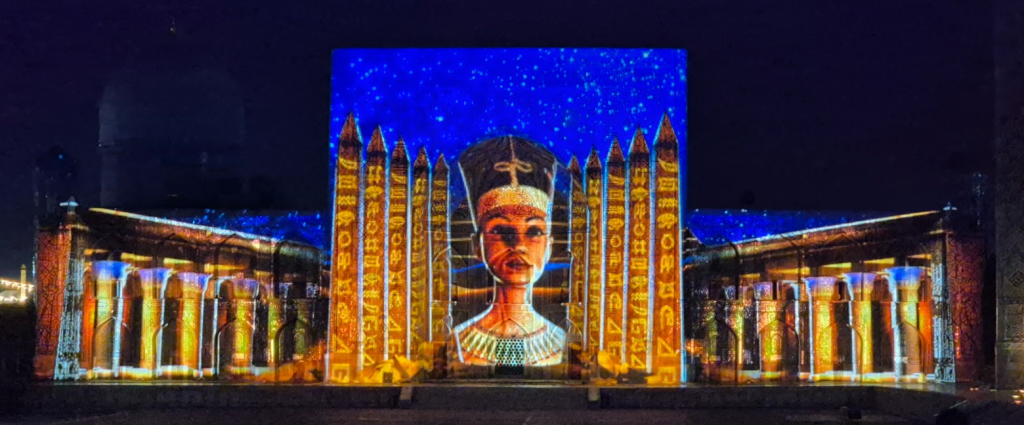
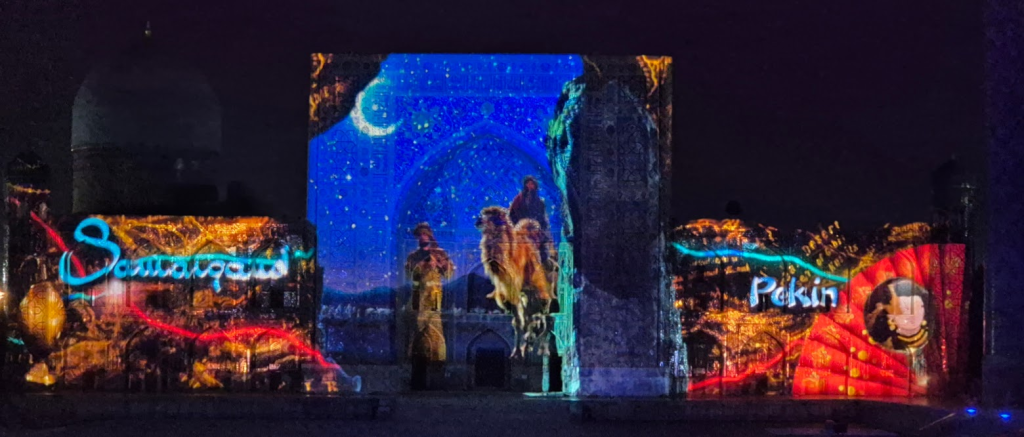
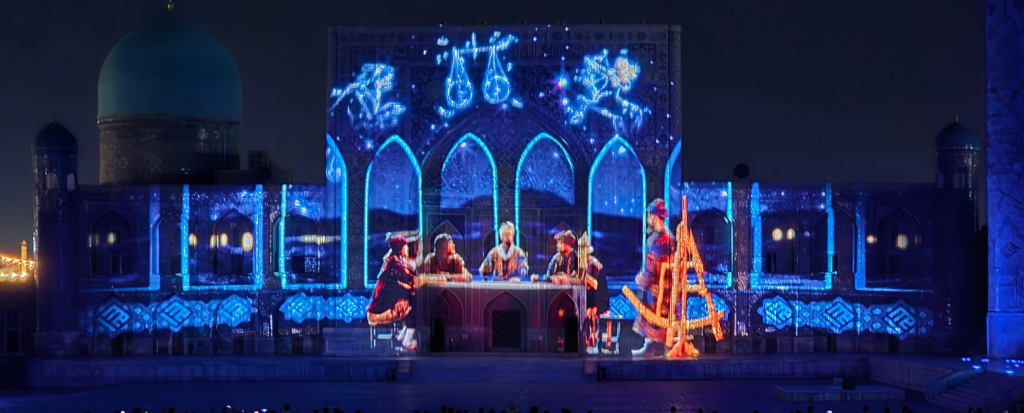
Later it had to offer ridiculously cheap food, and a stunning light show projected on the Mosque and Madrassas of Registan, which probably explained the history of Samarkand – the commentary was in Uzbek, so I wasn’t sure, I just recognised some of the pictures from the city tour. Anyway, we got to bed not to late considering we’d been up for nearly 36 hours.


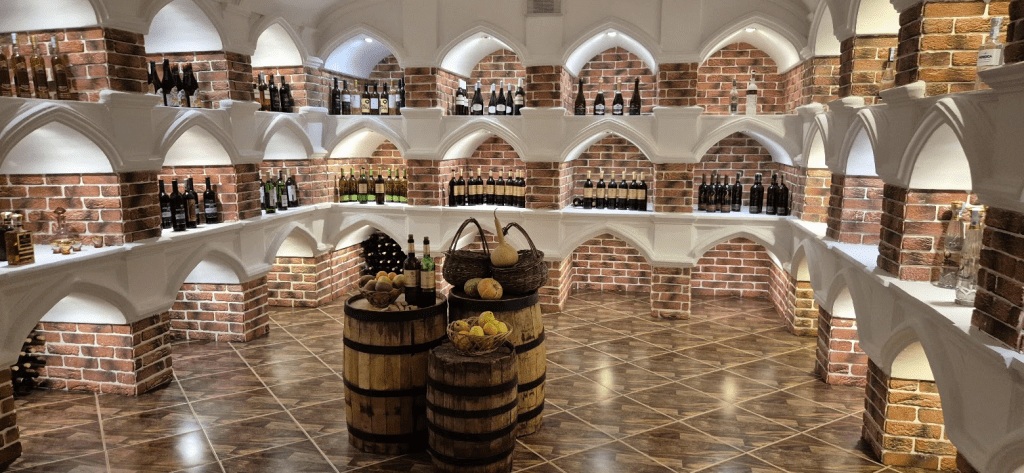
Finally, we get to some race related stuff, almost, we did fail to visit a vineyard and drink a bottle of Uzbek wine, with some cheese, courtesy of a very nice man called Chocolate (not quite, but nearly) who had trained as a chef in London and hence loved English (and Scottish) people.
After that we had race check-in and kit check. We’ve gone through Spine Race kit check (several times) so no other kit check holds any fear. The kit list was fairly minimal and mostly sensible (although I’m not sure what use the compass would be, given we didn’t have a map) so there wasn’t much to trip up on. Geert did my kit check, a volunteer I knew from previous races. I think he knew that, contrary to appearances, I knew what I was doing and so kit check went very smoothly. My camp bag weighed in at 10kg so that was OK. My only slight issue was it was VERY tightly packed but I expected this to become less of a problem as the race went on and I ate the food, which filled at least half the bag. Sharon had sensibly opted for a slightly larger camp bag and had no such problems. We were slightly worried about the medical forms though. In the UK it has become very difficult to get a medical form signed to declare you fit to race without spending several hundred pounds. We had seen our doctors, had all the relevant jabs, and been counselled about the hazards of the country. However to get the form signed we had had to resort to an online medical service. Fortunately by the time we got to see the Doctors it appeared a few other Brits had been through and so they were aware of the difficulties of getting things signed and accepted our online declarations without comment. This just left us to pick up our bibs, caps and other goodies and then to do the most painful part of the whole process, pay for our trip and extra hotel night. Actually this wasn’t too bad considering, but not a cheap as the previous night’s dinner.
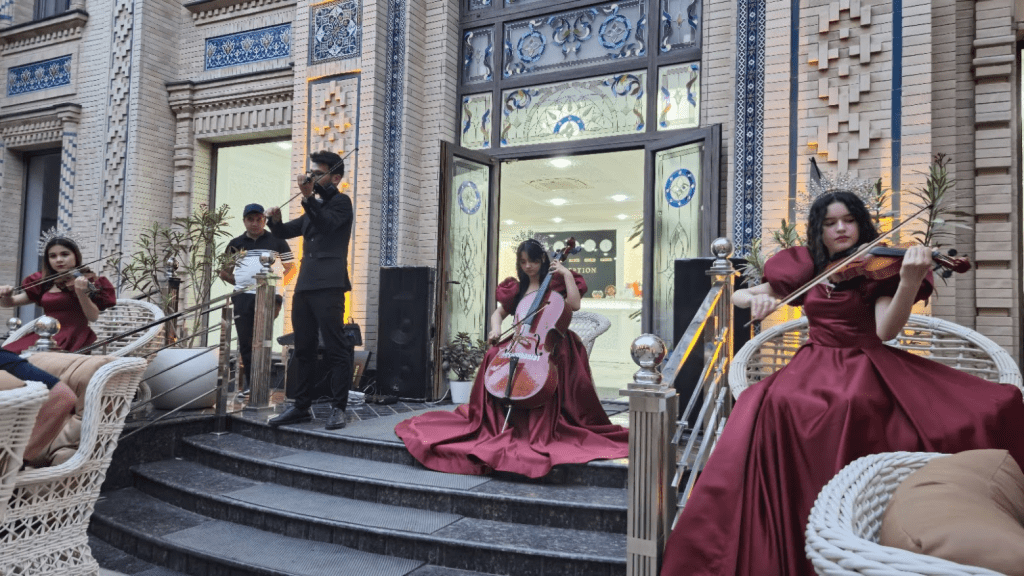
Tonight’s dinner was the welcome event for the race. It started with a drink on the hotel rooftop bar – which we eventually found, followed by an open air buffet complete with a string quartet.
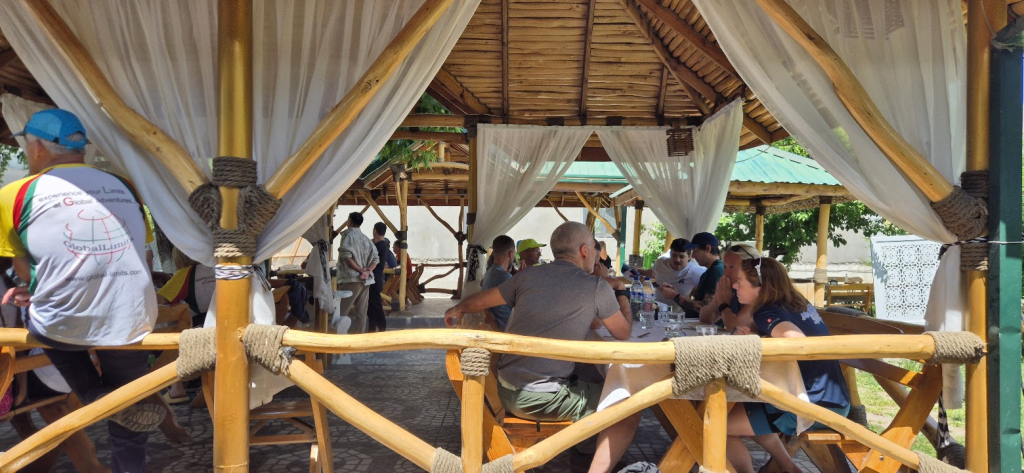
Sunday morning we had breakfast, checked out, left our bag of stuff we wouldn’t need on the race in the right pile, and boarded the coach for the three hour transfer to the first camp. The journey was fairly uneventful apart from an unscheduled toilet stop with free toilets (almost all toilets in Samarkand coat 3000 Soms to use – but as this was only about 18p it wasn’t a big deal). At midday we stopped for lunch, which was nice and invested 3000 Soms to make the remaining part of the coach journey more pleasant.
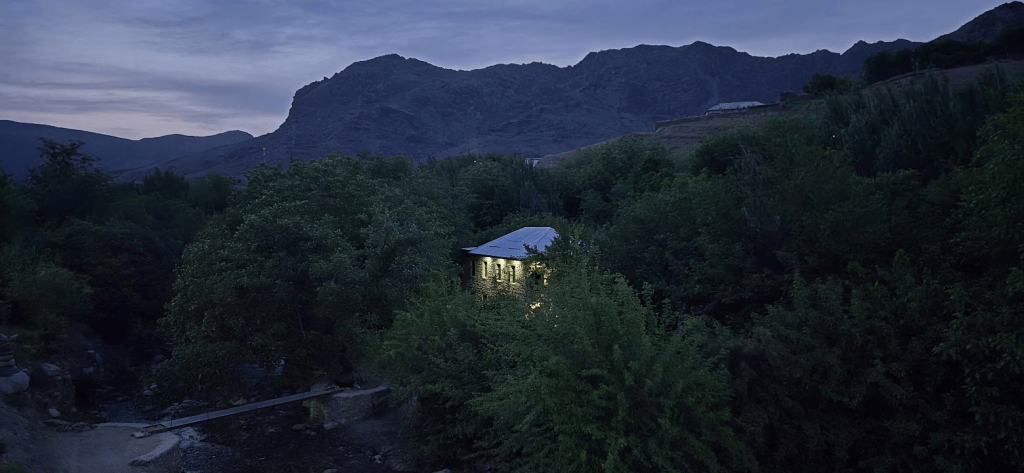
The first camp was in guest houses in the Sentob Valley, our group had taken over three of them. The last few kilometres of the journey were unsuitable for our coaches and so Stefan had arranged for a fleet of ten mini-buses to transport us. This seemed to have got lost in translation as there were only six or seven but after some shouting and organisation we were crammed into a very small vehicle and taken to our accommodation – the ‘New Building’. It certainly smelt very new although it looked much like the other buildings in style. There appeared to be some cosmetic work required to totally finish it off but everything worked and was functionally complete. From pictures I had looked at online, all the guest houses in the area appeared to have very similar rooms with four single beds in them, two on each side of the door. We were sharing with Mark and Frances, an English couple we had the very cheap dinner with on the first night so that was all good.
Stefan very generously provided Plov, a traditional Uzbek dish of rice, meat and vegetables. This was much better than the freeze dried meal we had planned – although it did mean my camp bag didn’t get any smaller that night.

The first race briefing took place that evening. The highlight was Stefan assuring us there were no dogs in Uzbekistan – just as something that looked very much like a dog emerged from the undergrowth behind him. We were also told that the first stage was the hardest, as it included a significant amount of ‘up’.

For the first time in Global Limits history, there were to be age group prizes. Presumably this was possible due to the larger than usual number of runners. With prizes for the top three overall plus the first three in each of three age groups, for male and female, the usual field of 40 to 50 would end up with as many people with prizes as without. I was slightly interested as this possibly gave me something to aim for. I’d looked through the entry list and there appeared to be too many young people in the race for me to realistically hope for a top three finish, indeed I wasn’t totally sure that top ten was possible. Even in my age group I knew that Peter Osterwalder at least had the potential to beat me, plus of course there could be some fast 60+ men I wasn’t aware of. From previous races I expected Peter to beat me on the first day as he is extremely good at ‘up’. However he had had knee surgery about a year ago and it apparently didn’t affect him going up but he had to be more careful on the ‘down’.
Anyway the time for speculation was over – tomorrow we would start running!
 The Only Way Is Pennine...