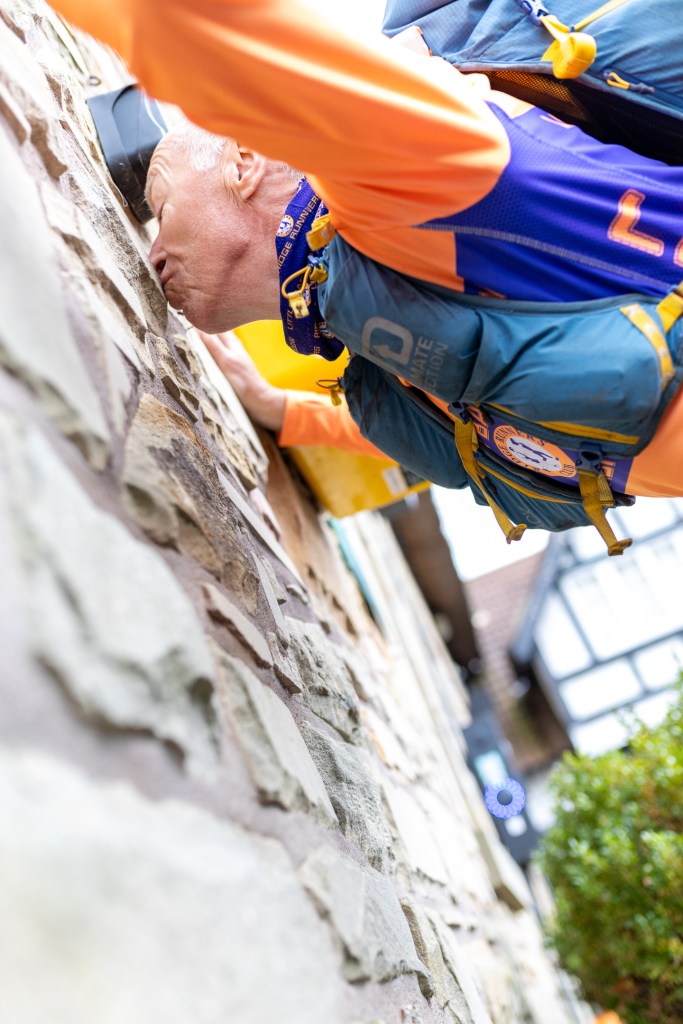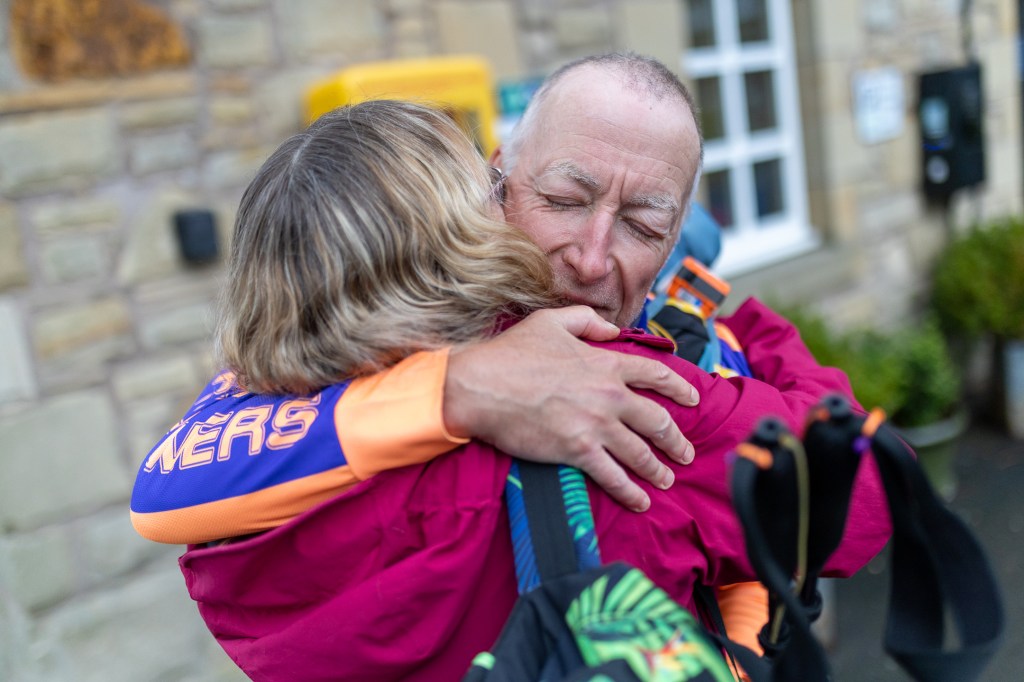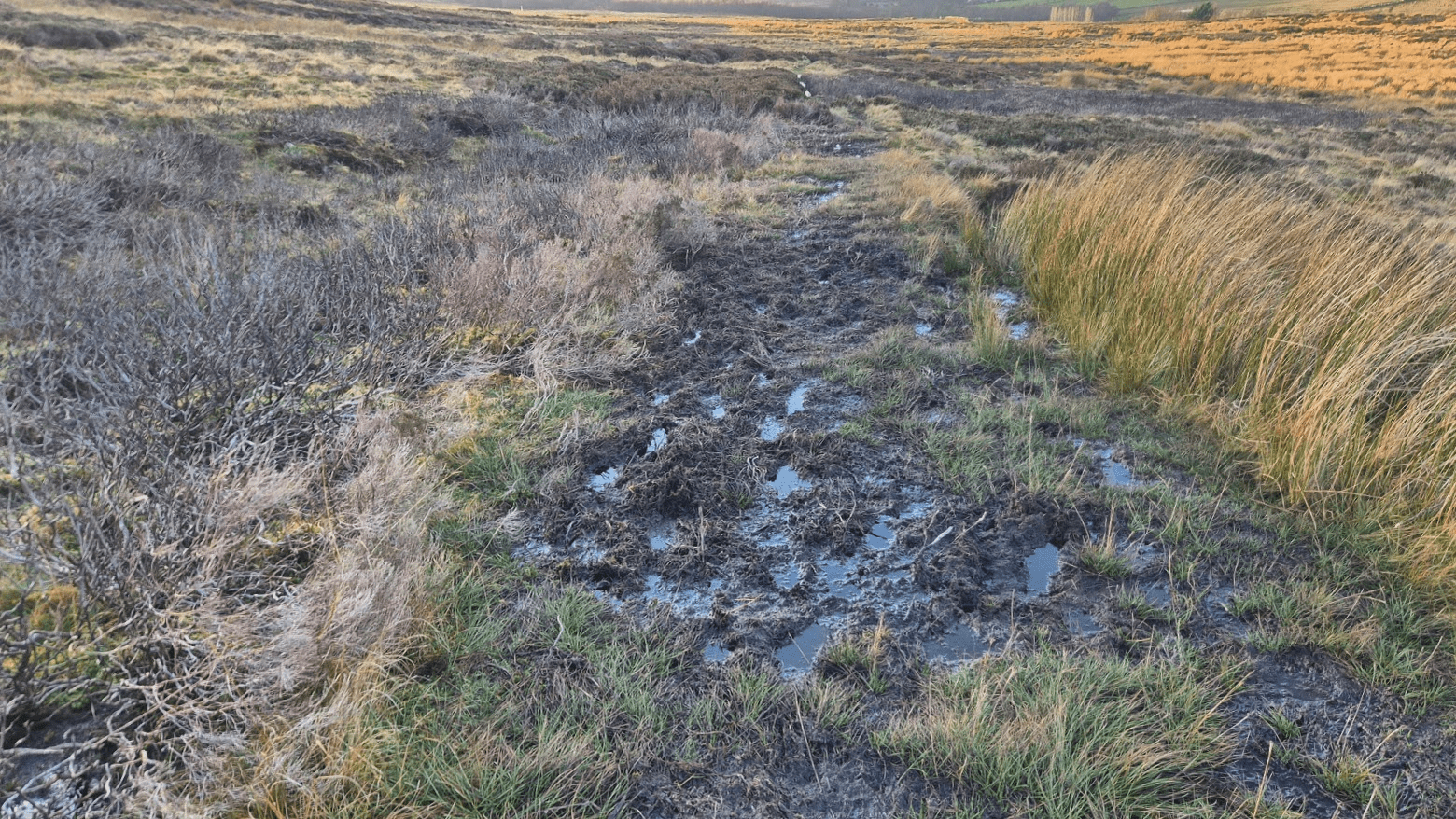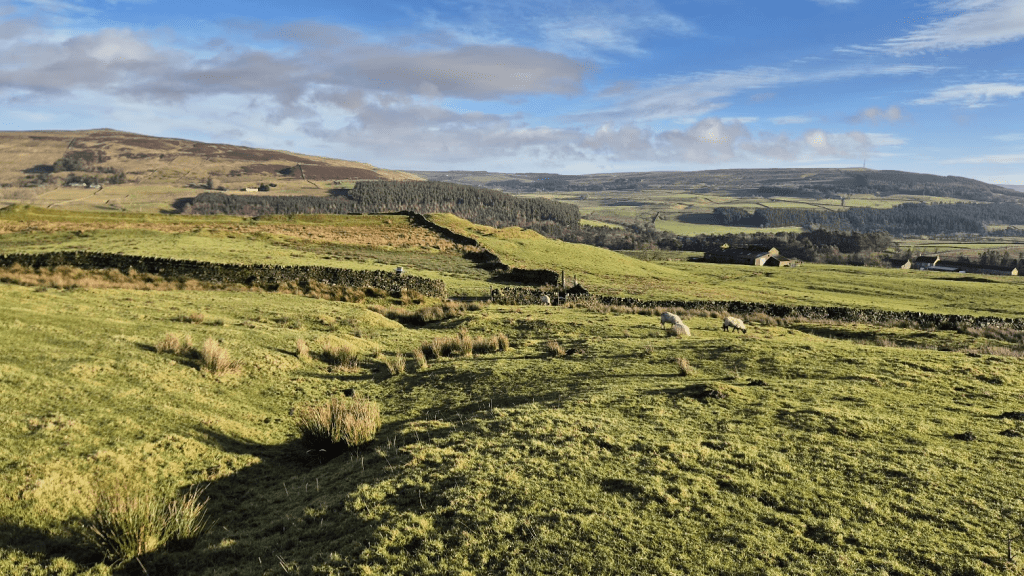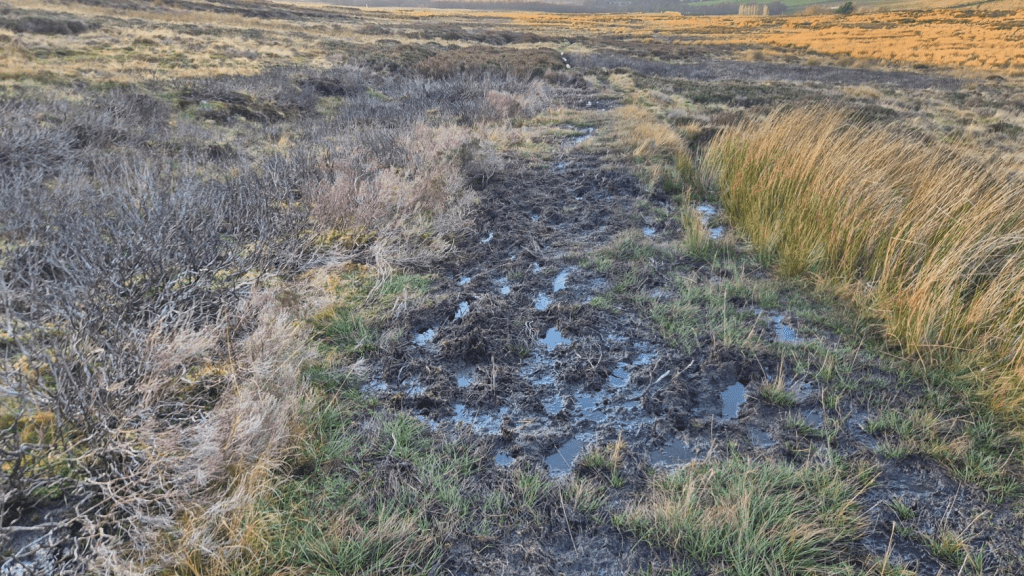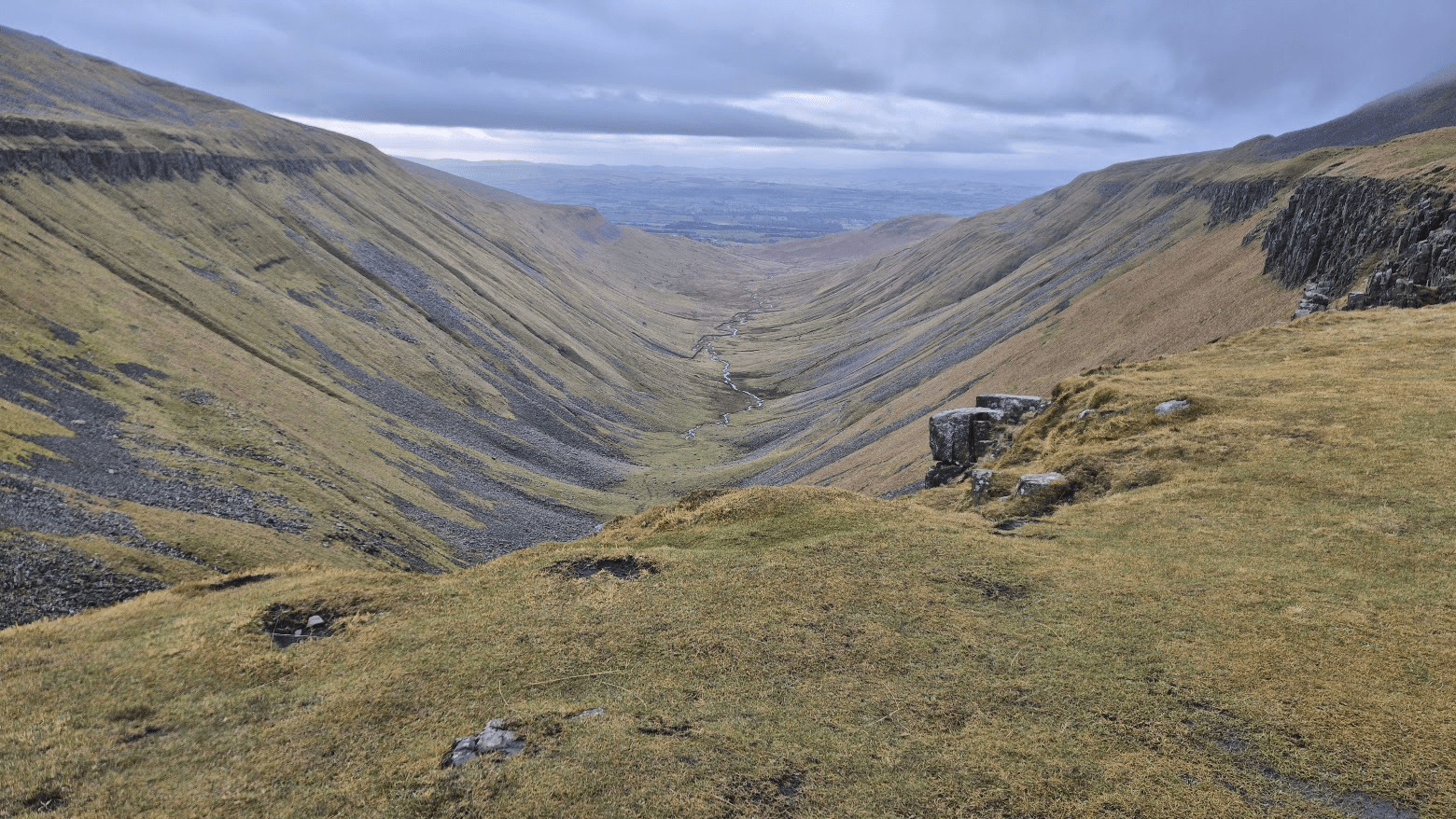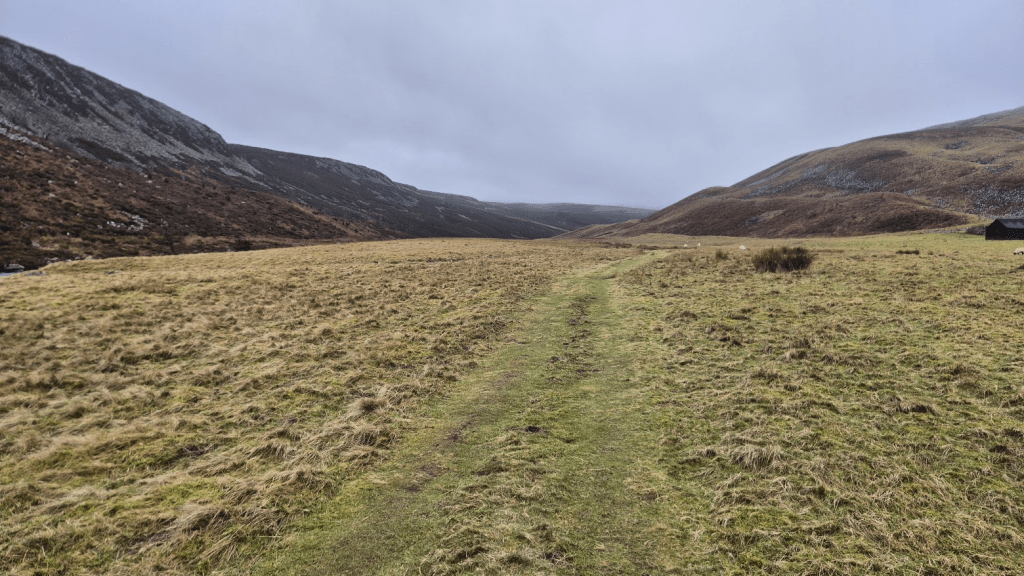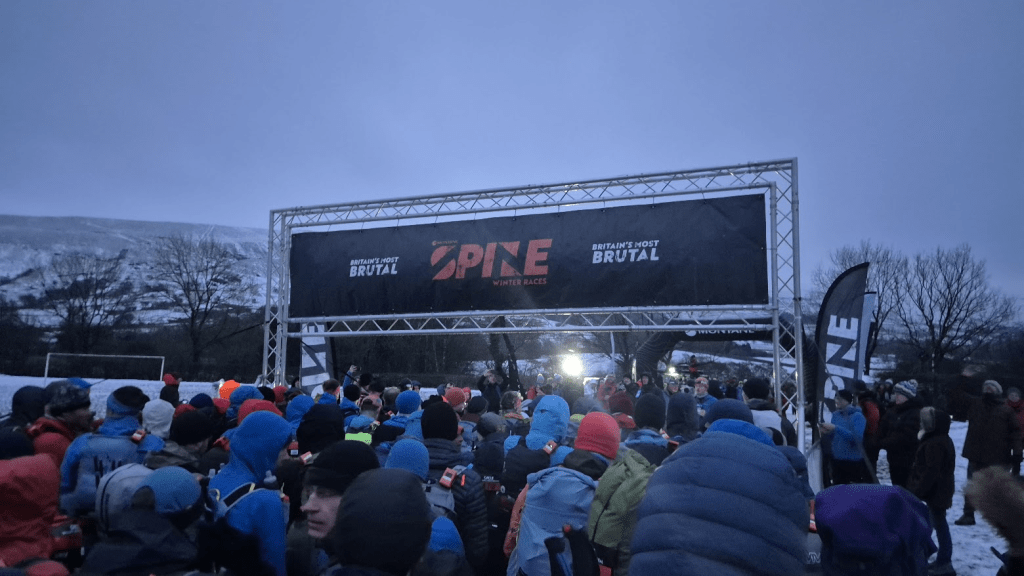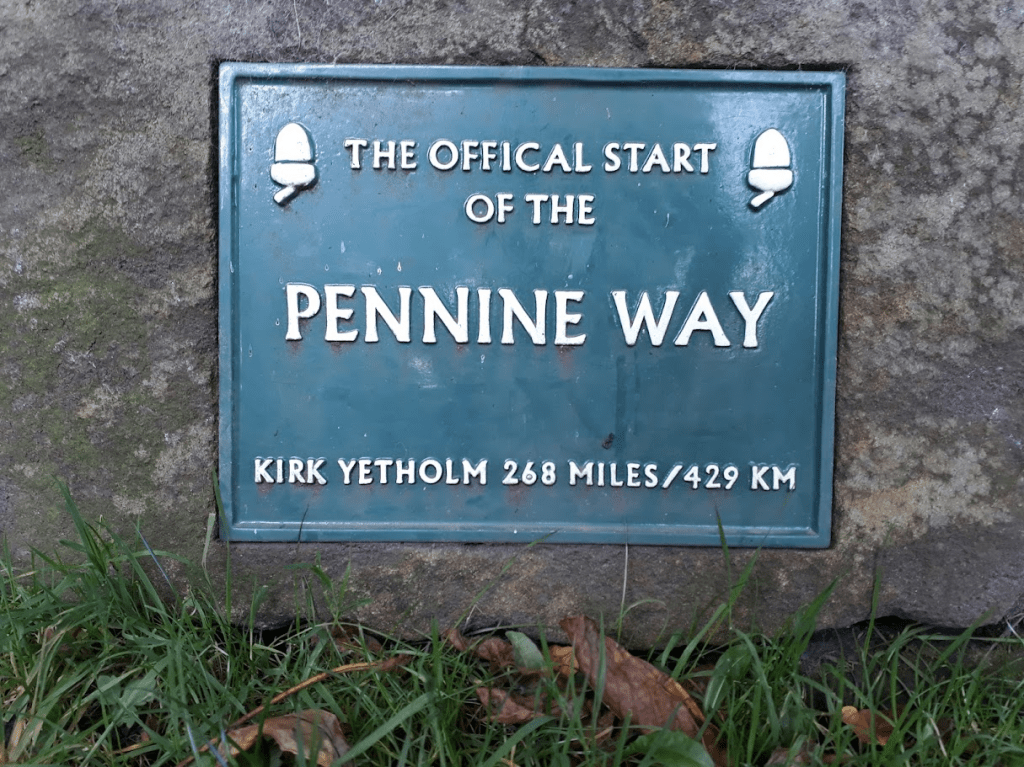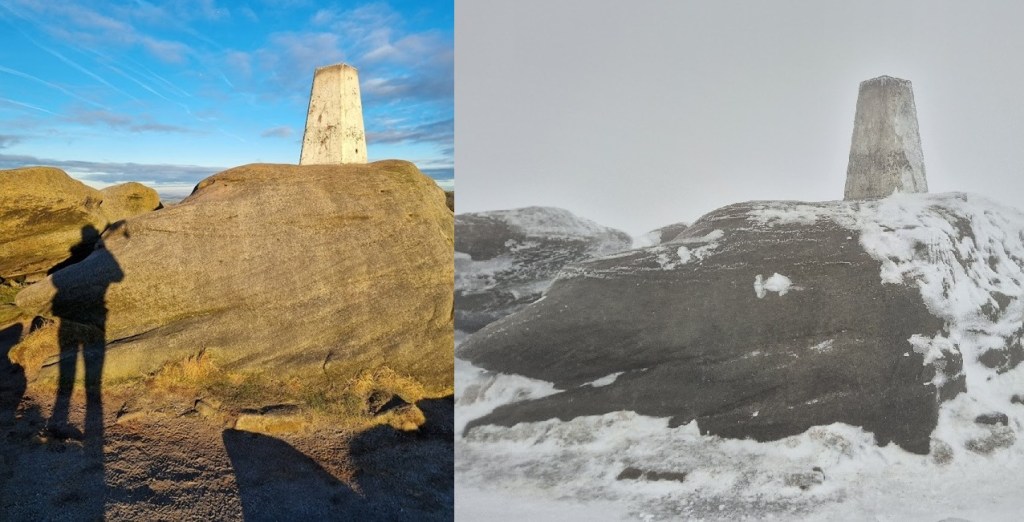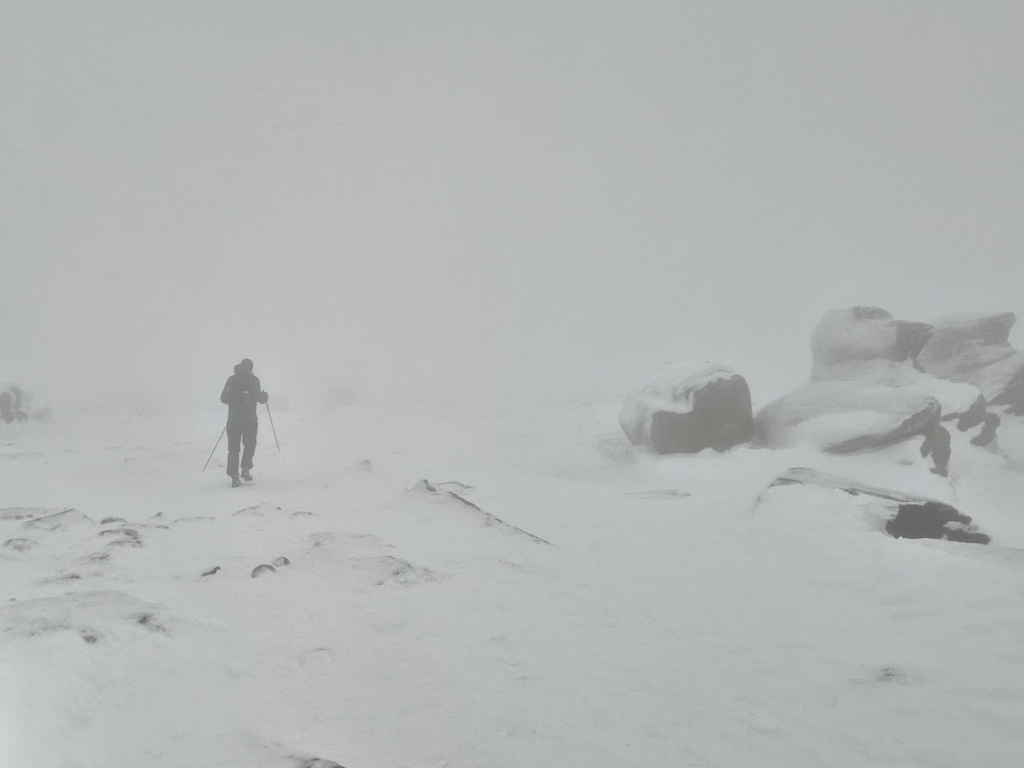
The Summer Spine Challenger North – tough enough (Part Two)

If you run, walk or stagger into a Spine checkpoint and say ‘Enough, I’m out’, the volunteers will politely not hear you and ask what you would like to eat and drink. They aren’t being rude, it’s just that the time you can spend in a checkpoint can change everything. When I DNFed in 2021, I expected my race to end at Alston. I didn’t want it to, I just couldn’t see how I was going to continue with my feet ripped to pieces with blisters. I was also fairly delirious and generally in a pretty poor state. I didn’t quite make it to the next checkpoint but I’m still amazed I managed to continue for another 35 miles to get beyond Hadrian’s Wall.

As I said in the first part of the blog, we had decided that sleep should be Sharon’s priority. Apparently a bed wasn’t immediately available so she took the opportunity to have a shower first and then lay down for a little less than two and a half hours. She thinks she probably got about two hours sleep. I had no idea as I was outside eating lasagne before going for a lie-down myself.

After her shower and sleep Sharon even managed some lasagne. The restorative powers of Alston lasagne are well documented so I was very happy to hear she’d been able to eat and keep it down. The medics rechecked her feet and were happy the infection wasn’t spreading. All blisters were retaped and our Spine journey could continue! Given the really quite concerning state Sharon had been in when we arrived in Alston, the transformation was remarkable. There was no more thoughts of dropping out, just of marching on to Bellingham and beyond to Kirk Yetholm.

Once again we would be going through the night. There would be an hour or two of daylight before it got dark, however the first part of this leg wasn’t the most interesting anyway and it would be light before we reached Hadrian’s Wall. It did mean I would have to concentrate on navigation though. It isn’t an inherently difficult section to navigate but it just requires a certain amount of awareness to avoid silly mistakes.

I remembered not to run into Harbut Law at the first A689 crossing. The Winter Spine GPX files had been slightly less detailed at this point and went diagonally through the aforesaid place (I think it’s mainly some holiday cottages). The new file made it clear the Pennine Way went along the road for a few metres before continuing cross-country but I remembered peering around there in the dark before anyway so I knew where I was going. I think there was a moments hesitation when we crossed back and went into a field further along the route but no real issue with navigation at this point.

We passed through Slaggyford (still love that name) too late for any of the Angels that I’ve seen there in the past to be out but we did top up our water at Yew Tree Chapel.

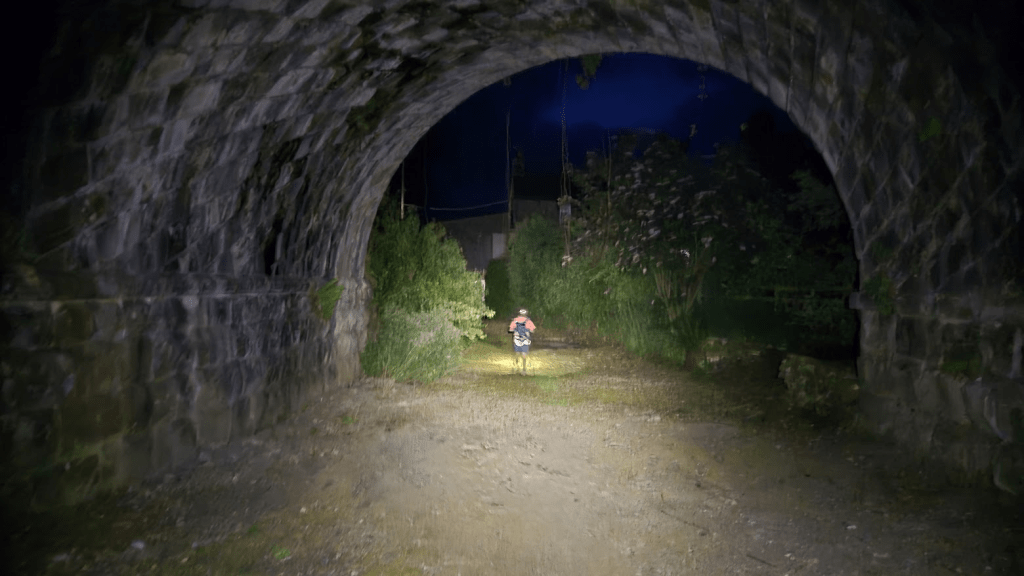
The Burnstones viaduct can cause confusion as you go under it, turn left along the road, and then go under it again. This is to cross Thinhope Burn on the road and sort of makes sense on a map but when you are there you just have to trust the GPX and the signs.

Sharon under the Burnstones viaduct for the first time

Anyway the reason I’m going on about how great my navigation was is because we are fast approaching my biggest error of the race. Shortly after leaving the viaduct the path head towards a wall with a gap in in it with some gate type things on it. I chose not to go through the gap but follow a path along the wall – all the time thinking ‘I’m sure I should have gone through there’. After about 150 metres I was proved right when our path was blocked by a wire fence. Fortunately it contained no barbed wire so we were able to climb over it and get back onto the correct path but I do need to remember this for future excursions on the Pennine Way.

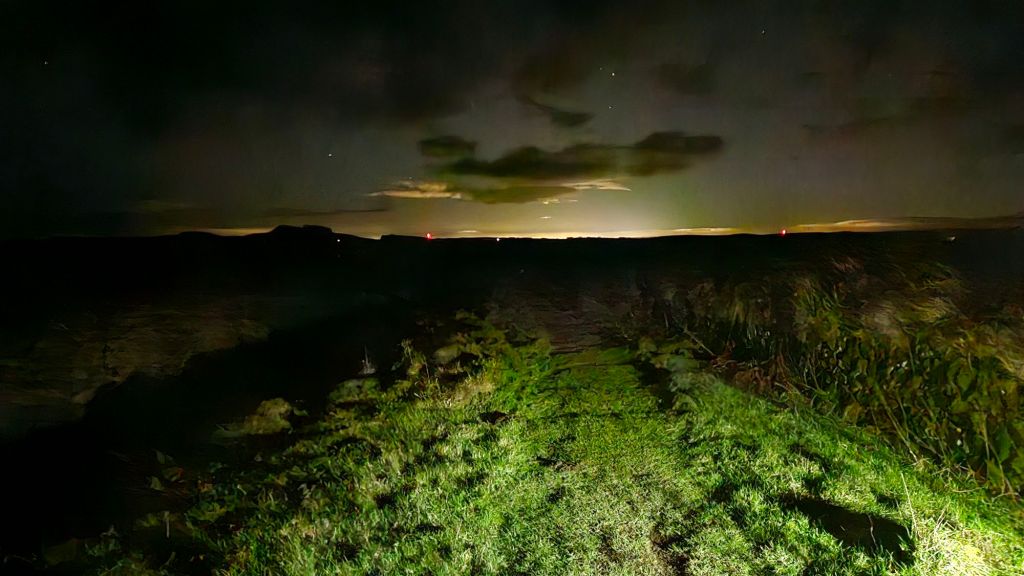
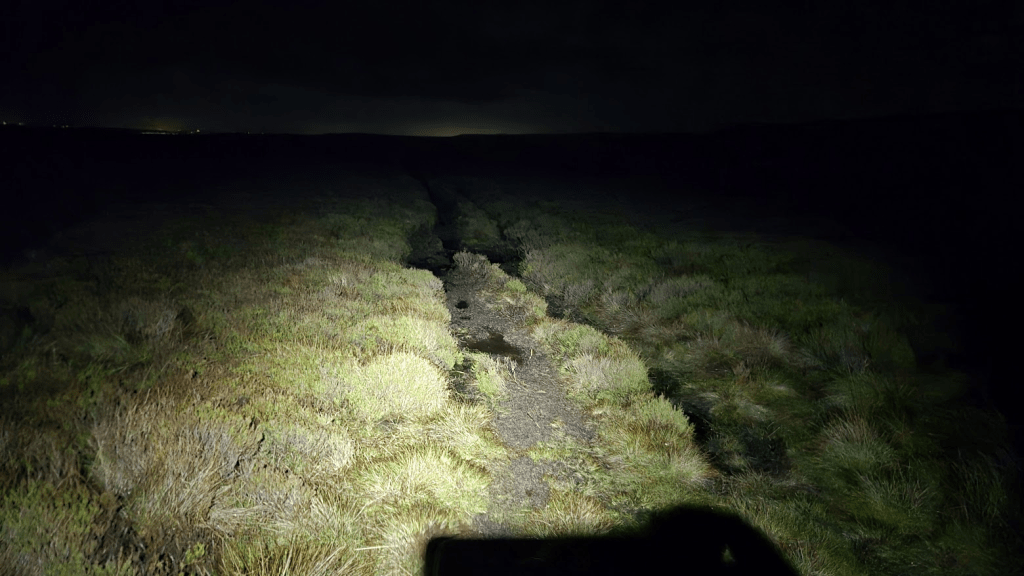
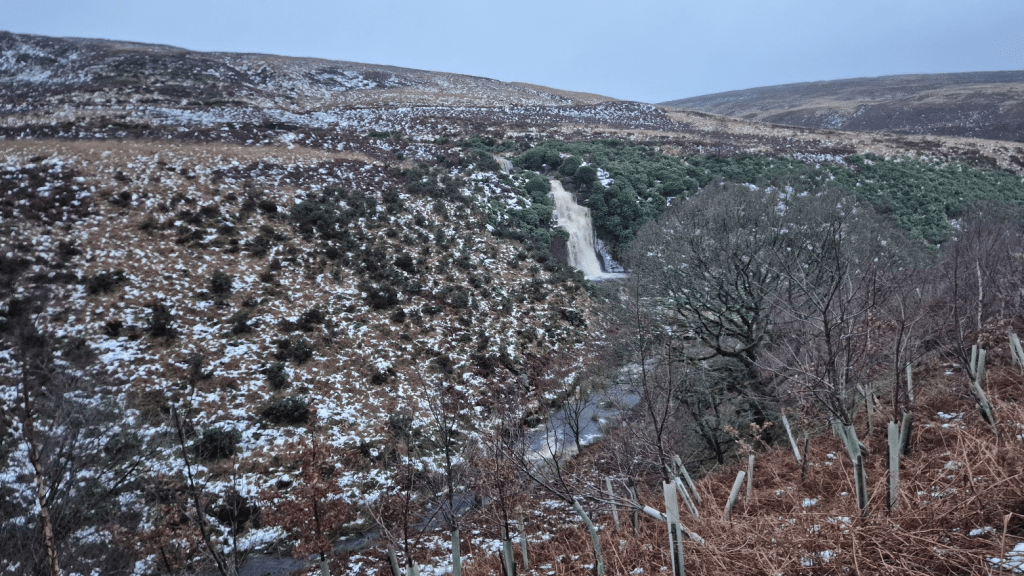
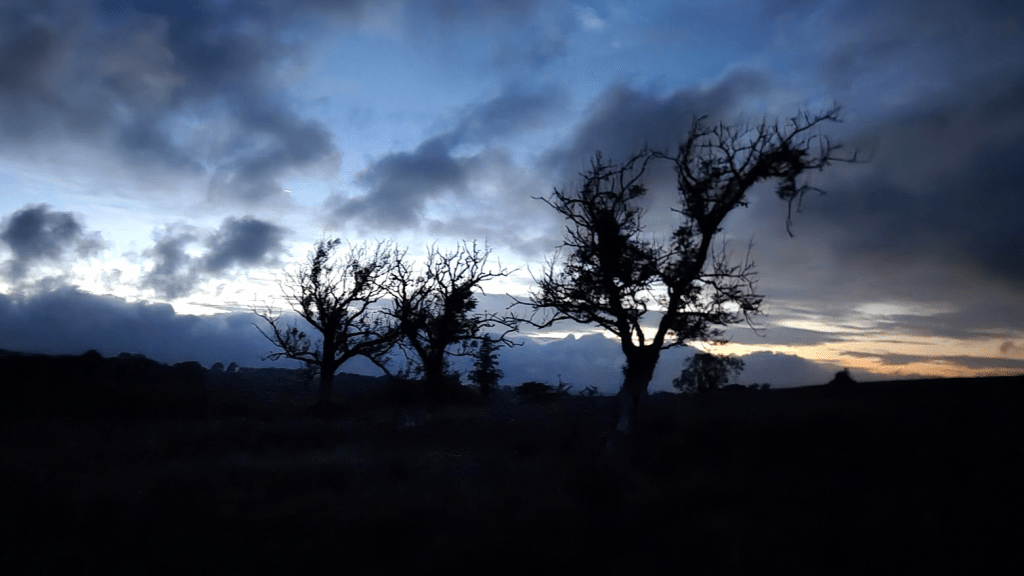
We were heading onto Hartleyburn Common (South side), soon to be followed by a short interlude before Hartleyburn Common (North side). These aren’t terribly exciting by day and by night there really was nothing to see. At this point we were sort of running with one of the Full Spine leaders, 152 – Dominic Gill (I think). I say ‘sort of’ because he was obviously much faster than us but he stopped for a couple of power naps so we overtook each other a couple of times. I followed him over the fence to the last part of Hartleyburn Common (South side) in the hope he might be able to find what I referred to as the ‘comedy footpath’. I call it that because there are three options from the fence crossing to the road – don’t bother, go straight to the road, do bother and follow the path to the road, come out a few metres up from the Pennine Way sign, or follow the GPX track through the heather to the Pennine Way sign whilst failing to find any sort of actual path at all. Sadly he had no more idea than I did and I think he followed the path to the road while I decided to just romp through the heather where the GPX file told me I should go. The section to Greenriggs was uneventful apart from a slightly atmospheric tree photo at two in the morning – oh, and Sharon kept finding frogs. Oh and there were some new steps at so we didn’t have to scramble up the bank at Foxhole Cleugh. Actually it was more eventful than I at first remembered.

Trees at High House (or Dodd’s Rigg – probably one of those anyway)
A frog (I have even less idea exactly where this was)

At Greenriggs things became even more entertaining and I’m sure regular Spiners will know why – we passed through the garden of Rasta Man Ralph. I thought it was too late at night/early in the morning for him to be around but he came out for a chat and gave us some huge burgers. We did a short video with him which is on his Youtube channel. He did think we were third and fourth in the full Spine but unfortunately I had to tell him we were actually near the back of the Challenger North. The burgers were good, and I was very pleased that Sharon was able to eat at least some of it.

Rasta Man Ralph

After Greenriggs it was finally on to Hartleyburn Common (North side) followed by the infamous Blenkinsopp Bog – sorry, Common. It was a bit boggy but nothing too bad. After that the path faffs around a bit before crossing the A69 and passing through the edge of the Haltwhistle Golf Club. There is a sign warning walkers to keep to the marked path – which, predictably, isn’t marked.

At Thirwell Castle we picked up the course of Hadrian’s Wall and after a short steep climb followed the road into the car park at Walltown, where we were met by a safety team.

Looking East from the climb

As it was quarter past five in the morning the café was shut but the safety team had water and some biscuits.

Safety Team at Walltown

Unfortunately the biscuits were too much for Sharon’s fragile digestive system but at least there were toilets.

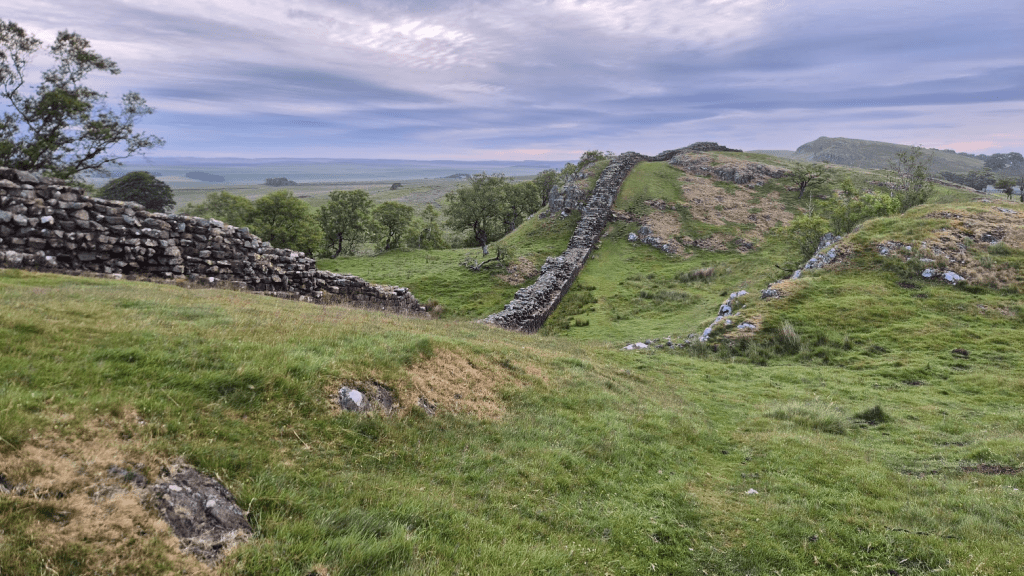
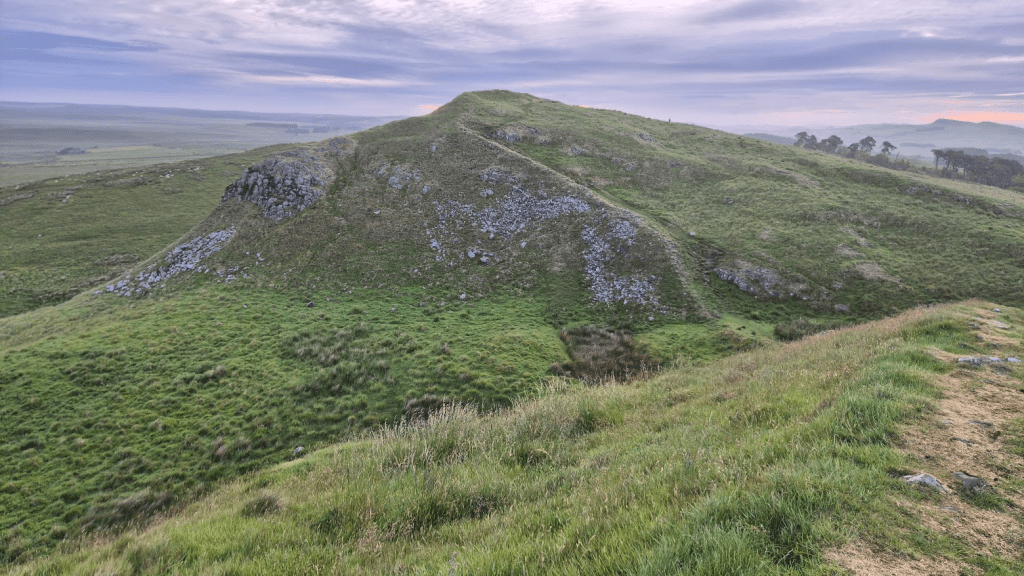
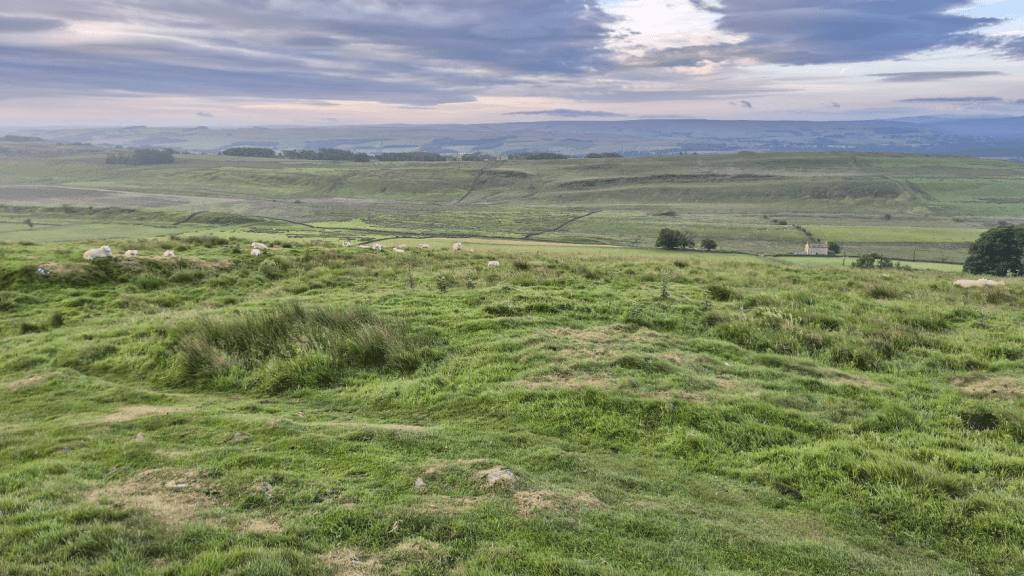
Now were were following the wall proper. Someone remarked that no-one really talks about Hadrian’s Wall on the Spine. Jacob’s Ladder, Cauldron Snout, Cross Fell, The Cheviots, some of us even have a lot to say about the Cam High Road, but not much is said about Hadrian’s Wall – although I guess Sycamore Gap has been mentioned a lot since September 2023. This is slightly surprising as it does represent a significant challenge. The Romans invented many things (as John Cleese was once told) but, if Hadrian’s Wall is anything to go by, the spirit level was not among them. The Pennine Way follows it for about eight miles of roller coaster like climbs and descents. I’ve written a lot so far so I’ll let some pictures do the talking for this bit.

The Wall
The wall running across the picture isn’t the Wall – that goes up and over the hill
Another up and over
Great views from the Wall
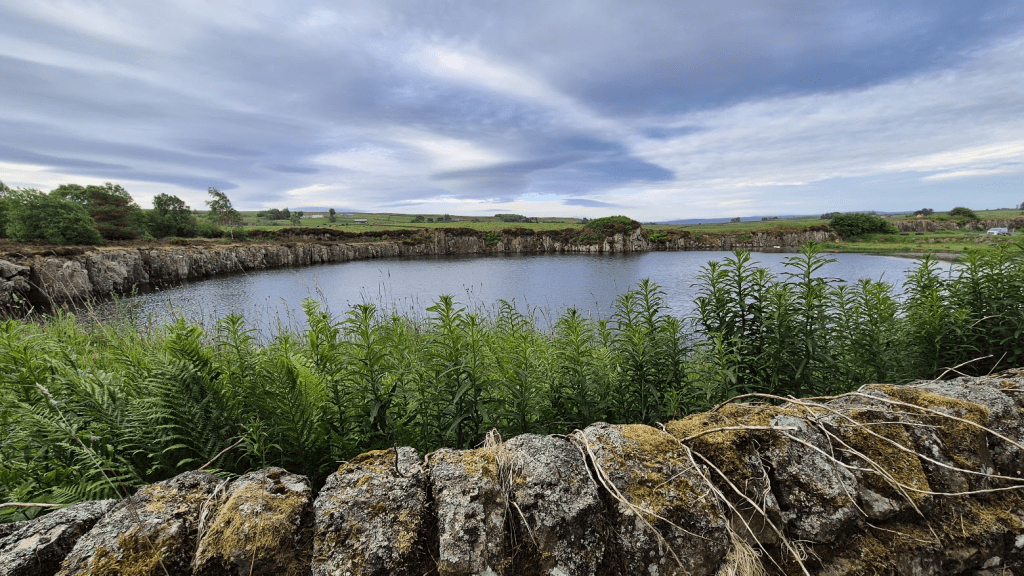
Cawfield Lake
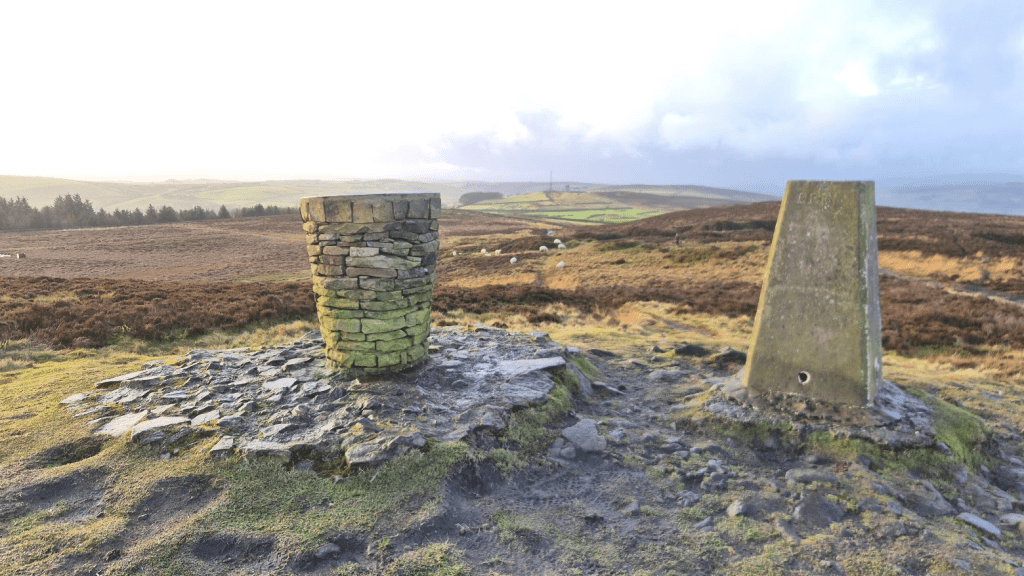
The highest point!

There is a car park at Steel Riggs, which I had marked on my GPX track as there was usually a safety team to be found there. As it was early morning they were actually able to park on the road where the Pennine Way crossed it and gave us a very welcome cup of tea.

Mile Castle 39 (Castle Nick) – it was probably higher in Roman times
Sycamore Gap from above
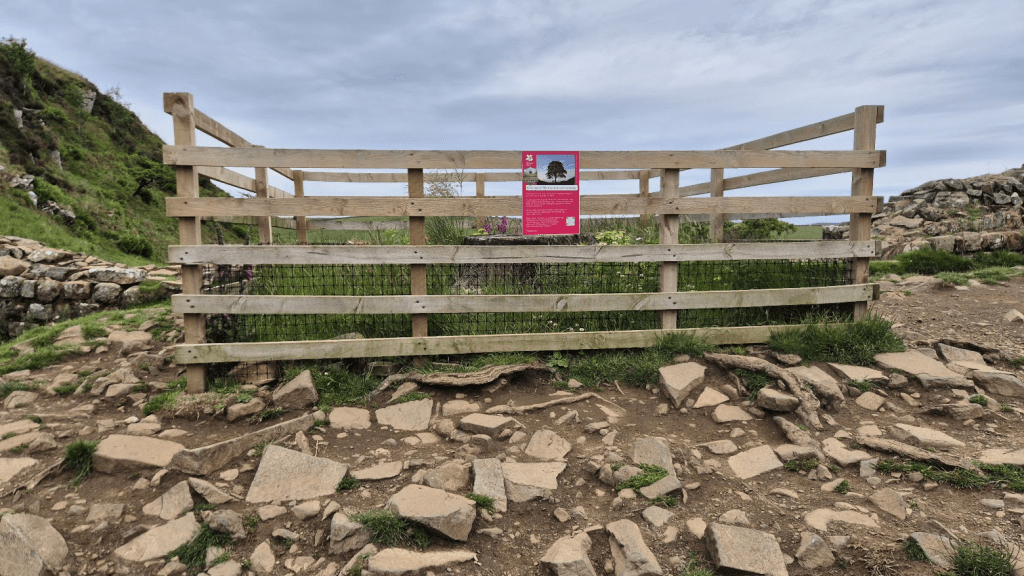
All that is left of the sycamore tree

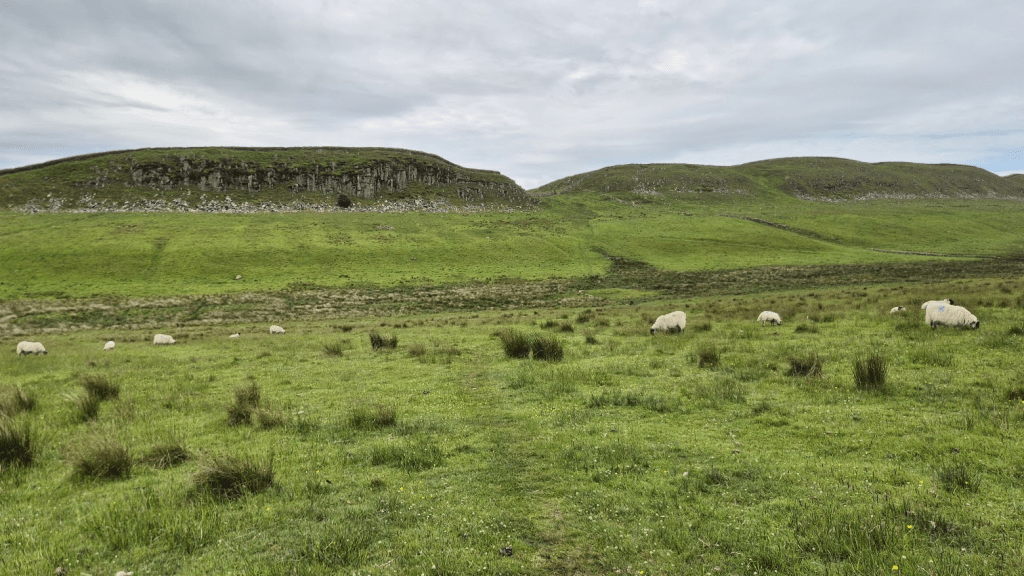
After we had passed Sycamore Gap we soon left Hadrian’s Wall and headed across Ridley Common (Bog) to Wark Forest.

Looking back at the Wall

I don’t like Wark Forest much. It’s a messy plantation that goes on for far too long. However it’s worth it for what follows, the unfailing hospitality of Helen at Horneystead Farm.

Life is good!

We had tea, sandwiches and cake. Sharon ate one and a half sandwiches with no real problem (predictably, I finished the odd half up). The cake was also delicious. We could have stayed all day but we did really have to get to Bellingham and also we were supposed to call in if we stopped for more than 30 minutes, so after 29 minutes and 59 seconds we left.

I did make another navigational error at Houxty Burn (on the OS Map) or Pundershaw Burn (on Open Streetmap). The main track crosses the burn via a ford but the Pennine Way bears left and crosses via a couple of bridges. I noticed we were slightly off track but we were nearly at the burn and following a decent track so I assumed we’d be OK. Fortunately we were, as the burn was very low and there were sufficient rocks to use as stepping stones across it. I think I may have got the wrong in Winter too, as a remember sliding across a frozen river somewhere around this area.

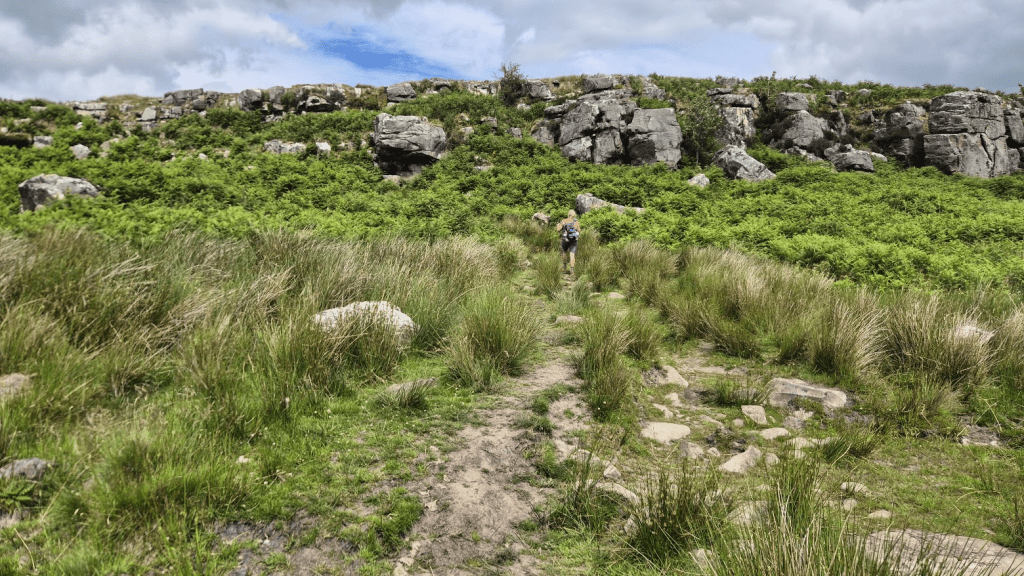
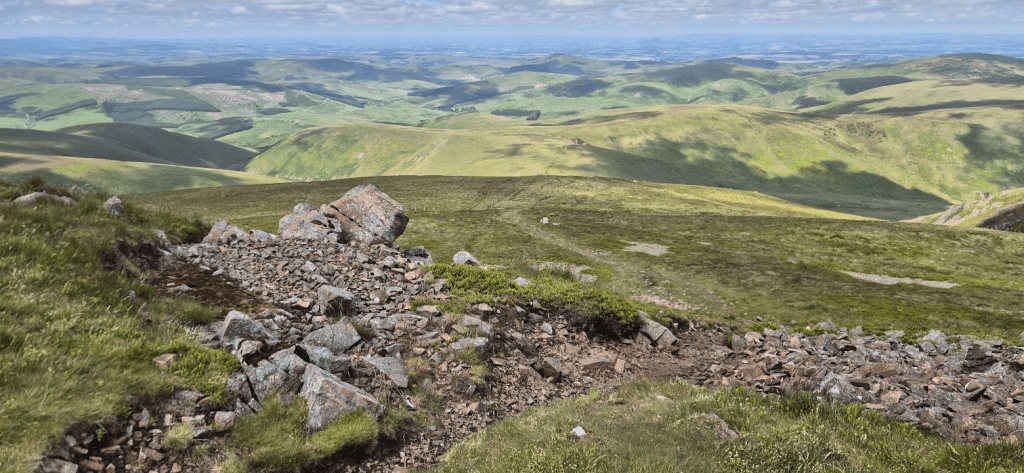
Shitlington Crags. Apart from the great name it was about here I realised my first spine dream had to die. They are a bit deceptive, if you look at the photo it looks like a boulder scramble up to the top but actually there is a very easy path that climbs gently to the left, which is fairly well hidden until you reach it.

Shitlington Crags

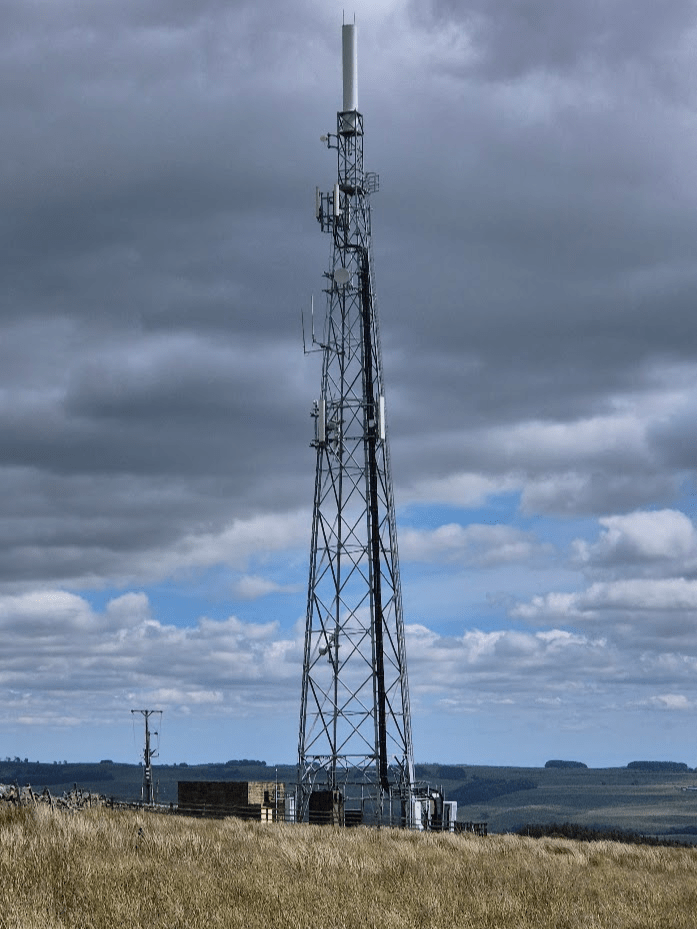
After the crags its a bit more up to the relay tower.

The relay tower – no, sorry, I don’t know what it relays

From the relay tower it was pretty much all downhill to the checkpoint. Flags started to appear to indicate where we should leave a small road – I suspect this was to ensure no-one simply ran down to the B6320 and followed the road to the checkpoint. I did almost try and turn into the Forestry Commission District Office instead of the campsite further down the road but the total lack of anything Spine related and the GPX track made me realise this would have been an error.

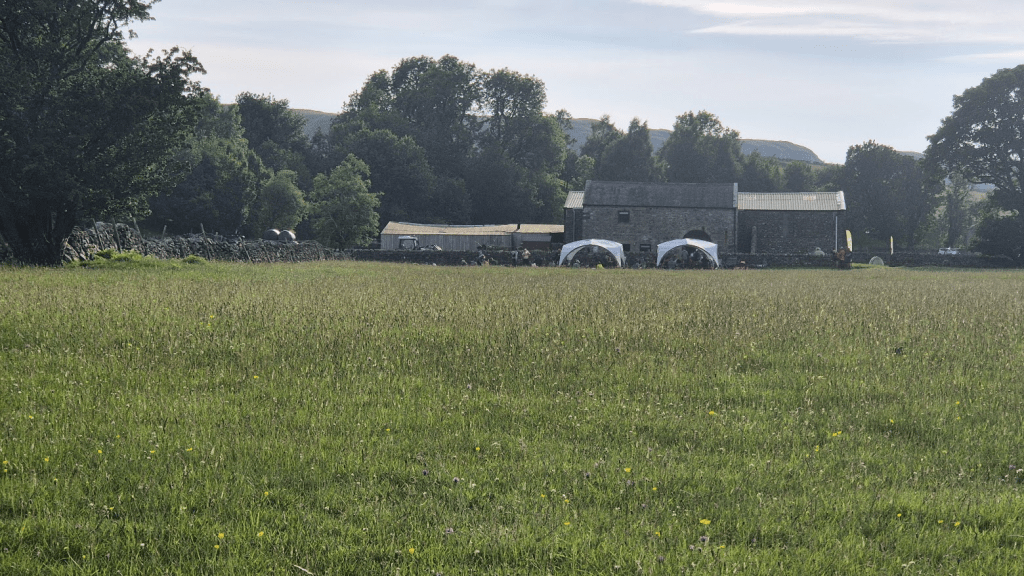
The checkpoint is over there – somewhere…

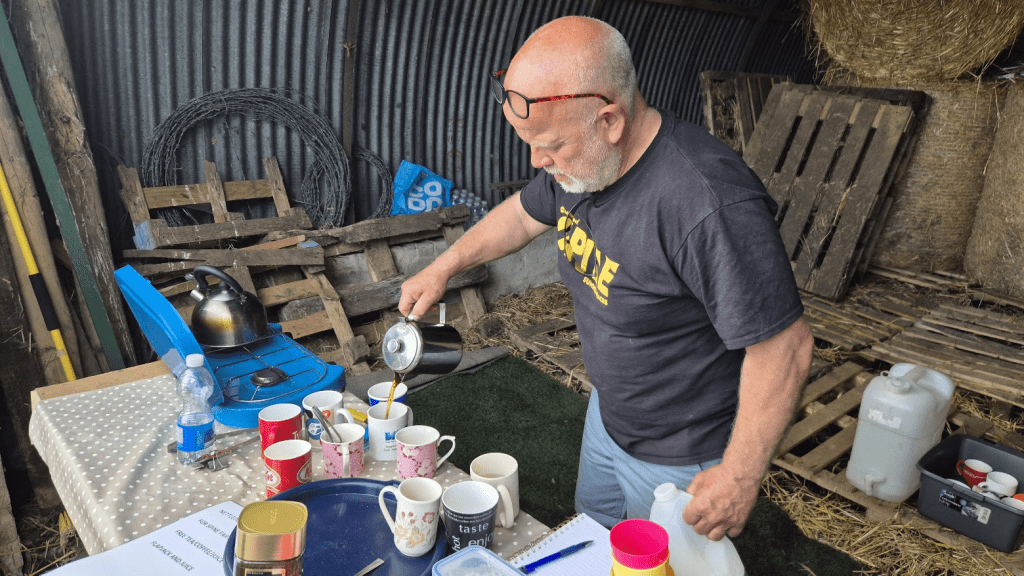
When I’d been to the Bellingham checkpoint before, sleeping had been indoors in a large hall. This time it was like the first checkpoint and consisted of tents. I did my normal thing of trying to eat my own bodyweight in food while Sharon found the sausage casserole much nicer than she expected. The tents were large and had big porches so we decided we could both fit into one. I think a lot of foot care and a very small amount of rest ensued. We forgot to tell the volunteers when we got up so I did find them in a slight panic, thinking we were still sleeping with less that 30 minutes of our allotted 6 hours remaining. I was able to reassure them that, not only were we up, we were ready for our kit check.

On both my previous Spine races that had got this far, I passed through Bellingham in the dark – at least that’s my excuse for never quite following the Pennine Way through the town. This time it was 8:30 in the evening, it would still have been dark if it had been winter but in June it was very definitely still daylight. I marked the occasion by carefully following the GPX route and passing through Bellingham on exactly the right path (I think). It also meant I was able to take a picture looking back towards Bellingham as we left the town.

Looking back to Bellingham

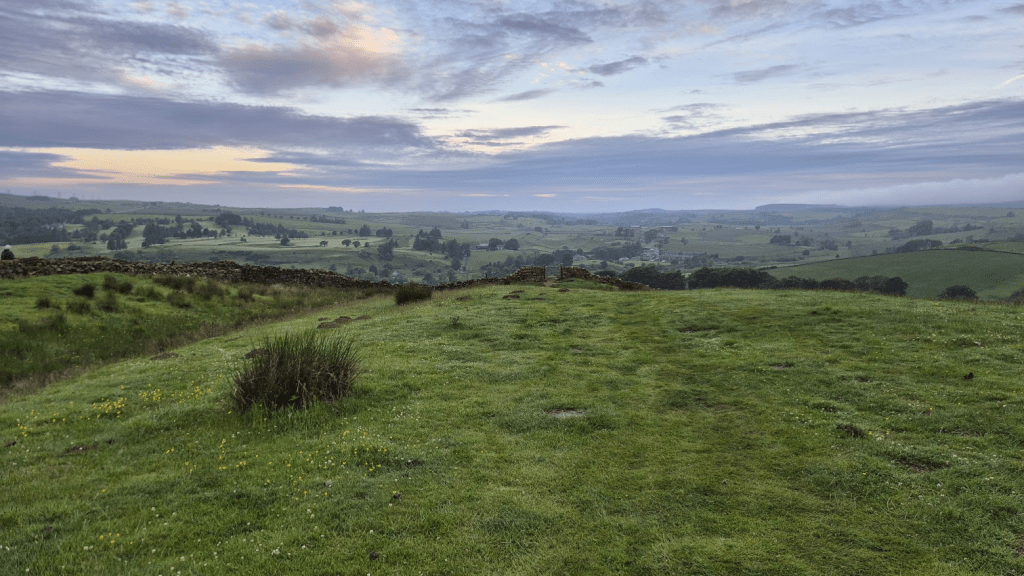
The next bit of the Pennine Way feels a bit like its just there to join some better bits up, it’s mainly farmland and heather. However this didn’t really matter as we would be doing quite a bit of it in the dark anyway. I did fail to capture sunset but did get a pretty sky.

A bit after sunset

The path through quite a lot of this is just a narrow line through the heather. It wasn’t the easiest to see in the failing light but, if I say so myself, I absolutely nailed navigation through this stretch and we kept up a good pace. I had a chat with a safety team about the eternal question ‘is Summer or Winter harder?’ at a road crossing which broke up the tedium a bit. Eventually we reached the steep slippery uphill bit towards Brownrigg Head. After that the path improved, sometimes a lot, sometimes not so much until it became a fairly well made track and eventually the ‘grey road’ through the forest – either Kielder or Redesdale, or both, I’m not sure where one ends and the other starts.

We were making good time, we had run along quite a lot of the grey road as it wasn’t any less boring in the dark and it is at least a good surface to run over. We made such good time that when we got to Checkpoint 3.5 at Blakehope it appeared deserted. We had arrived half an hour ahead of our ETA, according to our trackers, and so, as it was 2am, John Bamber and his assistant (sorry, I didn’t get your name) had got their heads down for a short nap. We obviously didn’t arrive quietly as they soon appeared and made us tea and coffee, which was nice. What wasn’t so nice was the midges (I still have the bites over a week later) so we drank our tea through our head nets and set of to the church at Byrness.

Checkpoint 3.5

The path from CP3.5 to the church follows the River Rede. It was a narrow path with high, wet vegetation. Although it is fairly straight, I always feel I’m walking in a circle and expect to emerge from it a 100m from where I went in.

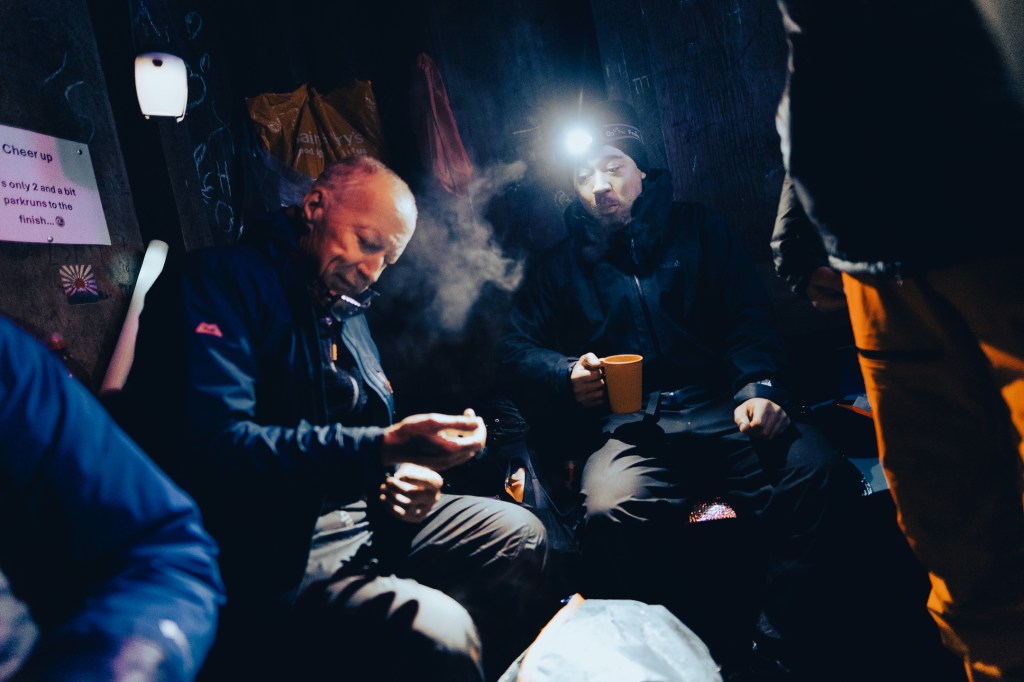
The church was very busy with Spiners so we popped in to sort ourselves out ready for the Cheviots and then left after quite a short stay. I did joke with the safety team outside that the Spine occupancy of the church might be greater than the average Sunday congregation.

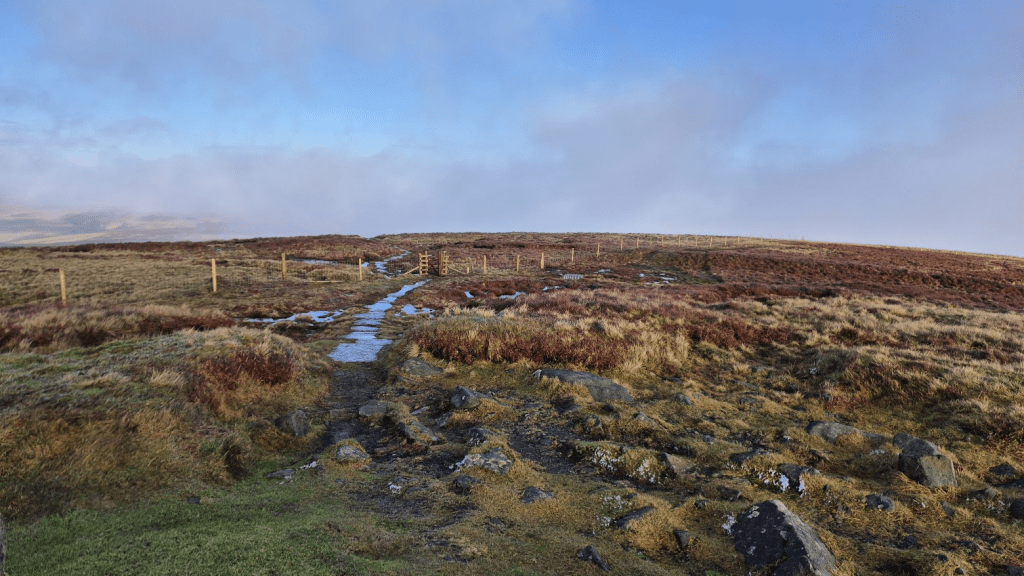
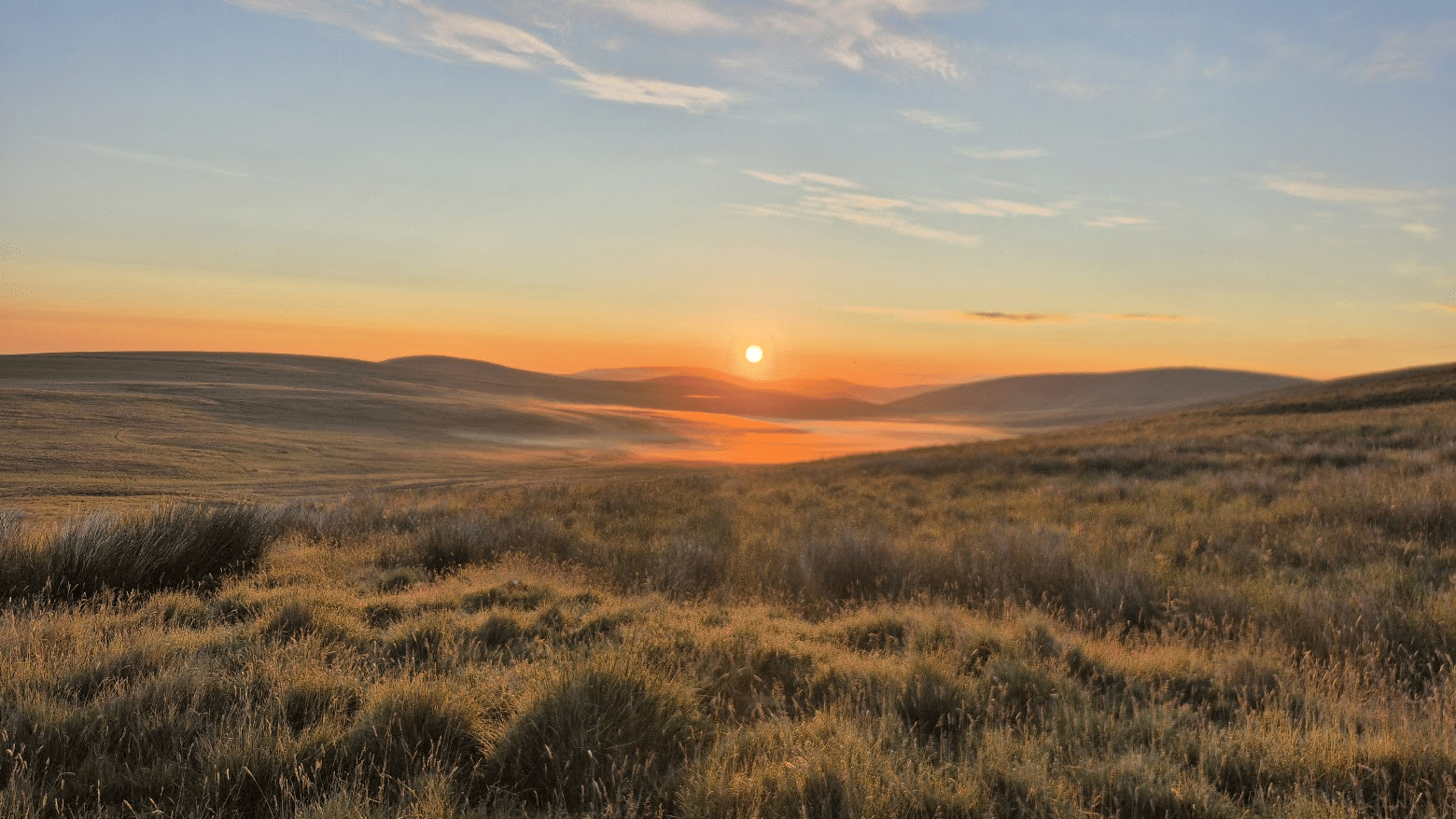
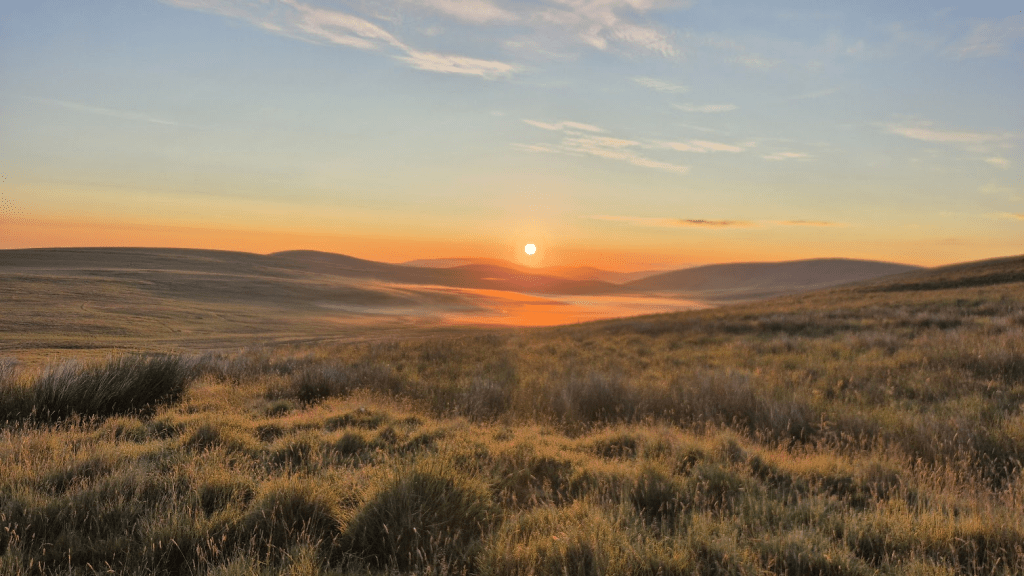
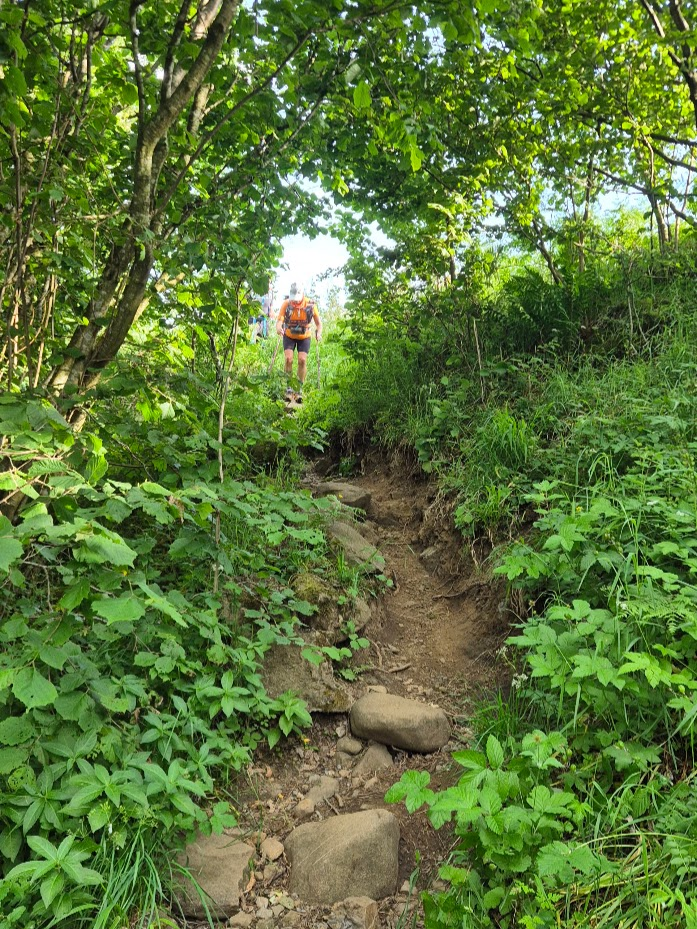
The climb up Byrness Hill is steep, can be slippery and does involve negotiating a few rocks but that was fine, it was getting light and we would be on the Cheviots for sunrise. And what a sunrise, and a cloud inversion over Chew Green. I took many photographs and for once I think it was justified, make your own mind up.

Amazing sky from Raven’s Knowe
Sunrise
A cloud inversion – does it get any better?
Just one picture of an inversion isn’t enough

It was a truly magical 30 minutes. We forgot the horrors of Cross Fell, the pain, the fatigue and just enjoyed nature as we walked along. We only saw a couple of othe runners as we crossed the Cheviots so I don’t know if we were the only ones to experience the inversion but I know we did appreciate how lucky we had been to be there to see it. Of course it wasn’t quite so pleasant when we reached Chew Green and had to walk through a cold damp mist but hey ho.

Getting up close and personal with the inversion

We spent a very long time playing the ‘Is that Hut One?’ game. We were moving much more slowly than we would normally run an so were having problems adjusting to how long it took us to cover quite short distances. Finally we did arrive at the Hut.

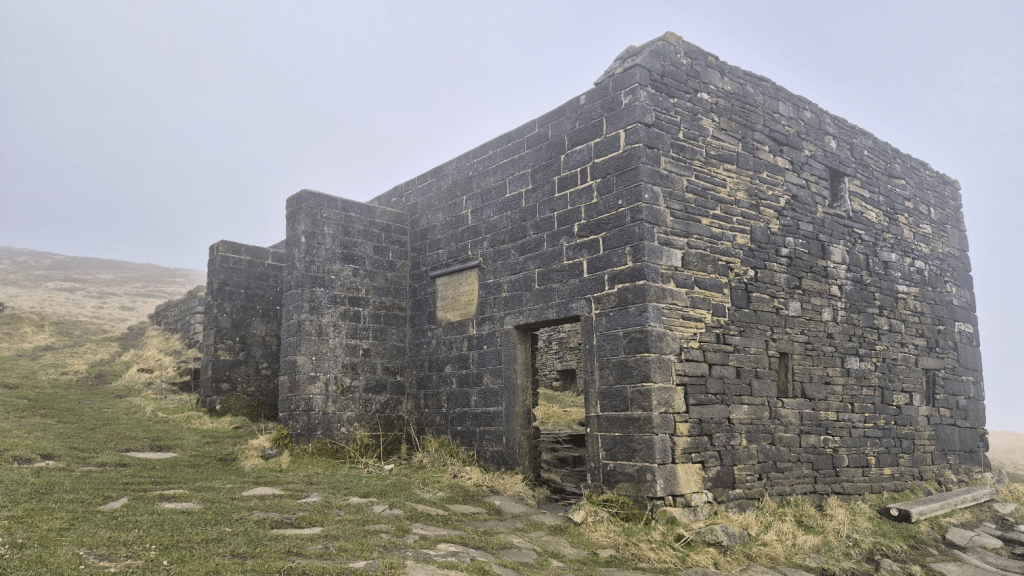
Hut One

The medic at Hut One felt that Sharon looked a little dehydrated and suggested she take one of the sachets of rehydration salts we had to carry as part of our mandatory kit. I asked for codeine as my feet, whilst not particularly blistered, felt absolutely battered and were painful to walk on. She kindly obliged and I let her have some of the charge from my power pack I was carrying for her phone so she could message HQ to record my prescription.

Sharon decided it had taken far too long to get to Hut One and, as it was nine miles to Hut Two, we should get a move on. As a result whilst we were travelling in single file along the trail, she was never very far behind me and I didn’t have to wait any time at all for her to catch up when I stopped. We did stop occasionally to take in the beauty of our surroundings. When I’ve been on the Cheviots before I’ve invariably been knackered and it has often been dark so it was great to have the energy and the light to appreciate where I was.

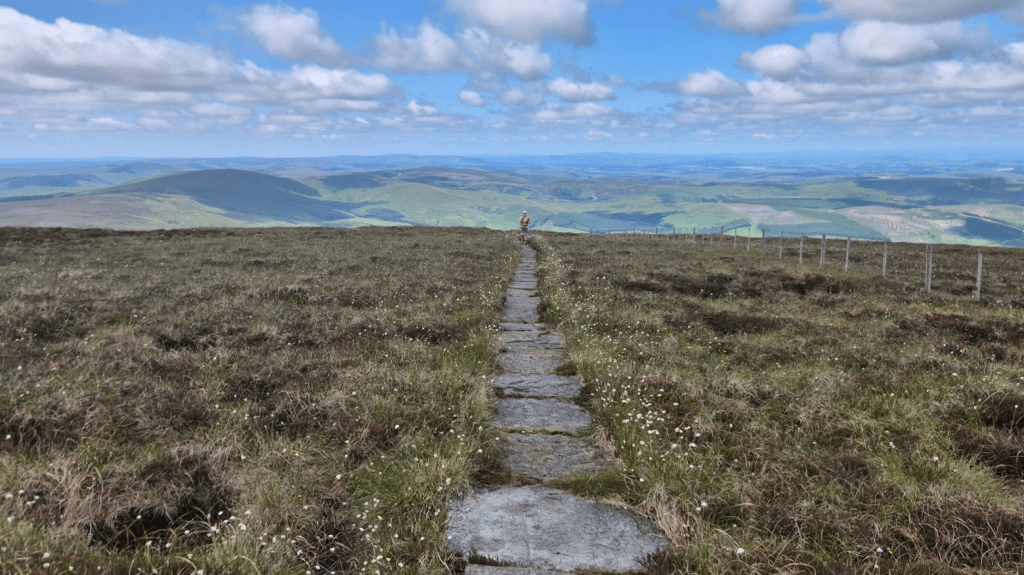
I think the fence marks the England – Scotland border
Never far behind

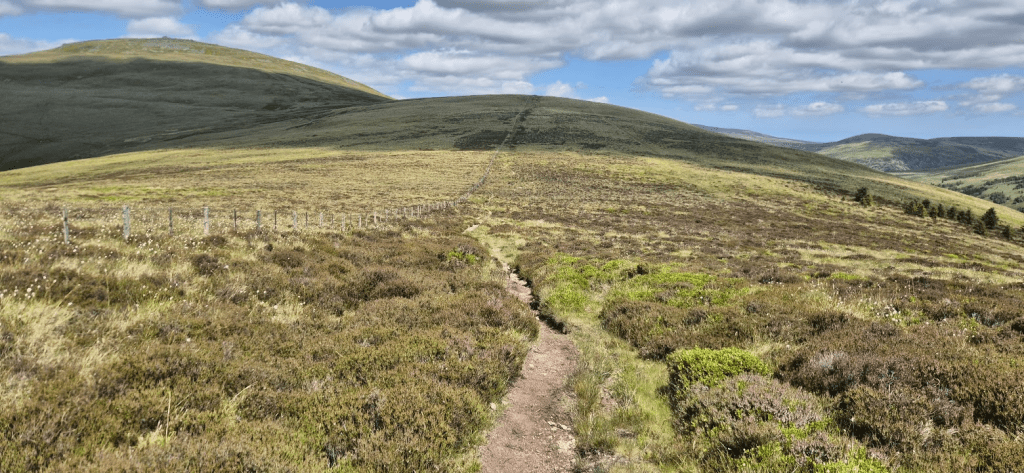
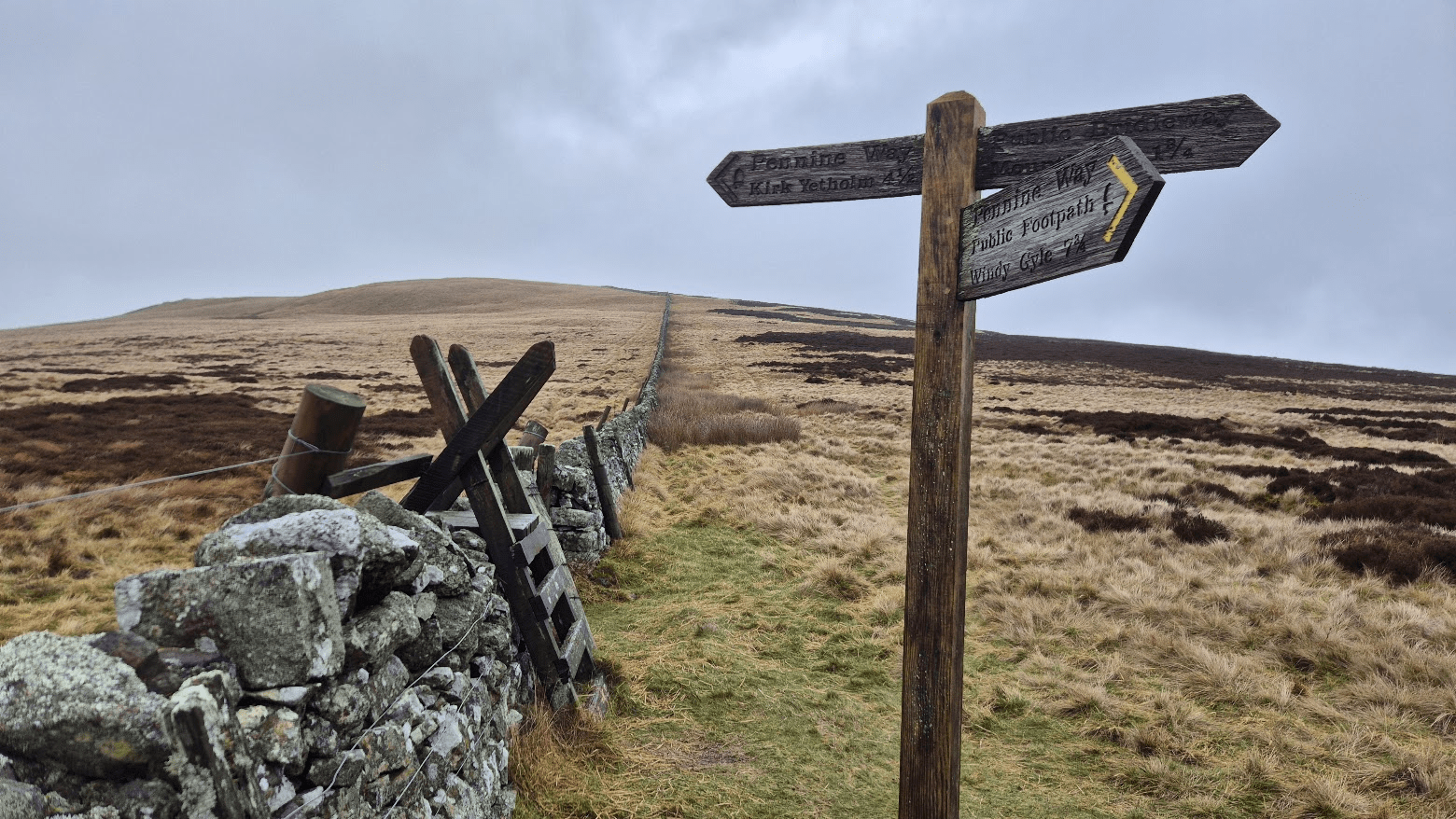
I always have it in my head that from Windy Gyle to the turn down Auchhope Ridge is a constant climb along a slabbed path, which it is – until it isn’t. The final climb to the ridge is steep and mostly lacking in slabs – I remembered this when I was looking up it, even though I’d only ever done it in the dark before. Anyway we got to the turn point and got our first view of Hut Two in the distance. I also always think its downhill all the way to the Hut – that isn’t strictly true either.

If you look very, very carefully, you can see Hut Two

One piece of good news was that the rocky part of the path down was much shorter and easier than I’d been leading Sharon to believe, and also marked with flags. Again, I’d only done this in the dark and had probably not seen the route down and just blundered through.

I like Hut Two because it means you really are on the last leg of your Pennine journey. Equally I know that getting to Hut Two still doesn’t guarantee success but it was just before midday, apart from both having epically sore feet we were in quite good condition, and the weather was glorious, so I was confident. I also told everyone around that navigation of the Schil was a doddle as you just handrailed the fence. I even discussed it with the volunteers at the Hut. I don’t know if the followed our dots down but if they did they must have been amused when I took a random path that went off to the right. I’d successfully not gone down Red Cribs but hadn’t noticed a path split just after. My watch alerted me and, as it was only a bit of scrub between where I was and the path, I bashed my way through the undergrowth and got back to where I should have been in the first place.

Wishful thinking started taking over at this point. The fence lead up a small peak, so we didn’t go up the big peak on the left, right?

So this must be the Schil then?

No, the fence unhelpfully turned left to give us this view…

Nope, that’s the Schil

On top of the Schil I think the lack of sleep and the joy of almost being finished must have got to Sharon. spine Legend Gary Chapman organises a race called the Haworth Hobble in March, we had done it as part of our training for this event. There had been a bagpiper on the course and Sharon, as a true Scot and teacher of Highland Dance, had a little dance with him, which I videoed. Before the race Gary had commented that he wanted to see dancing on the Spine. This was the last real opportunity to do in on the course so, after 150+ miles with appallling blisters, Sharon obliged and I videoed. Sadly I don’t seem to be able to embed the video into my blog but here is a still I captured from it.

Doesn’t everyone dance on the Schil?

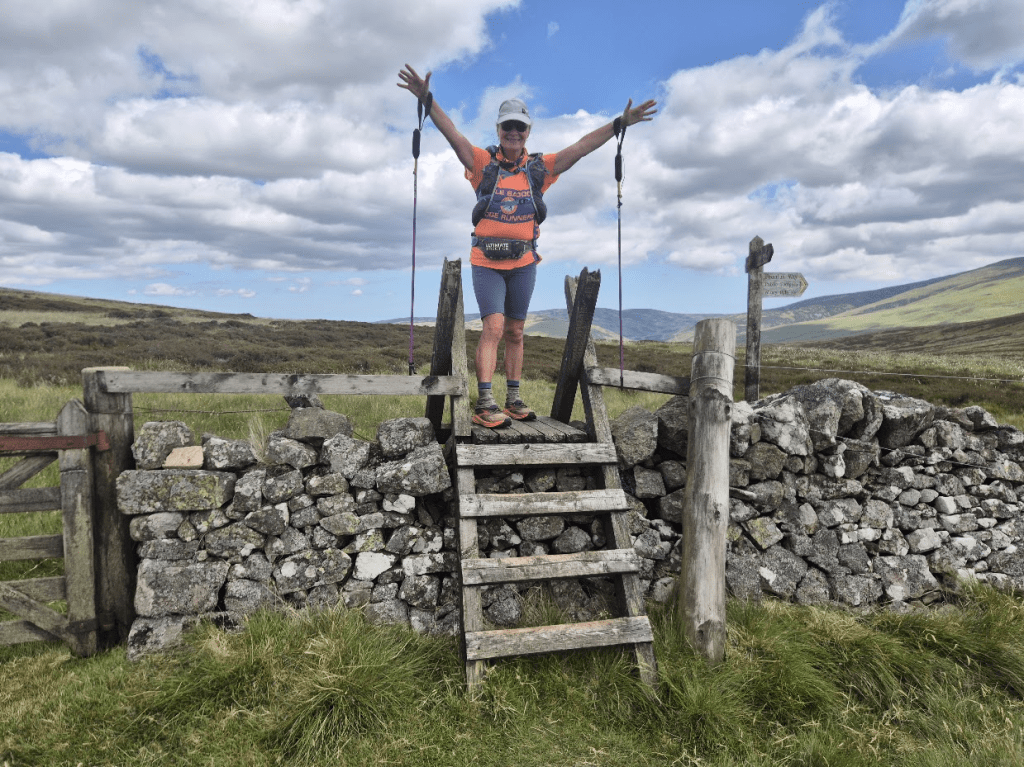
There is a particular Stile I always think of as the ‘Entrance to Scotland’. In practice I think the Pennine Way dips in and out of Scotland a few times but at this point you turn into Scotland and head away from the border. Sharon was excited to be there.

I’m coming Home!

She also got very excited by the huge Tunnock’s sign, being a great lover of Tunnock’s products.

If only this had been full of giant Tunnock’s wafers – we’d never have bothered to finish

Once we were on the roads it was just a mental battle to keep going. As with so much of this race, it wasn’t far but it seemed to take so long. We ran as much as we could but our feet were on fire and so we had to walk quite a bit too – then of course there’s that hill right at the end…

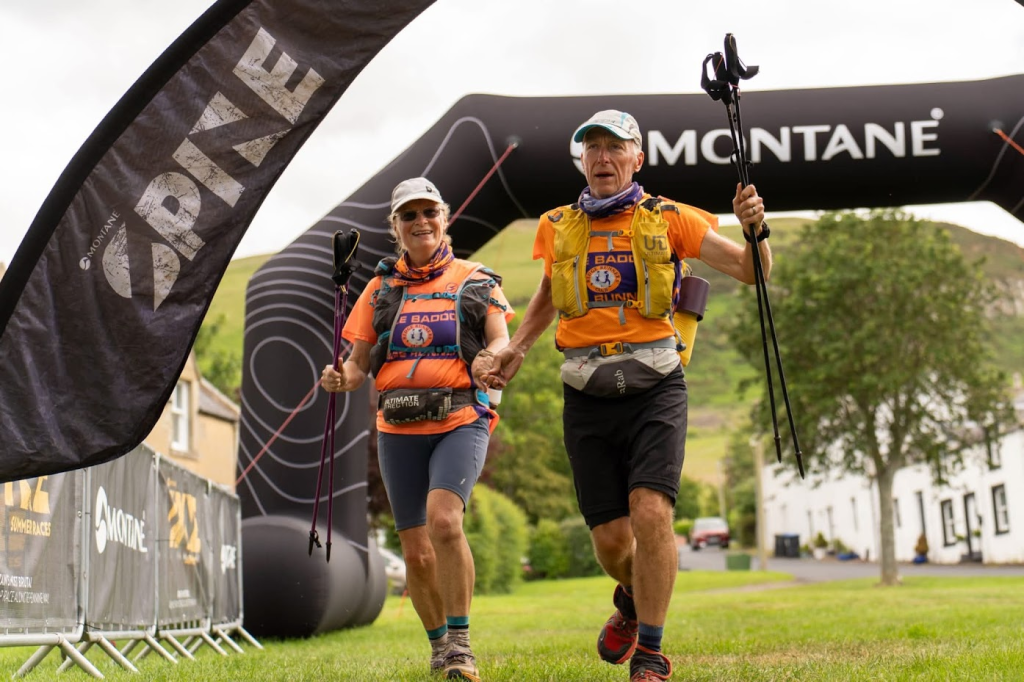
On Thursday the 19th of June at 15:02:09, Sharon finished the Spine Northern Challenger and completed the Pennine Way. Annoyingly I apparently finished 3 seconds later…

We made it! (photo credit Spine Media Team)

There are some that would say we hadn’t earned the right to kiss the Wall as we hadn’t done the full Spine. These people are entirely coincident with the group I don’t want to talk to.

Well earned

I know this blog has gone on a bit, I had more time for photos and to take it all in than I have in the past, but there is a bit more I want to say – sorry, stop reading if you want.

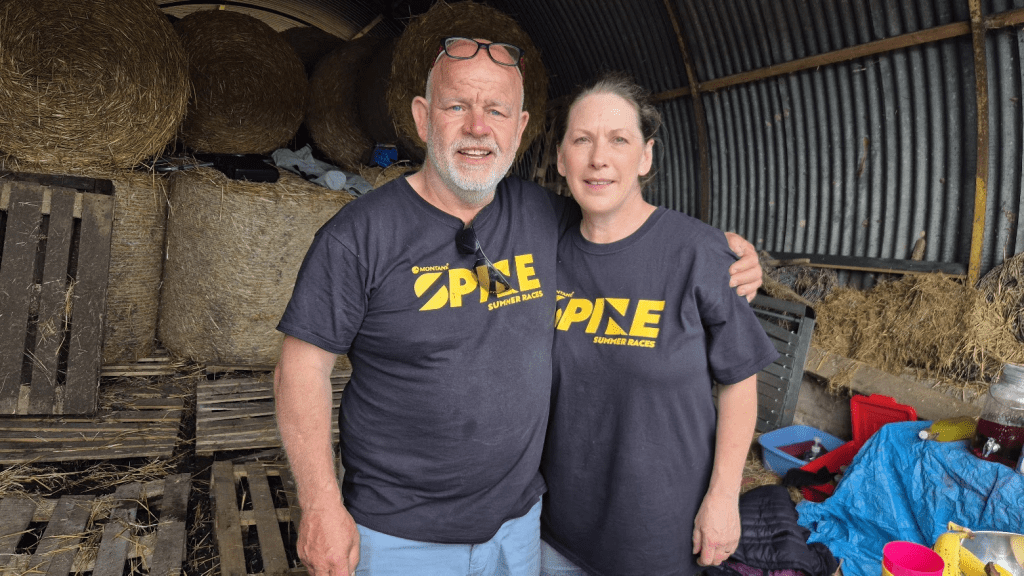
The first and most important thing to say is how incredibly proud I am of Sharon. Yes there was a slight wobble on Cross Fell but nothing of any consequence. She battled stomach issues, infected blisters and massive sleep deprivation to not only complete the event but to do a surprisingly large amount of it with a smile on her face. How tough? Tough enough. She has now run the whole length of the Pennine Way and is in no rush to go back to it. We did discuss doing Northern Traverse together one day, but that was after much alcohol whilst recovering in Berwick.

As always there has to be a massive thank you to all the people that make the race happen, all the volunteers and the safety teams – and all the Spine Angels that gave us little treats along the way – Thank You to all of you.

I’d like to think it was because I wasn’t so much in my little bubble as I normally am but I suspect the reality is that it was Sharon that was being sociable, but I felt I talked to more people than usual, which was nice. If I did talk to you at any point, I probably won’t recognise you next time I see you but thank you for making our journey better anyway.

So would I recommend the spine Challenger North? Yes, in fact I would say this is the perfect Spine Race for most people. It will test you to the limit, with three checkpoints you get a very real Spine experience, you take on some of the hardest sections of the Pennine Way, but it is just about possible to complete it without going into the places in your soul that you would rather leave unvisited. Dancing on the Schil is optional.

I already have my place in the Winter spine next year and on Monday I will probably sign up for the Summer edition too. I’ve been on the start line of a Spine race every year since 2021, and completed them all since 2022. Will I complete the double in 2026? Watch this space…

The Summer Spine Challenger North – how tough? (Part One)

After I completed the full Summer spine in 2022, I persuaded Sharon to join me for the Sprint in 2023. she didn’t hate that so in 2024 we did Challenger South. She did hate that but still decided she would like to do the Challenger North anyway to complete the Pennine Way.

As our Challenger South journey had ended at the Green Dragon in Hardraw, it seemed a logical place for our Challenger North journey to begin. The train journey to Garsdale went smoothly enough but I was a little worried that some Spiners on our train appeared to have organised Taxis for their onward journey to the Hawes area. We were planning on catching the ‘Little White Bus’, which I was expecting to see at the station – it wasn’t there. Obviously the correct reaction is to walk backwards and forwards between the station platforms trying to decipher timetables of various vintages whilst not phoning a taxi. I eventually worked out that the bus didn’t actually meet this particular train but arrived some minutes after. I worked this out as said bus arrived…

Anyway we checked into the Green Dragon, got the last table for dinner and all was well in the end. I had a quick kit faff because it was at least 18 hours since I’d last checked the contents of my bag.

The next morning we had breakfast, checked off our kit against the kit list and walked across the bridge to the Challenger North start for kit check. We also caught up with Mick Browne, an ultra-running legend in my eyes, and regular Spine runner and volunteer.

I know some people get stressed by kit check and I knew some of my kit (specifically my insulated jacket) was marginal but I wasn’t worried. I have quite a good relationship with the Spine kit guru, Lindley Chambers, and had already checked the suitability of most of my kit so I was quietly confident. Sharon has now entered three Spine races and this was her second full kit check. This wasn’t a problem as she tends to have all my really good, lightweight, Spine kit, and I have to make do with my old kit. Anyway kit check was passed, the rest of race check-in completed and we went back to the Green Dragon.

Sharon getting her traditional full kit check

By complete coincidence Tom, one of my tent mates from my first MDS was also doing Challenger North. He’d done the Challenger South a few years ago and would be running with Luke, who he met on the aforesaid event. We had lunch with them after they had done their kit check.

The next morning we had our trackers fitted, dropped our drop bags, and went back to the Green Dragon for breakfast. Full breakfast service didn’t start until 8am but they kindly provided a very comprehensive Continental breakfast from 7am for us and the other Spiners staying there. After that it was back out for the start of the 2025 Summer Spine Challenger North!

Tom, Luke Sharon and me at the start

Obviously I’ve done the Pennine Way before but we had also recced quite a lot of the first couple of legs so we both knew what was coming. The first four and a half miles or so from Hardraw are all uphill as the route climbs to the highest point on the first leg, Great Shunner Fell. Obviously this early in the race the runners aren’t too spread out and my attempt to take a selfie at the top was rescued by another competitor (sorry, didn’t get you name or number) who kindly offered to take our picture. There were a few people taking photos and selfies and why not? It was a nice day and we’d just completed the biggest climb of the leg, all was good – only another 150 odd miles to go.

At the top of Great Shunner Fell

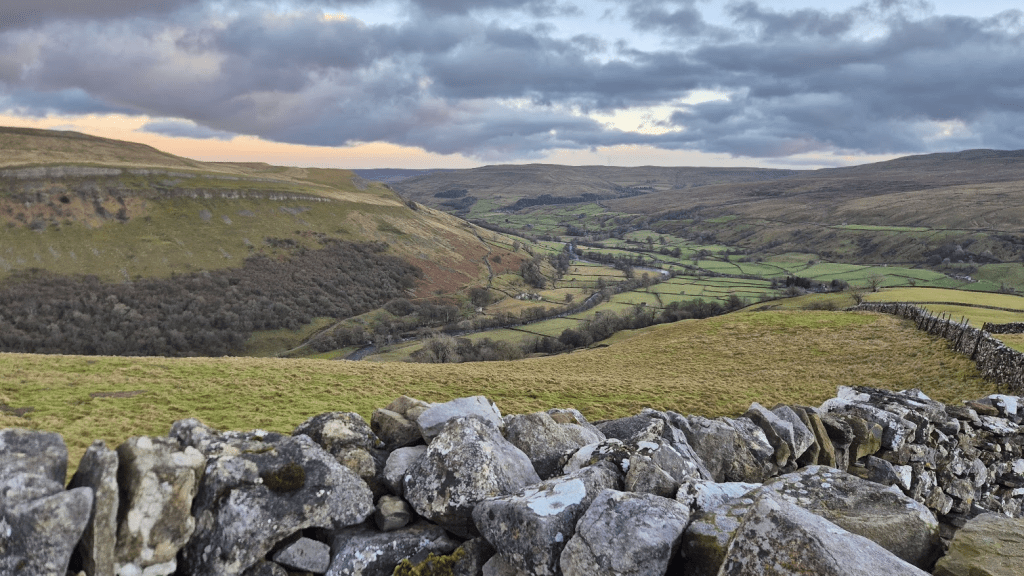
After all the climbing we were rewarded with a long downhill section to Thwaite and some great views on the way.

Descending from the Fell
The last rack off the Fell before the road to Thwaite

I caused a certain amount of consternation as we arrived in Thwaite, by running off in completely the wrong direction. There was a safety team and a very welcome pop-up cake and squash stop outside the café in the village. I had previously checked and found that the café was closed on Monday but the owners of the hotel attached to it had very kindly provided some refreshment for hungry, thirsty Spiners.

An unexpected treat!

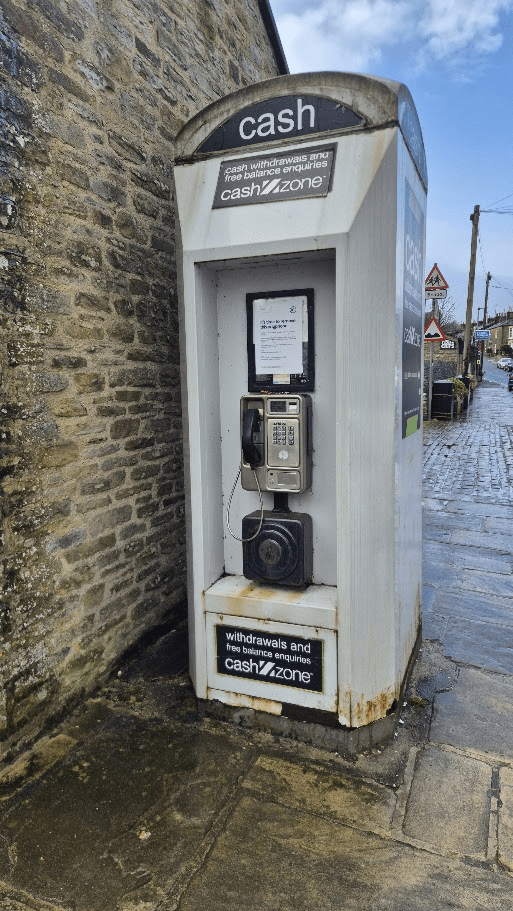
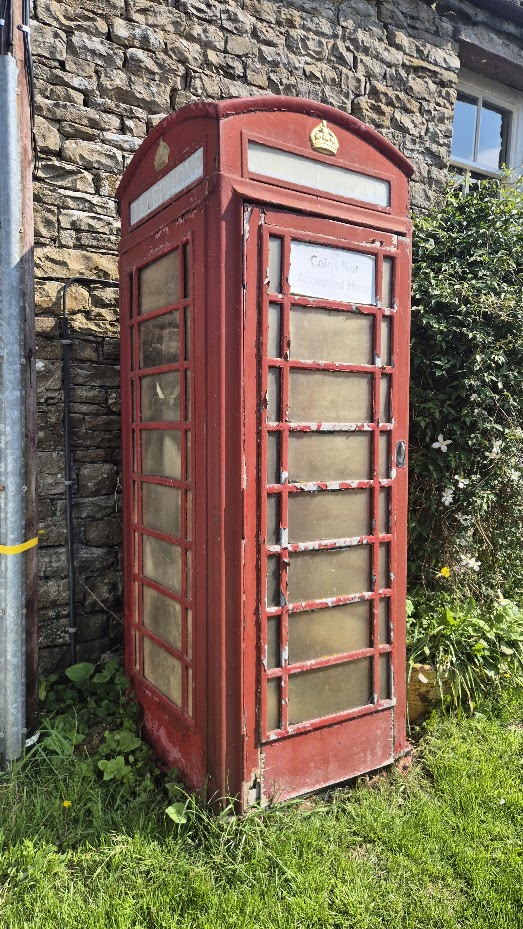
So why was I running off in the other direction? Those of you that know me might be able to guess… Usually when I’ve arrived in Thwaite it’s been with a 108 more miles in my legs and I’m just focussed on keeping going. This time I was just under 8 miles in and so had the energy to go round the corner to find the Thwaite telephone box. It wasn’t in the best condition but I added it to my ‘collection’ anyway.

Thwaite’s phone box

Upon leaving Thwaite there is a short, sharp climb to reach the path through the North Gang Scar. This path annoys me. As it goes through the scar, there are a lot of rocks to negotiate. It is by no means the worst part of the Pennine Way for that (we’ll reach that bit later) but it annoys me because there appears to be a perfectly good path along the river the Pennine Way could take instead – especially as just outside Keld we go back down to the river anyway. I appreciate my annoyance isn’t rational as the entire Pennine Way could be rerouted to avoid many annoying bits (Cam High Road?) but I have a relationship with the Pennine Way now, and, as in most relationships, I can put up with most of its annoying habits but there is always one that just grates. On the plus side, you do get some amazing views up there.

Looking back towards Thwaite
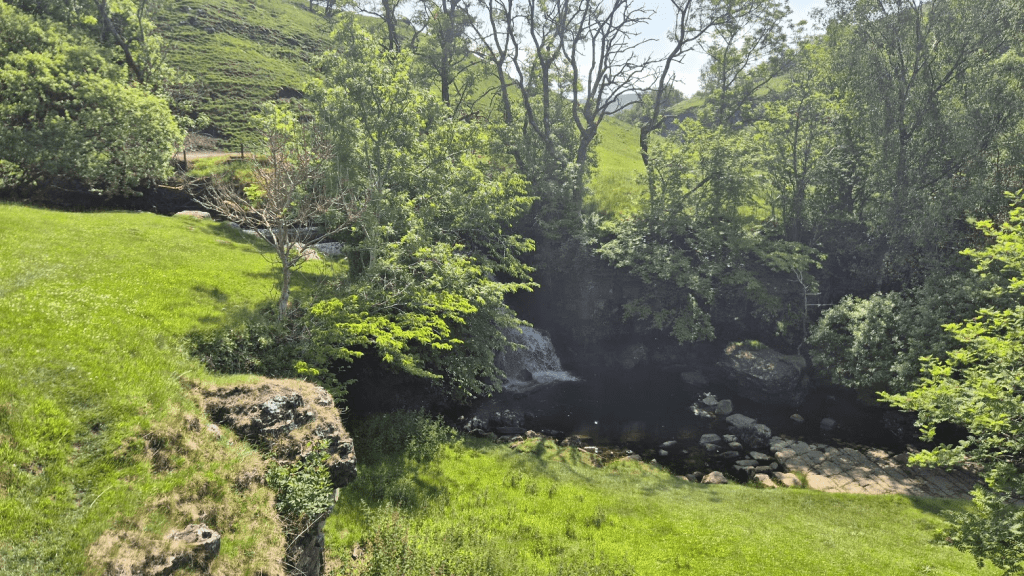
East Gill Force

It’s also less than three miles, of which only two are annoying so I’ll try and chill out next time I’m there. Anyway we were soon passing East Gill Force, which meant we would be crossing Black Moor, Low Brown Hill (you can guess what that looks like) and Stonesdale Moor to arrive at the legendary Tan Hill Inn.

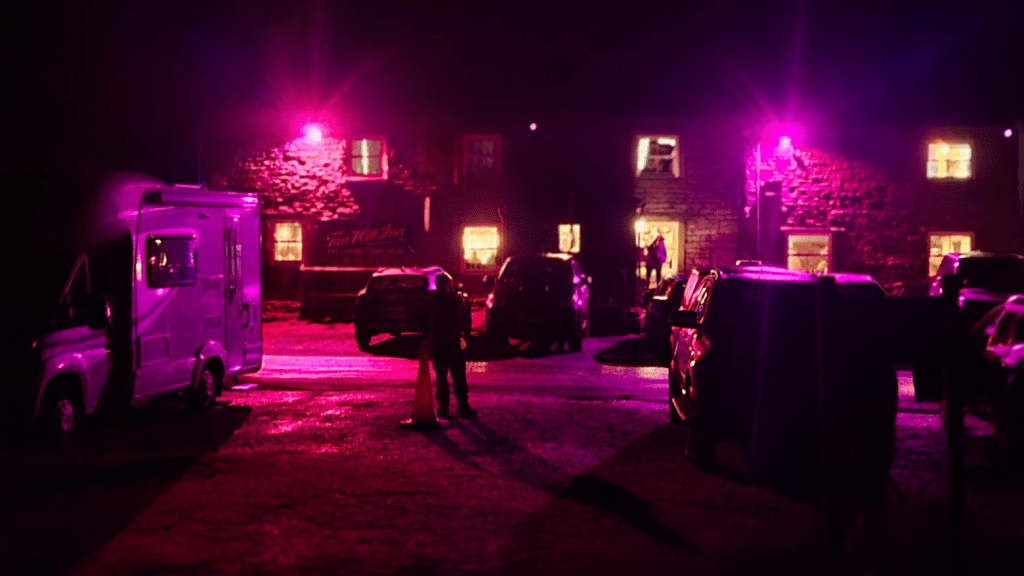
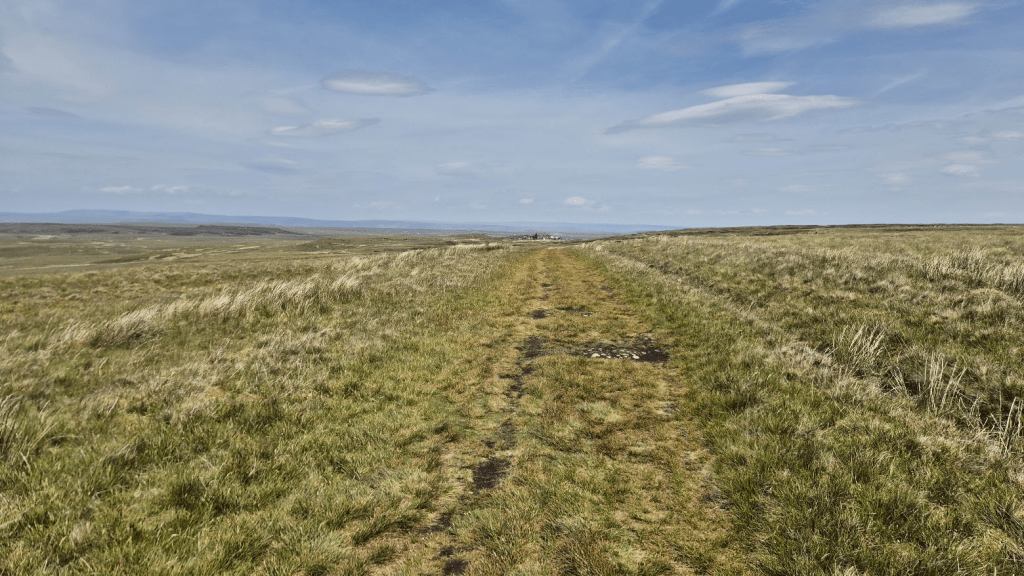
First sighting of the Tan Hill Inn

It does take longer to get to the pub from the first sighting than it seems it should. Whilst the path seems to be headed straight for the Inn, it takes a few twists and turns on the way.

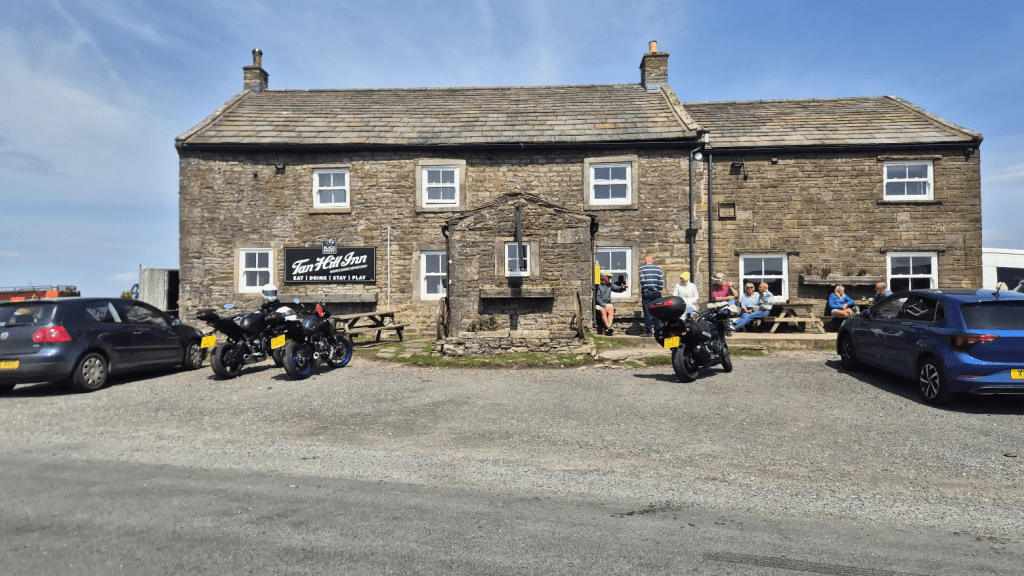
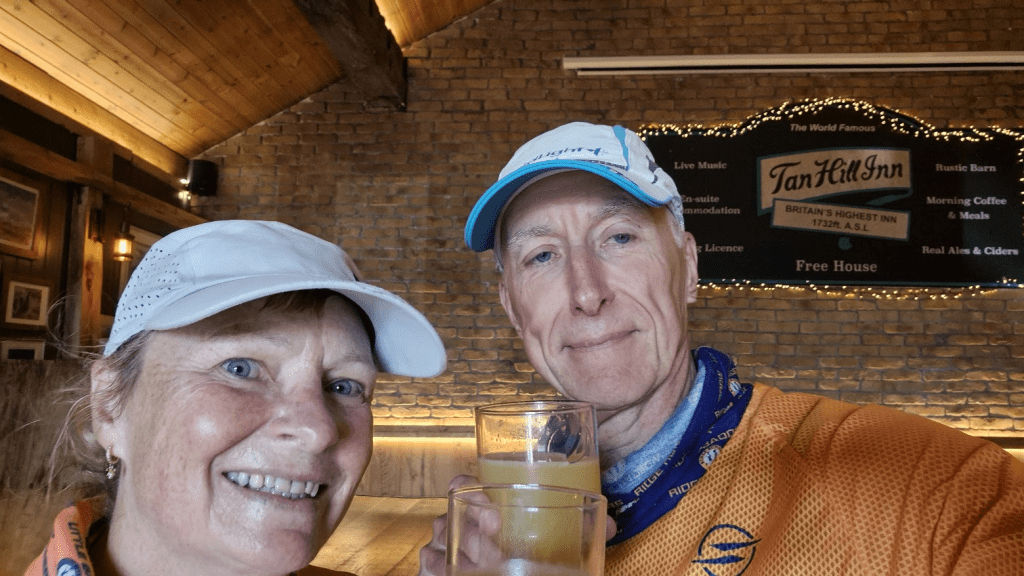
The highest pub in Britain!

Our plan was to have a drink (non-alcoholic, as per race rules) and some chips, so we did. Slightly surprisingly we had caught up with Dan and Luke and ran with them for a couple of miles to the pub. However their plan didn’t have as long a pub stop as us so they left some time before we did. Sharon’s feet were already starting to blister and she changed into waterproof socks for the moors ahead.

If I could have had beer I might have smiled

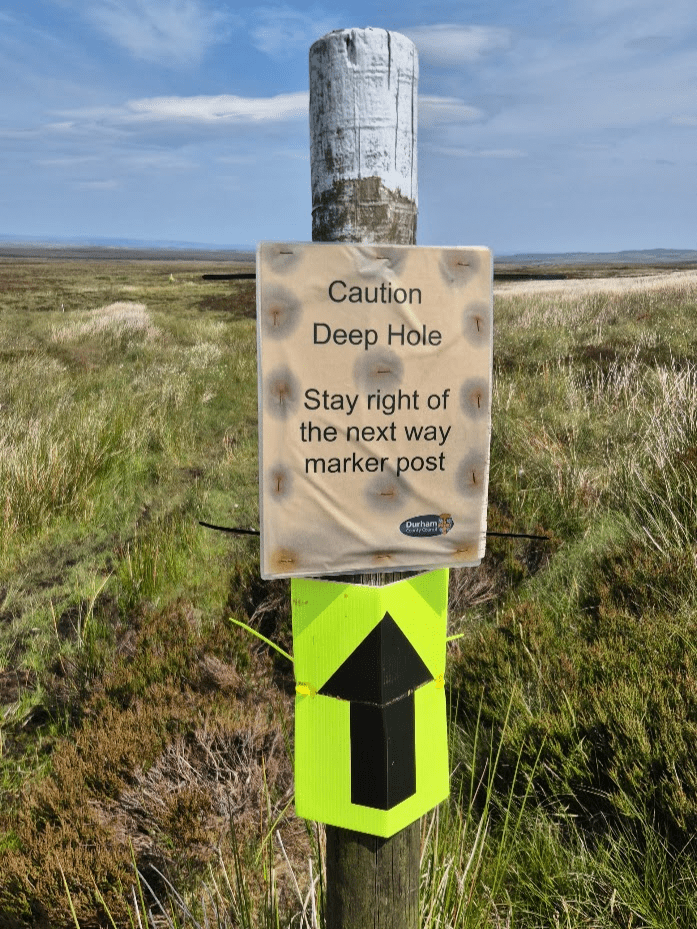
After we left the pub, Sleightholme Moor beckoned. This can be notoriously boggy but the bigger worry this time was the massive sinkhole that had opened up, which would apparently quite happily swallow any errant Spiner without trace.

Good advice

Fortunately the route to avoid being swallowed had been well marked and we passed the hole without incident.

I guess this was the hole – I wasn’t inclined to get any nearer to find out

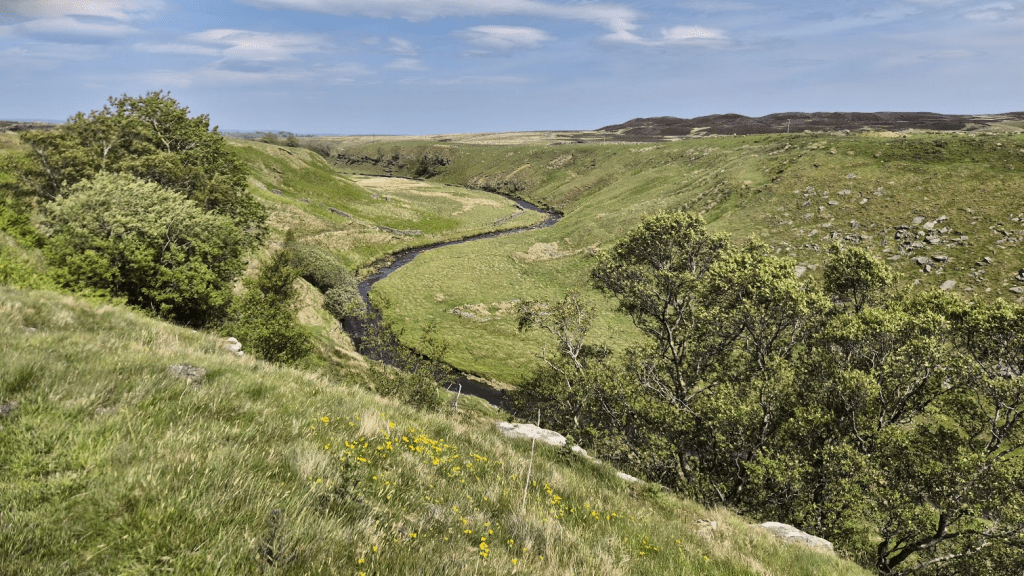
It’s just under three miles across the moor before you join Sleightholme Road but, like so much of the Pennine Way, it seems longer.

More Moor

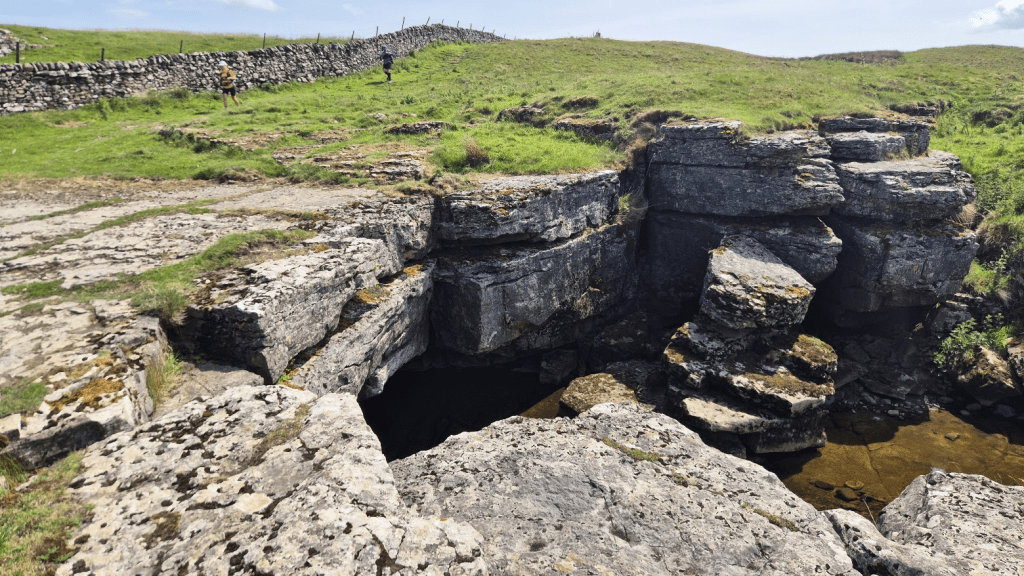
A small climb and yet more moor took us to God’s Bridge – a naturally formed bridge over the River Greta.

Sleightholme Beck
God’s Bridge

After God’s Bridge the Pennine Way crosses the A66 through a stock tunnel and then… more moor.

All the moor was worth it though when we got to Clove Lodge. I’d stopped in the barn there on the Winter Spine and been very grateful of it. This time it had outdone itself in terms of variety of stock (Coke, orange juice and Tunnocks Teacakes were our items of choice) and we got to meet the person responsible, the very lovely Angela.

Angela, the Angel of Clove Lodge

After a bit more moor, we came to the reservoirs at Grassholme. I’d seen in the press there were drought warnings and the level of the reservoirs seemed to bear that out.

Less water than would be considered ideal

When I did the Winter Spine, there was a simply amazing couple stood at the B6276 road crossing at about 10 ‘o’ clock at night, in the freezing cold and probably snow, who had opened a gate so we didn’t have to climb a stile and were handing out some incredibly tasty flapjack.

As we approached the stile I remembered the couple fondly and noticed that this time we would have to climb it as the gate was closed. I wasn’t quite prepared for what we found the other side of the wall though. On our way across the fields we had seen a sign. I assumed it would be asking Spiners not to sleep in the nearby derelict barn but instead it was a sign for ‘The Nettlepot Café’, something I was entirely unfamiliar with but sounded possibly interesting – so interesting I almost immediately forgot about it. I was quickly reminded about it though when it turned out that the lovely couple from Winter 2024 had significantly upped their game and turned the hut by the side of the road into an entirely free pop-up stop for Spine racers!

The Nettlepot Café!

We had a choice of tea, coffee, squash, I think there was fruit and biscuits on offer too but, for me, it just had to be the home-made flapjack again. I learnt that the couple were Neville and Gail (I hope that’s the right spelling) and that Gail had gone to get some more supplies including a new offering of home-made ginger cake. She was expected back soon. Strangely my cup of coffee lasted just long enough to see Gail return. I can confirm the ginger cake is as good as the flapjack!

Neville and Gail two more Spine Angels

I have since discovered that Nettlepot is a small collection of buildings about quarter of a mile South-West of the Pennine Way. There only appears to be around half a dozen building at most but on the OS map it is still split into East and West Nettlepot. We were assured there was only one more hill and we would be on our way down to Middleton-in-Teesdale.

Looking back to Nettlepot – East and West

Sure enough we climbed for about a mile and could see the town ahead of us.

All downhill from here

We had done the very last section along the river only a few weeks before on a recce so Sharon knew the path and soon our first checkpoint came into view.

The riverside path is challenging in places!

It was still a bit of a trek once we could see the checkpoint as we had to go around the wildflower meadow rather than directly to the CP but we soon got there – Leg One done!

Checkpoint One – or Three if you are a full Spiner

Tom and Luke were at the checkpoint and took our photo – we did our best to look as if we were enjoying ourselves.

Us at the first checkpoint

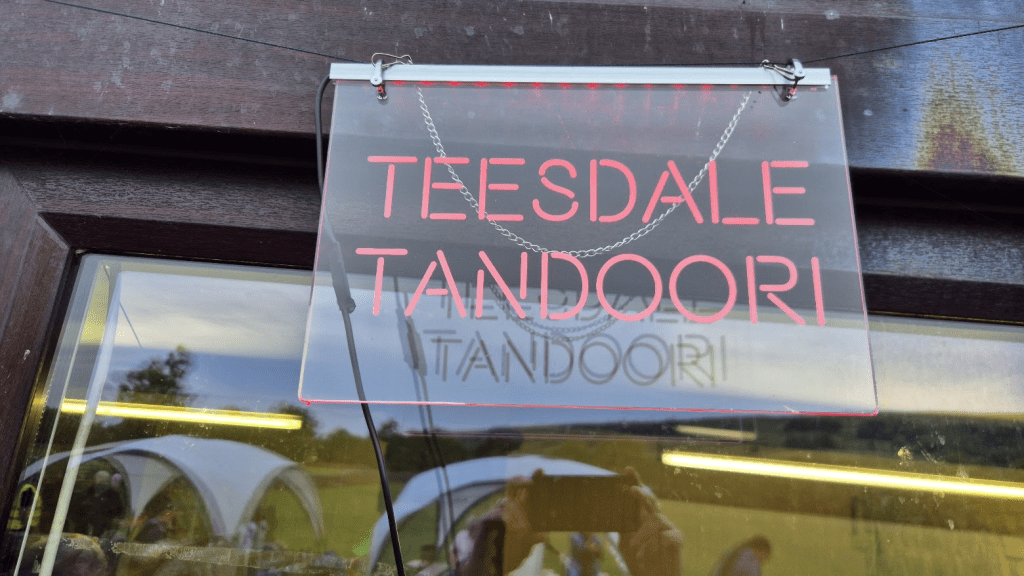
The checkpoint styles itself ‘The Teesdale Tandoori’ as the main dish on offer is korma, rice and naan bread. Apparently it is on Google Maps. I hadn’t learned anything from my Winter experience and ate the naan far too quickly and had to drink copious amounts of squash to ease it down.

As it says

Julian, a fellow Spiner I had randomly met when I was running to a dance competition in Colchester (not to compete), was volunteering at the checkpoint. All the volunteers are great but its especially good to see a familiar face. Sharon was struggling to eat and wasn’t feeling great. She had a number of blisters which had to be dealt with. We had the hydrogel squares that Dr. Ryan had used to such great effect on my feet on Uzbekistan so I was hoping we could patch her up and relieve some of her pain. I was in reasonably good shape and ate enough curry (and rice pudding, and biscuits) for both of us.

We stayed at the checkpoint for about three hours in total before setting out again. The sun had set and we would be trekking through the entire of Monday night. Sharon wasn’t feeling great and it was fairly dark so we agreed we would walk until it was either light or she felt OK, whichever came last. As I mentioned we’d recced Middleton to Dufton a few weeks previously so she had seen the highlights of the Tees section of the Pennine Way, which was just as well as I wasn’t expecting us to get to High Cup Nick before sunrise. When I first attempted the Spine in 2021 I took a photo of Stoodley Pike at night and was rewarded with a black subject on a black background. Phone cameras have improved massively since then and I was able to get a couple of pictures along the river despite the low light.

Low Force
High Force

Whilst on the section by the Tees, we had been passed by, and then passed when she stopped to put waterproofs on, Jo, an Australian Spiner. We also picked up an American gentleman whose name I never got, as he dropped back from us at some point. We met him at a point where navigation is very easy in daylight as you can see the stile and the footpath sign, but much harder in the dark. He had gone slightly wrong and retraced his steps. I had to have a bit of a think but once I swung my torch round and saw a sign I remembered exactly what came next, a short descent, a bit rocky at the end, followed by a footpath diversion around a farm. This seemed to convince Jo and the American I knew where I was going as they declined my offer to go ahead where I knew the path was narrow, and followed me along the Tees. It had been quite windy on our recce and, once again, it was windy.

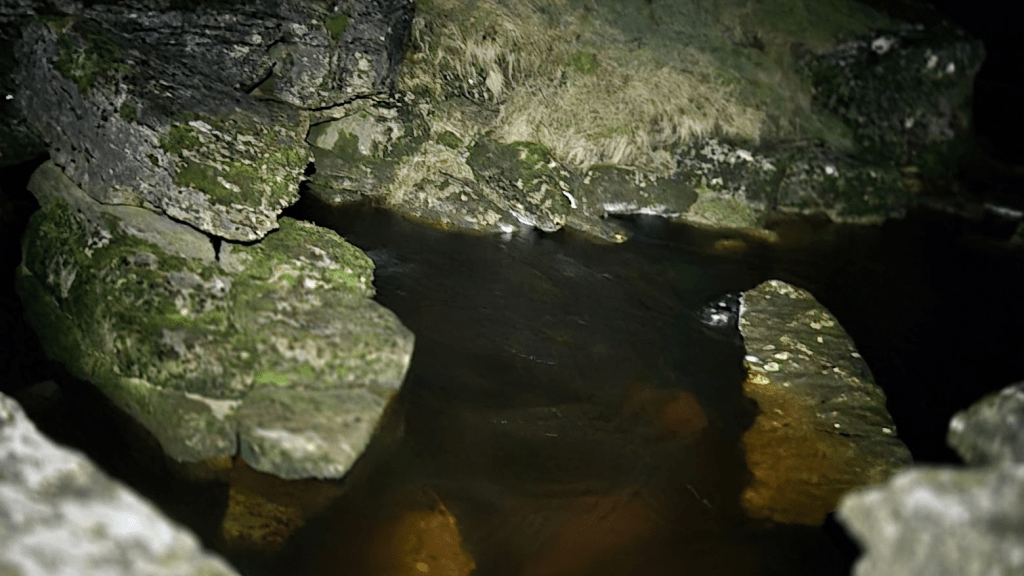
I did warn Jo about the boulders along the riverside and assured her that this was the National Trail, even if it was hard to believe that in places. However we negotiated the boulders and boardwalks and arrived at the foot of Cauldron Snout.

The scramble up Cauldron Snout isn’t hard but it is a little trickier in the dark as you have to be aware of where you are aiming for and not just climb randomly. I took us a bit too far to the right but we reached the top without any real drama.

I think there was a safety team and some other Spiners just past the top of Cauldron Snout, however my attention was completely distracted when Jo produced a bag of Australian Koala keyrings and began handing them out! I’ve done a few ultras now but that was a first – what a lovely gesture!

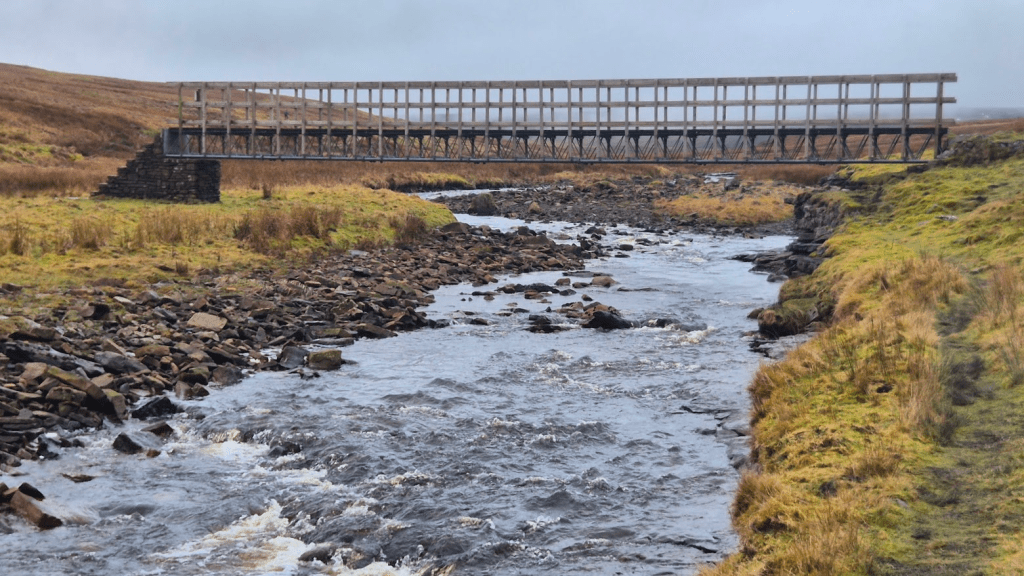
We started the trek up to High Cup Nick. It was becoming clear that we wouldn’t have a great view as the weather had become very misty as well as windy. We stopped at the wi-fi access point at Birkdale. I think the idea was to check for messages from Spine HQ but I think I just checked Facebook… The only other landmark that could be seen in the dark and the mist was the impressive bridge across Maize Beck. We crossed the bridge as shown on the GPX trail but the Pennine Way does also continue on the North side of the Beck. Apparently this longer route dates back to before the bridge was built as it wasn’t always possible to ford the Beck at this point.

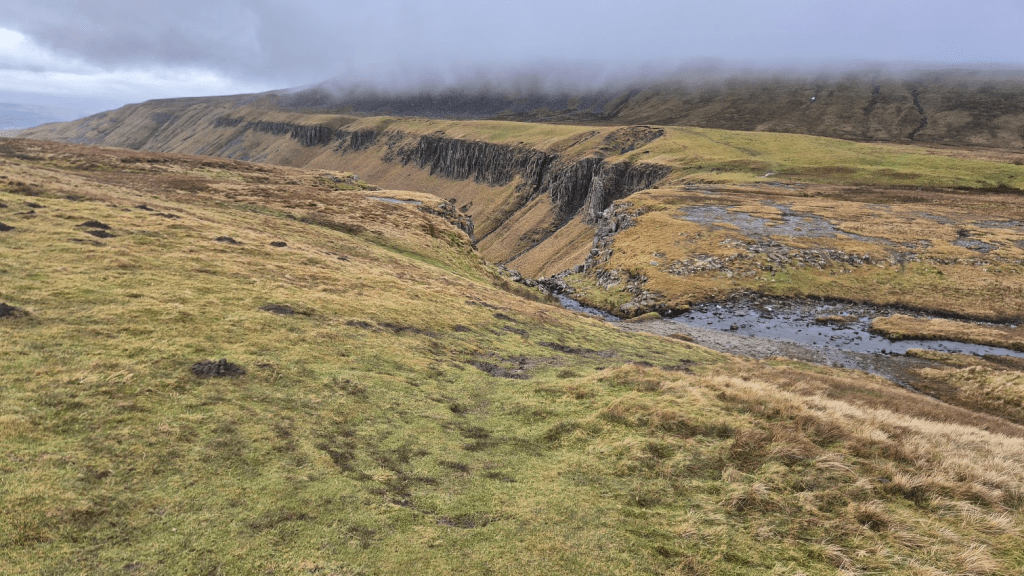
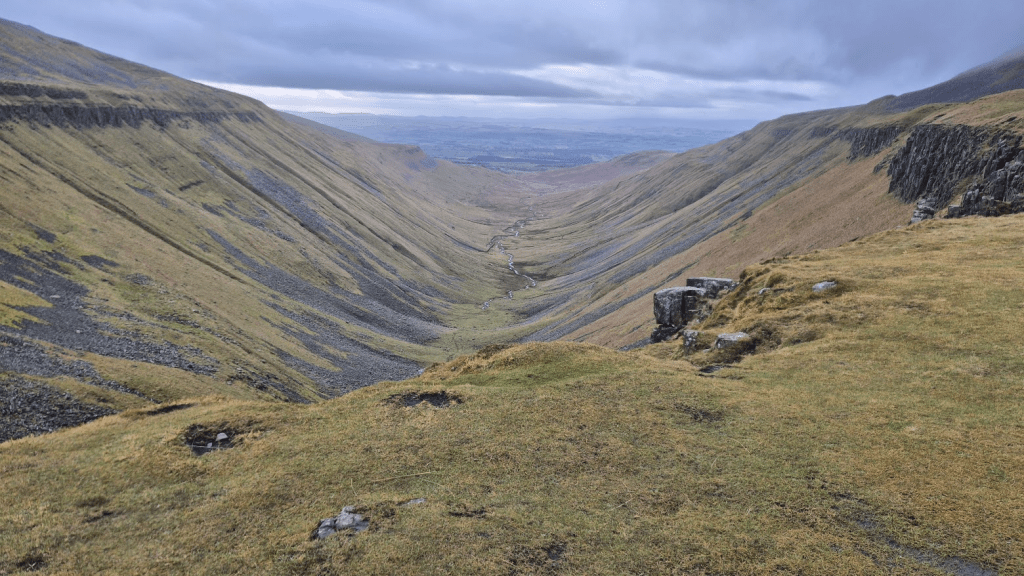
The view from High Cup Nick was the grey blur I had sadly predicted. I felt a bit sorry for Jo, she’s come all the way from Australia only to have no views at all along one of the (in my opinion) best parts of the Pennine Way. As the day became brighter we all headed down to Dufton.

We arrived in Dufton a little after 6am – sadly far too early for the Post Box Pantry to be open. We stopped for the maximum time allowed of 30 minutes. We ate some of our food (two Peperami Pizza Buns for me) in order to fuel ourselves over Cross Fell. Unfortunately Sharon was feeling quite ill by now and didn’t exactly manage to hang on to what she ate. We left the bus shelter and set out to the biggest climb on the Pennine Way, up to Cross Fell.

Still smiling – for now…

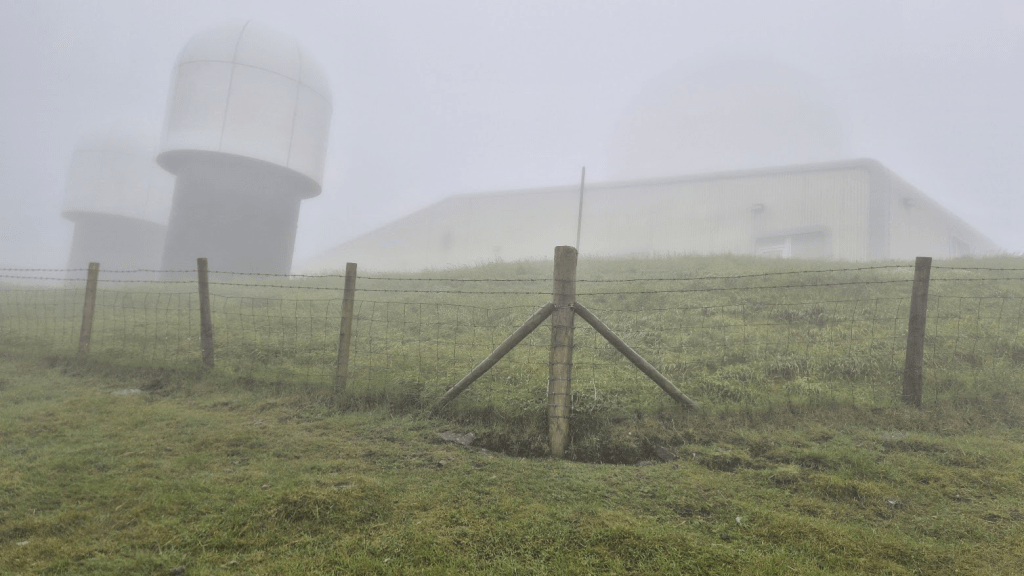
As we ascended the weather got worse. We had put our waterproof trousers on at Dufton and this seemed to have been the right call. Usually you get a view of the giant ‘golf ball’ on Great Dun Fell on the way up but not this time. I had seen signs warning of construction traffic on the road to the radar station but when I couldn’t see the ‘golf ball’ I assumed it must have been dismantled – hence the signs. I was so convinced I took a picture of the base of the structure. It was only much later when I was going through my photos I saw that the ball was just faintly visible but the rain and mist had completely obscured it from view to the naked eye!

The golf ball is just visible on the building

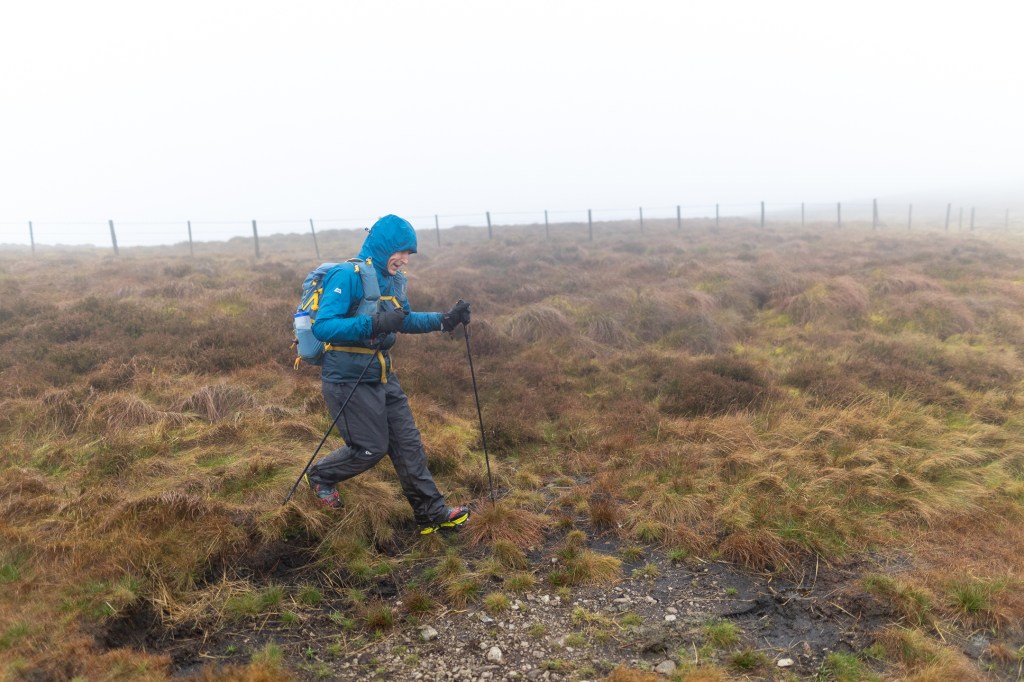
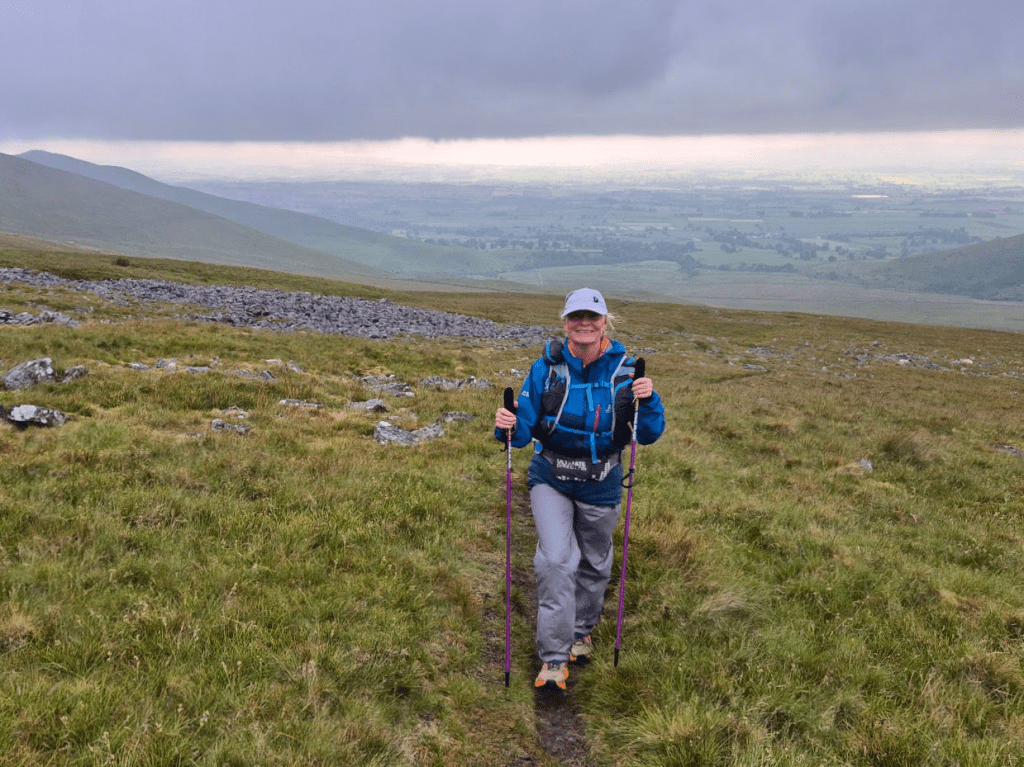
The weather was the worst I’d ever had on Cross Fell. About four miles from Greg’s Hut Sharon turned to me a said ‘I think I’ve bitten off more than I can chew’ however we had no choice but to keep moving forward. Sometime later I looked at my watch and saw we were down to two miles from Greg’s Hut’. I told Sharon, ‘You’ve chewed two miles, just keep chewing and we’ll get there’.

Sharon, trying to get some respite from the wind at the top of Cross Fell

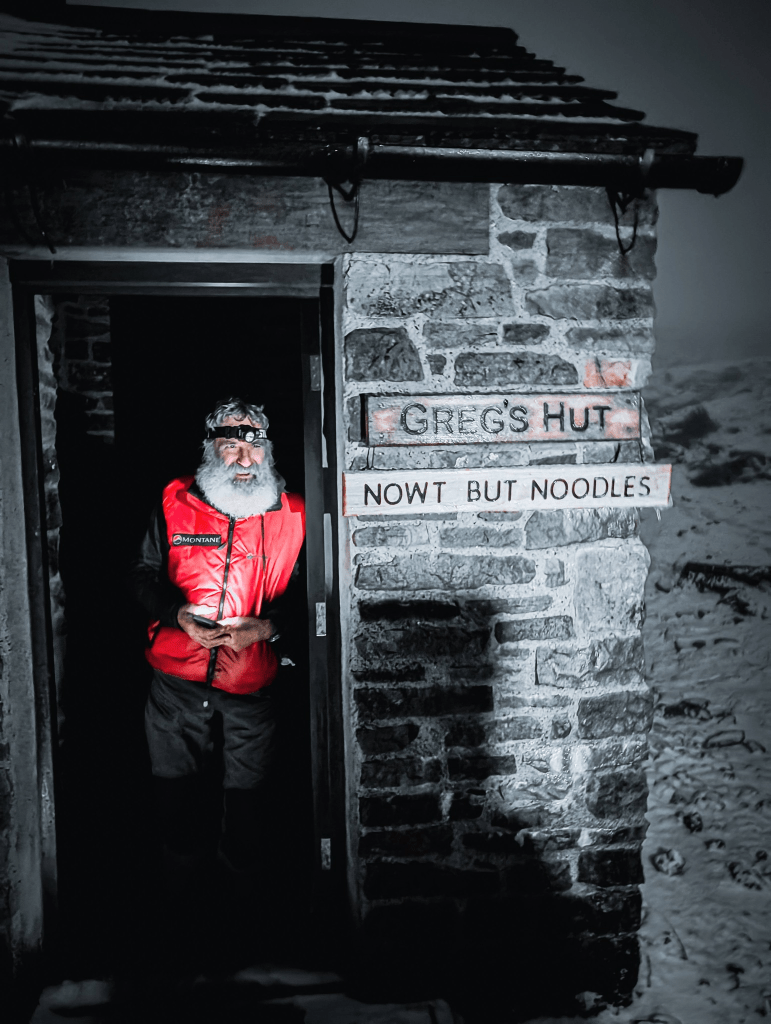
Eventually we made it to Greg’s Hut and joined several other shell-shocked Spiners having a break after the horrors of Cross Fell.

Greg’s Hut

Sharon said she was dropping out, apparently she had kept herself going by promising herself she would call it a day when she got to Greg’s Hut. I told her this wasn’t possible. ‘Why not?’ Well, if you phone Spine HQ and say you are dropping out, as soon as they know you are mobile and not alone, they will tell you to walk down to Garrigill to get picked up. Garrigill is only four fairly flat miles from the next checkpoint at Alston so you might as well get there. Besides, you’ve done the hard part, we are definitely not going back up onto the top and it’s a fairly easy, if somewhat boring, walk down to Garrigill. A couple of the other people in the hut backed up my assertion that the path wasn’t difficult and so we rested for a while and then started the walk down – which is actually slightly up for most of the first mile and a half, but then it really is downhill all the way.

There is another well-known Spine Angel in Garrigill called Annie, who opens her house to weary Spiners. I think every other time I’ve been through Garrigill it has been at an anti-social hour but this time we could have gone into Annie’s. However Sharon felt that if she stopped she might not want to start again so we passed on that opportunity and headed out of Garrigill.

The footbridge at Dryburn was still out of action so we would have to take the less nice route on the North East side of the river. Personally I will be surprised if the bridge is ever replaced. This is a shame as the North East path is not as nice as the original one, and has many challenging stiles on the way.

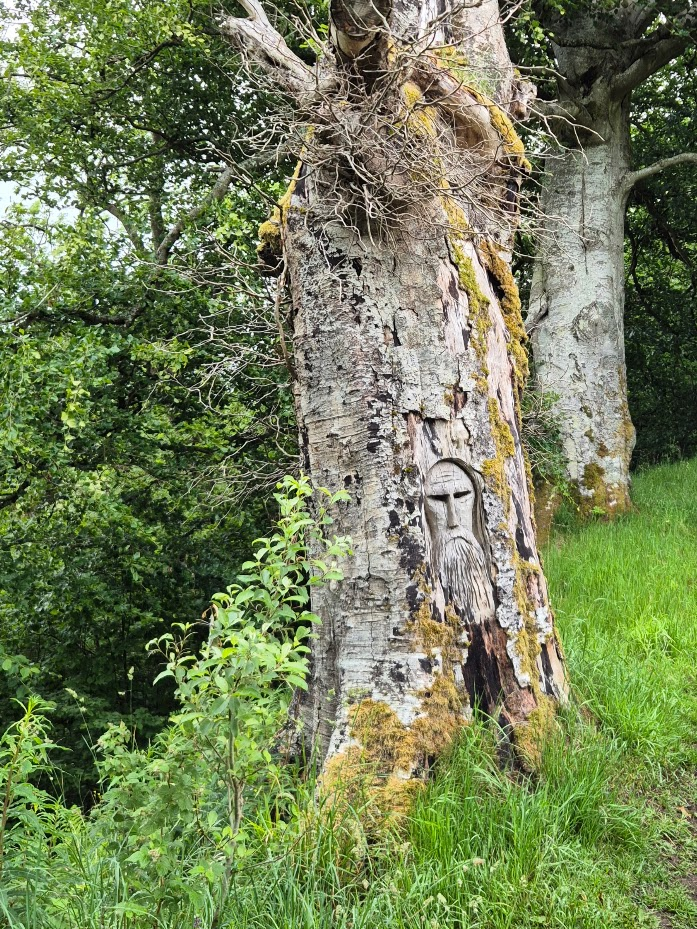
As we neared Alston we came across a carved tree. What was this about? Was there a secret Alston cult that worshipped Lindley Chambers?

Is this the face of Lindley or just a coincidence?

In order to maximise our time at Alston, we took off our waterproofs before we arrived at the checkpoint. We had also decided that, although the usual routine was to eat first at a checkpoint, Sharon would sleep first. The rationale was that if she ate and it upset her stomach it might stop her sleeping. If she slept, ate and it upset her stomach at least she would have slept.

The medics had a look at Sharon’s feet and drew lines around two toes to indicate the extent of the infection in them. This concerned me quite a lot as when I had infected blisters there was some doubt as to whether I would be allowed to continue. Sharon had been pushed to her limit, she was sick, her blisters had blisters, some of which were infected, I wasn’t sure if this was where our Spine adventure would end…

In the Footsteps of Alexander the Great – on the plains

We had been told at the opening race briefing that the race was one of two halves – the physically tough stages in the mountains, followed by the mentally draining stages across the plains. We were warned the plains were very flat and we would be able to see runners tens of kilometres ahead.

However on the morning of the fourth day it was definitely the physical challenge that was concerning me. This was the long day, 64km. Granted there was only 50m of up and 250m of down to contend with – and the promise of real beds and showers at the finish – with but my slightly altered gait from the day before had left me with incredibly tight calves. I started the day hobbling around the campsite – not a good look for someone hoping to hold on the fifth place and the men’s over 60 title…

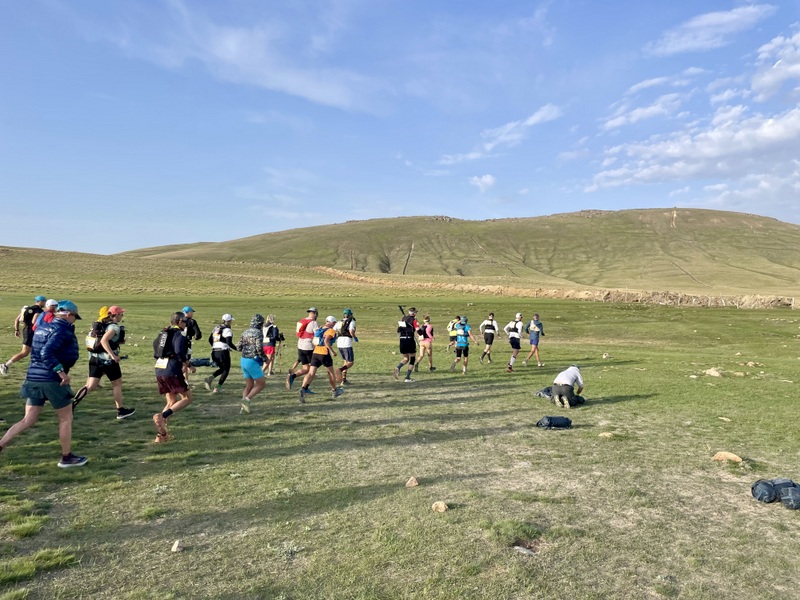
The only ‘good’ news was that I effectively had an extra hour for my calves to loosen up as the day started with a split start. The top 15 would start at 7am, everyone else would start at six.

6am start

Miraculously my calves did indeed start to loosen off a bit and by 7am I was moving a bit more freely. The vast majority of the downhill, such as it was, was at the start of the leg, dropping out of the last bit of the valley and onto the plains proper. I was hoping that this meant that any discomfort from my calves or blisters would be mainly at the start and that I would be OK for the rest of the stage.

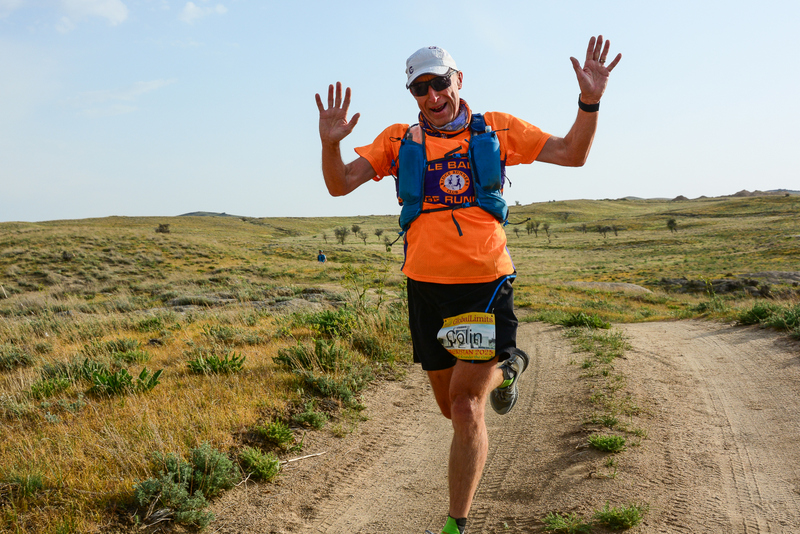
7am start – quite excited apparently (photo credit Global Limits)

Once we started running I felt surprisingly good…

Leaving the mountains (photo credit Global Limits)

… and after about a hour I started to catch the first of the 6am starters.

Valentin (4th) ahead with Mel (I think) from the 6am start ahead of him

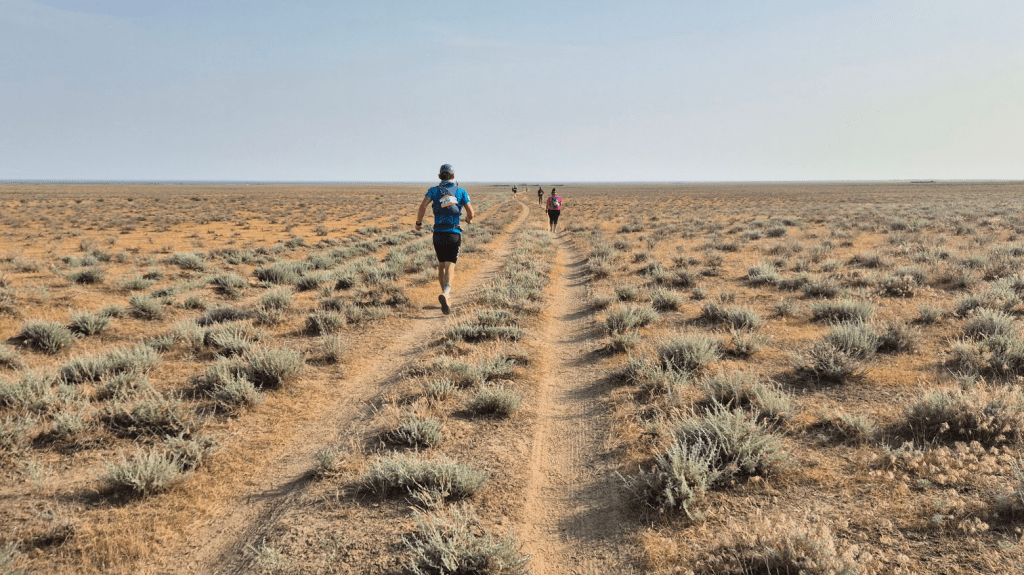
The later start was a definite advantage for me as it meant the boredom of the plains was broken up by passing the earlier starters. everyone was very friendly and encouraging as I passed them and I tried to be as friendly and encouraging as I could be. Some of these guys were going to have a VERY long day and would finish after dark.

Still people ahead of me – a very long way ahead it would appear…

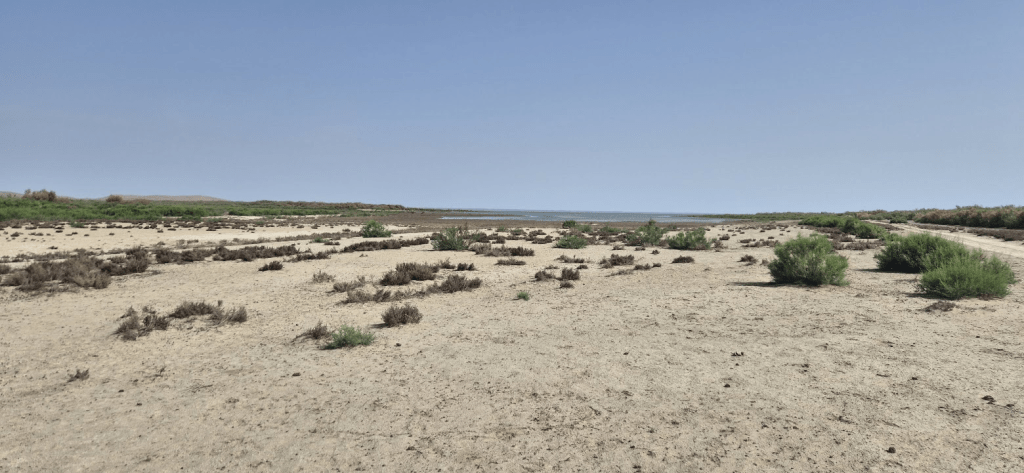
After about two and a half hours I arrived at checkpoint two by a lake, one of the few ‘features’ on the stage. However I was very sad to find Sharon sitting at the checkpoint. I expected to catch her at some point during the day but not quite so soon. She had been sick and wasn’t feeling well. It’s not completely unusual for Sharon to suffer on long stages in the heat, but given she had felt great after the previous days stage and it was still relatively early in the day, this was disappointing to say the least.

Haydar Ko’l is a natural lake located in the Jizzakh Region of Uzbekistan, and very beautiful. Due to the somewhat flat nature of the terrain it was quite hard to take a decent photograph of, so I didn’t.

Haydar Ko’l

After making sure Sharon was OK (she wasn’t but she was going to continue anyway) and topping up my water, it was back to the plains.

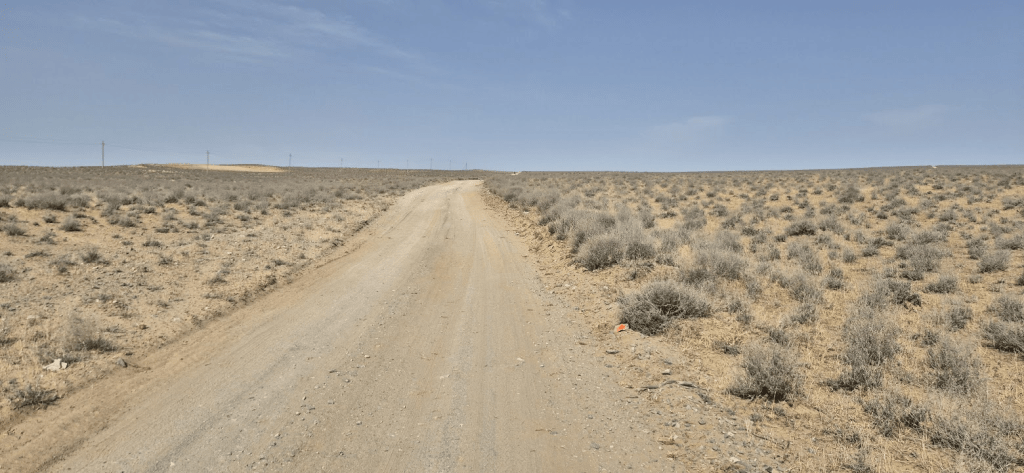
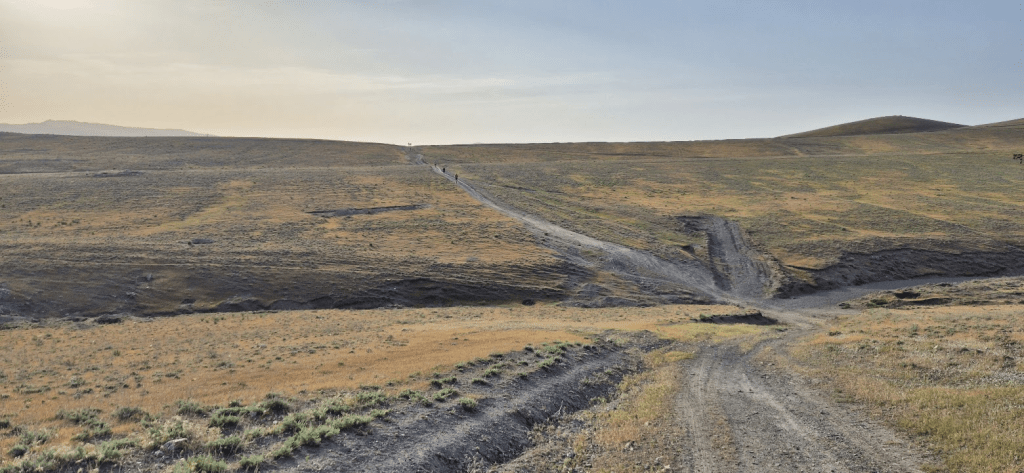
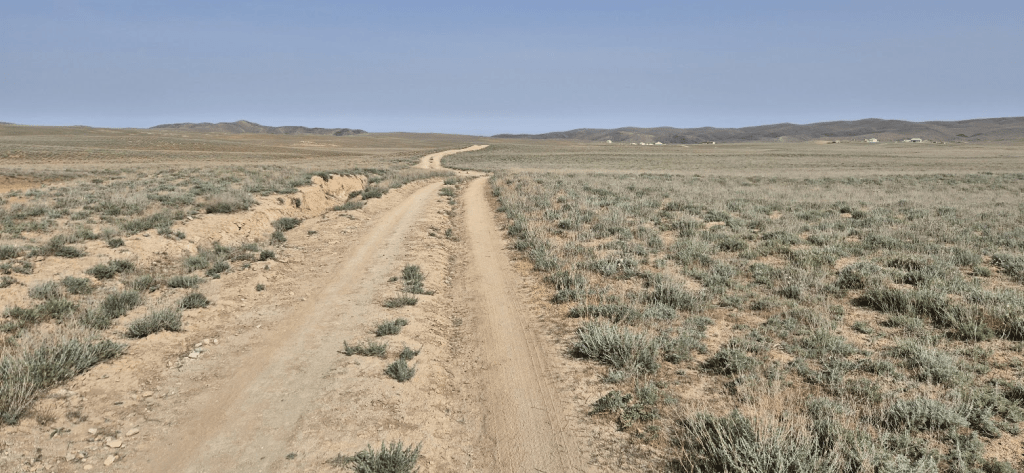
More empty track…
…and the same behind me
Hang on, there’s a village over there…

We had been told there was a shop en-route where we would be able to (hopefully) buy a cold drink.

A brief respite from the dusty tracks of the plains

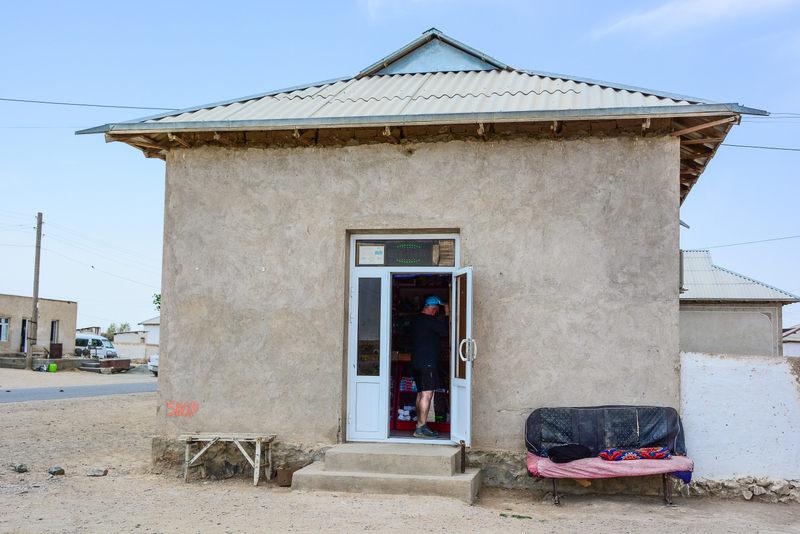
There was indeed a shop! The course marking team had helpfully sprayed ‘SHOP’ on it’s bottom left hand corner – I assume the owner didn’t mind.

The village shop
The shop was very popular – even Stefan popped in for a Pepsi! (photo credit Global Limits)

I bought a Pepsi and drank it whilst walking through the village back to the plains.

Still no-one to see ahead

I was starting to struggle a bit. It was getting very hot, temperatures of 39 degrees Celsius were mentioned. At the next checkpoint Ollie (I think it was anyway) thoroughly doused me with water to cool me down and I pressed on.

I think Checkpoint 2 is up ahead…probably

By the final checkpoint I was really struggling. I filled up my water and left when the volunteers said they could see the next runner coming in. I desperately hoped it wasn’t Peter and staggered back onto the dusty track.

By now I could hardly run at all. Every time I did I started to feel lightheaded. As there was nowhere to get any respite from the sun I just had to do a run/walk sort of thing, with the amount of run constantly decreasing.

Although the kit requirements said we had to be able to carry two litres of water, I had only been carrying one. This was the first point where I almost wished I had more. I say ‘almost’ because the water I had left was almost hot enough to make tea with and as I didn’t have any tea bags with me it wasn’t exactly pleasant to drink.

Not far into the leg the next runner caught me up. This Mike, which wasn’t so bad because, whilst he could push me down the overall standings, he at least wasn’t in my age group. He asked if I wanted to try and work with him to get to the finish but I knew by that point I was spent so I thanked him and watched him disappear into the distance. About 10 minutes or so later Harri overtook me. A couple of minutes after her it was Peter’s turn to pass me.

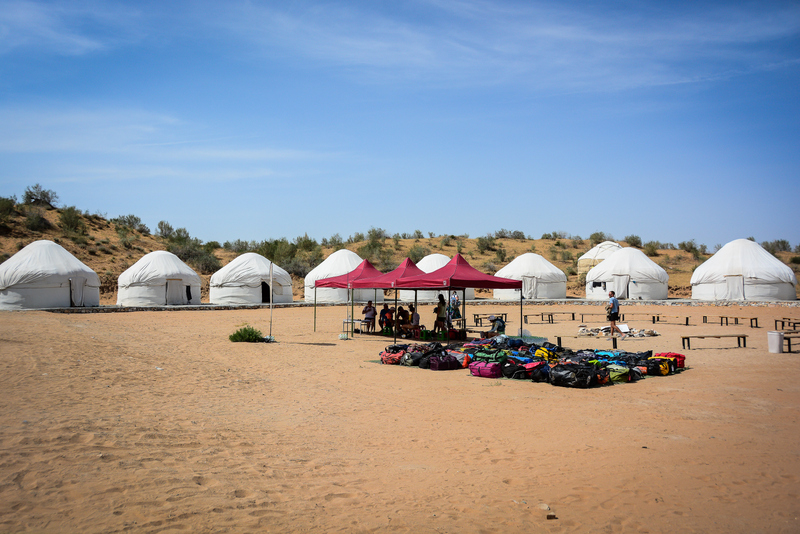
Eventually I could see the Yurt camp and made some sort of attempt to run across the finish line. I was 10th overall (two of the earlier starters had stayed ahead of me), by far my worst finishing position. The only good news was that Peter had only taken about two and a half minutes off me so I was still first in my age group.

The Yurt camp (photo credit Global Limits)

I was able to have a shower and even better, the camp had an air-conditioned bar/restaurant!

Quite a contrast to the yurts!

However, despite all this luxury I wasn’t able to relax. Sharon was somewhere out on the course and I wasn’t even totally sure if she was still running. No-one seemed to have heard she’s pulled out so I was hopeful she was still running, but I had no idea what time she would finish.

Dr. Ryan could see I was wandering around like a lost tortoise and offered to tape my feet. Just as he was about to start he was called away to a medical emergency. One of the runners (Chris Lewis, a regular volunteer on GL events and also Way of Legends) had collapsed on the last leg of the course and had hit his head. Fortunately he hadn’t sustained a serious injury, although the Yurt camp did call an ambulance – much to Stefan’s displeasure. The ambulance turned up just as Dr. Ryan was about to try and sort my feet out the second time…

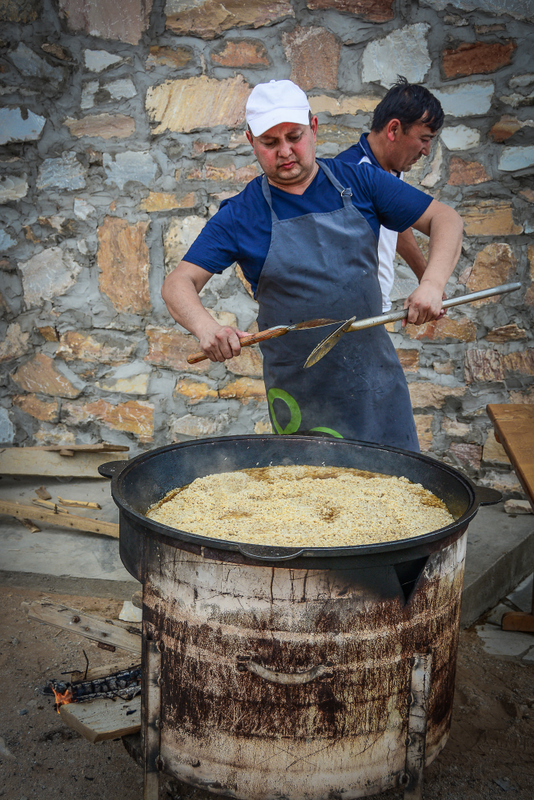
Eventually the medical excitement abated for long enough for my feet to be rebuilt. The hope was that this would last until the finish. Stefan had laid on another plov for us this night so I used some of the time waiting for Sharon to eat.

Plov! (photo credit Global Limits

Sharon finished about three hours after me, comfortably still in daylight. She had been very sick since I had seen her at checkpoint two. She had had a 30 minute lie down at the last checkpoint. She said it was quite hard to carry on as a few people dropped out there and cars were sent to pick them up. However she resisted the temptation to get in one and soldiered on to the finish. She had a shower and even managed to eat some plov.

Battered but unbowed – and trying to eat plov
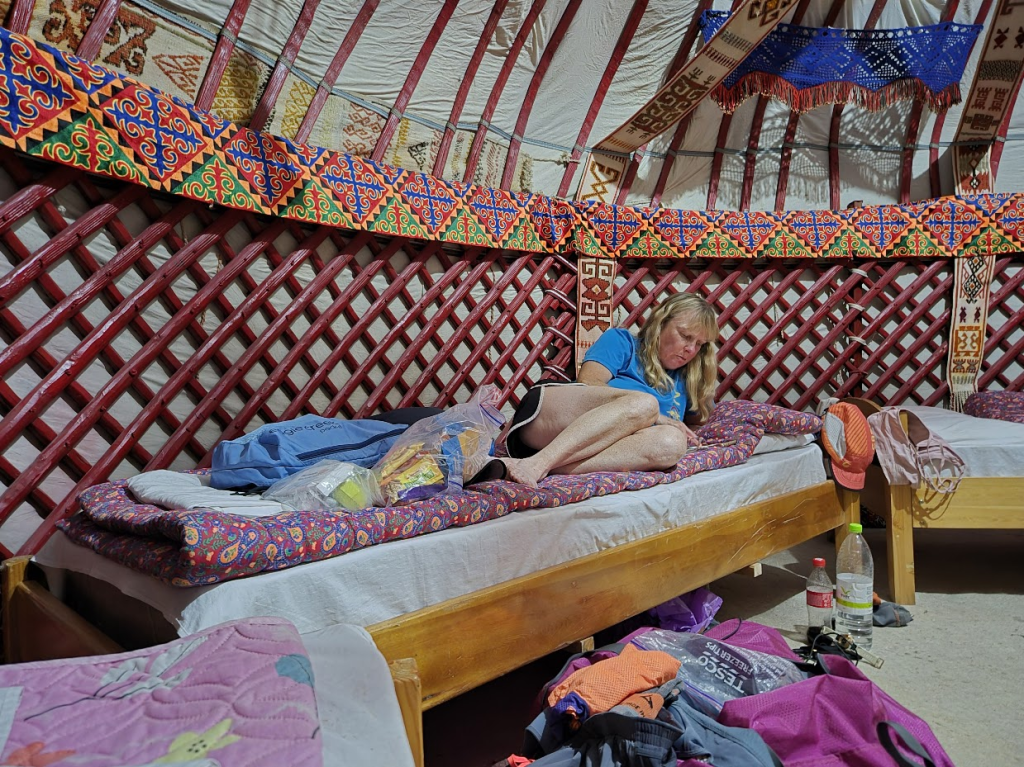
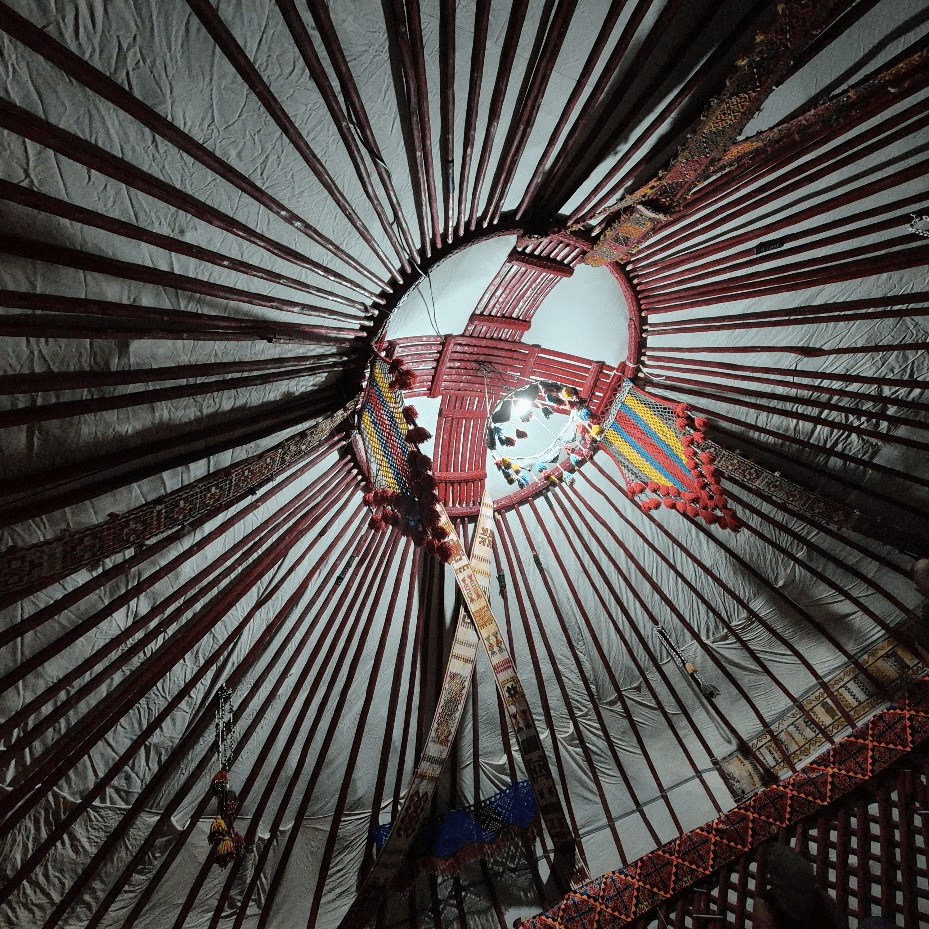
Relaxing in the yurt
Looking up from my bed

About ten people had failed to finish the stage, quite a high proportion for a Global Limits race. Frances was last to finish in 15 hours 25 minutes and 2 seconds, after dark (9:25pm) but well before Stefan’s prediction that the last finisher would be around midnight.

Camp at dusk

Day Five promised to be much like Day Four, only shorter, 38km with 390m of climb and 190m of down. Sharon wasn’t feeling great but was ready to carry on. I didn’t feel amazing but I was hoping I’d be able to keep running for 38km.

Day 5 start – leaving the yurt camp

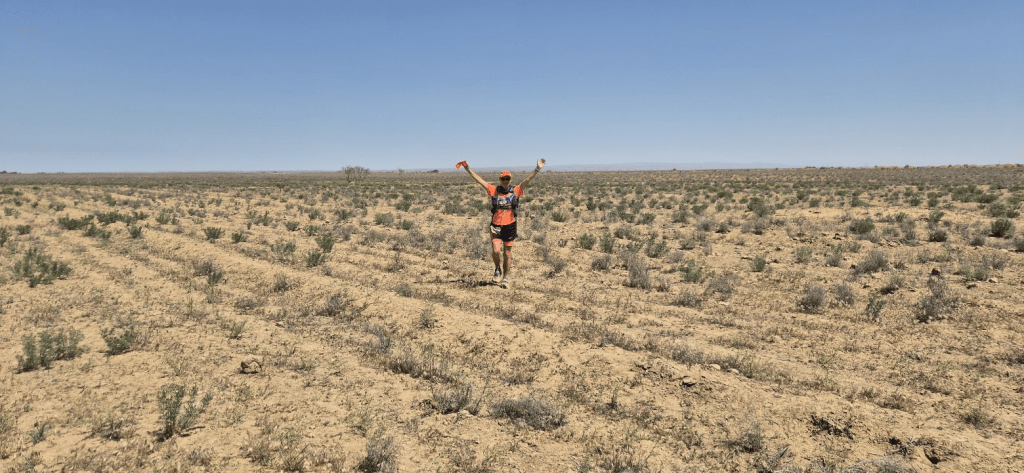
I settled into fourth place for the first few miles.

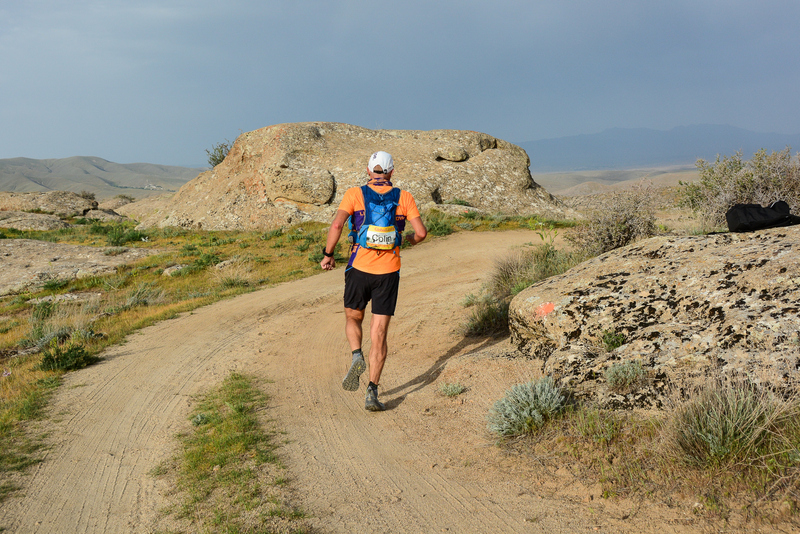
Hard to miss the orange shirt (photo credit Global Limits)

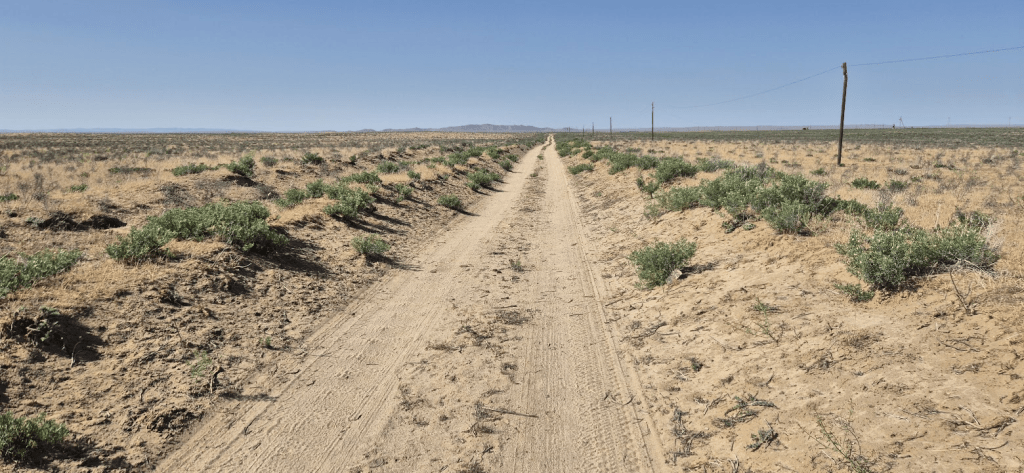
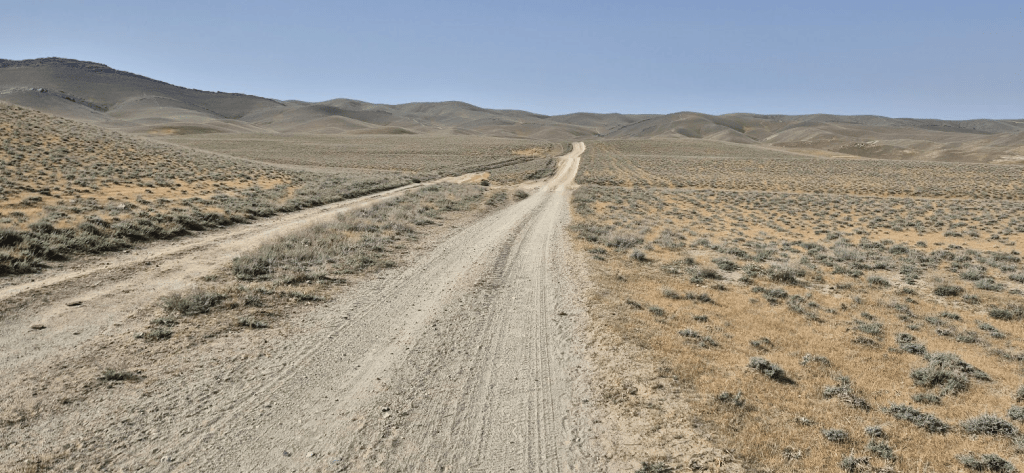
It’s fair to say that today wasn’t the most exciting day of racing I’ve ever had. I took a photo of the course…

Not a lot to see…

…and one an hour later.

…and still not much to see

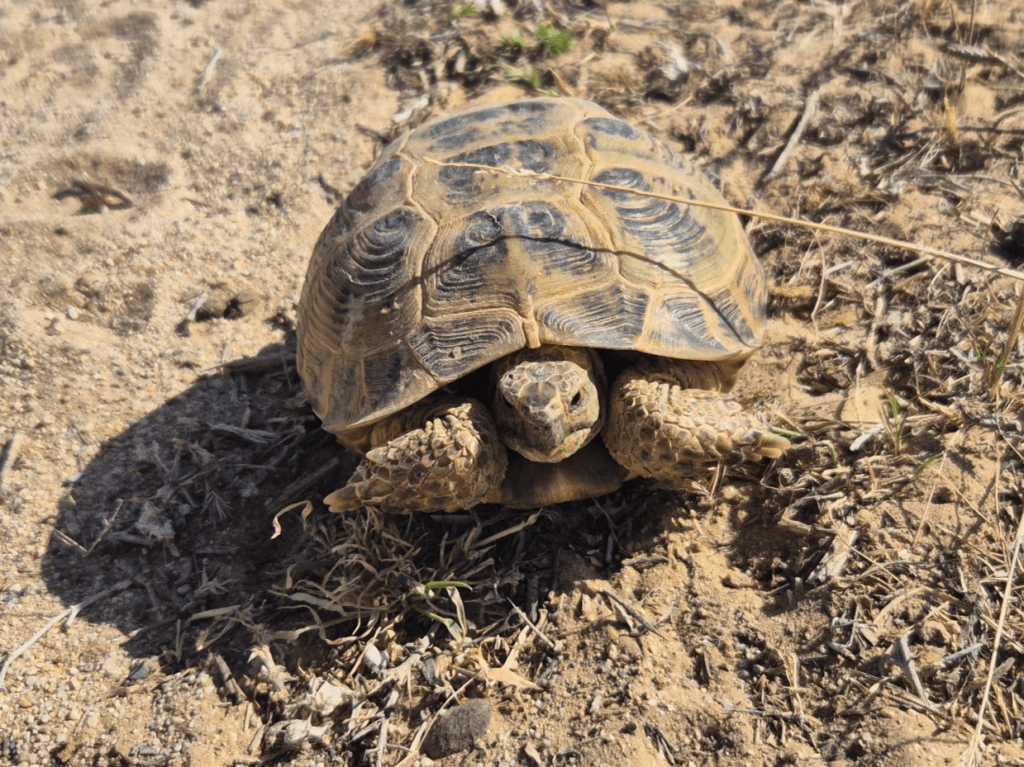
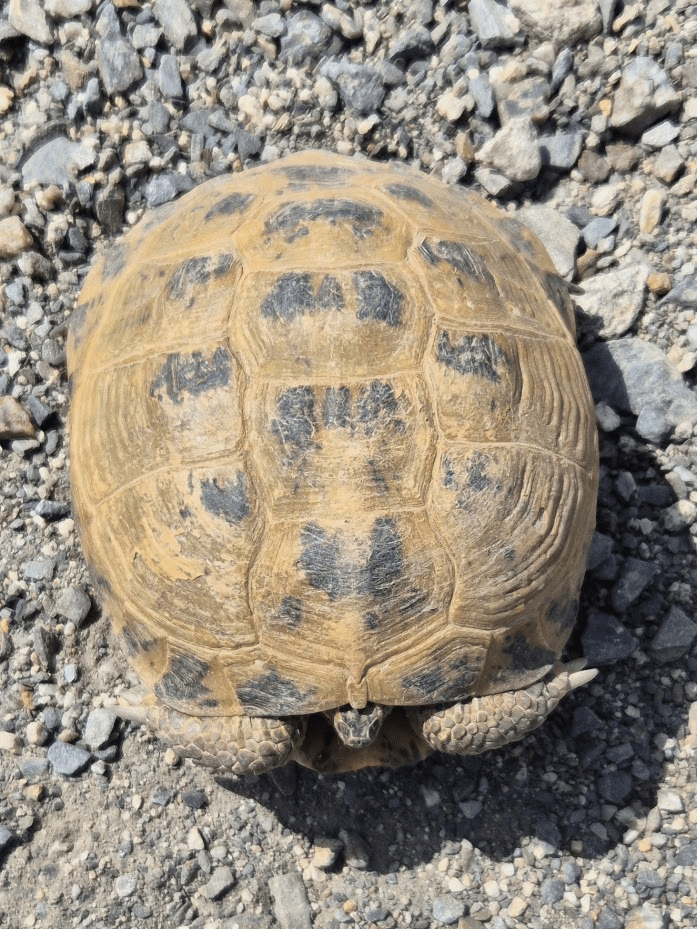
I’d love to say the scenery changed between the pictures – but I’d be lying. I did see a tortoise though.

Local wildlife

The biggest excitement was at the second checkpoint, where I had to negotiate some goats.

Uzbek roadblock

To be fair there were a couple of sections of interest – one where I managed to go the wrong way until Valentin (who overtook me for fourth place) called me back and one where I though I was probably gong the wrong way but the flags and paint were correct, it just didn’t look like a path (it wasn’t, but it was the route).

About two or three miles from the finish I heard barking behind me. I’m not sure if the dog was actually chasing me or not but I did find discover I still had the ability to hit 7:30 minute/mile pace!

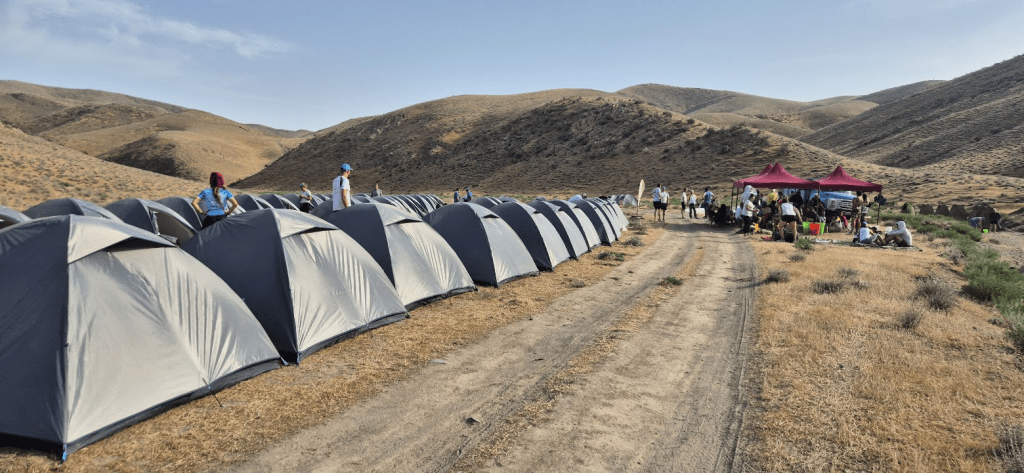
We had been told that the campsite was in a plum orchard so any group of trees was hopefully surveyed in case it was concealing the finish. When the correct group of trees came into view the course turned off onto another ‘non-path’ across a field to the finish.

Tent city

The trees provided some welcome shade and coolness but also numerous opportunities to bang ones head, which I took full advantage of. My head had taken a battering the previous night too, as I seemed incapable of remembering how low the yurt door was.

Although I felt I struggled a bit, I still managed another fifth place, about 50 minutes behind the stage winner, Bryan. Benjamin was second, Kurt third and, as previously mentioned, Valentin was fourth. Peter was tenth. I know had a 27 minute lead over Peter, which I thought should be enough to take the over 60’s male title unless the last day went badly wrong.

Sharon was still suffering a bit but managed to finish with a smile on her face.

Almost home!

The camp had a large irrigation tank we were allowed to dunk ourselves in if we wanted. Many people did but I decided against it.

Cooling off

I was just too tired to be able to summon the energy to play in the water. Plus, if I had, the dressings would have probably come off my feet and, whilst I’m sure Dr. Ryan would have redressed them for me, I was grateful for all the attention they had been given already and didn’t want to create unnecessary work for him.

Me with possibly the finest foot fixer I’ve ever had the good fortune to meet

I think one of the main reasons I found this day so much duller than the first day was the fact we all started together. This meant I spent quite a lot of the day on my own and didn’t get to say hello to the other runners in the same way. It’s only when I’m totally on my own I realise what boring person I am to be with.

Sunset across the plain

The last day was a short stage of 17km, finishing in the ancient Nur Fortress, built by (or more accurately, for) Alexander the Great in 329 BC. There was 330m of up and 190m of down. This should be fairly straightforward but I thought that about the last day of the Global Limits race in Bhutan – which had 800 steps and a section running on the edge of a water channel with a sheer drop off the side. However given the fairly flat nature of the part of Uzbekistan we were in I was hoping this really would be fairly easy.

It was made a little complicated by the fact we would pass through a very large cemetery. To respect the local culture we had to have shorts that were at least knee length, tops that covered our shoulders and we had to walk through the cemetery. I had some longish shorts but was advised that the pair I had brought as camp shorts, which were actually some very old zip-offs, would be better as they were definitely knee length.

In order to compress everyone’s finish times (there was a three hour coach journey to do after the stage) there would be three start times, 5:45am, 6:30am and 7:am. Sharon was on the 6:30 start, I would start at 7:00.

I haven’t said too much about the local support crew – they were excellent, always on the ball keeping us supplied with hot water, getting tents set up, digging latrines and probably a hundred other things we were blissfully unaware of – even Stefan didn’t shout at them much! Oh, and most importantly, they managed to supply cold beers and Cokes every evening.

Some of our local support crew – apparently the lorries came 900km for the race! (photo credit Global Limits)

I’m not sure I’d stirred out of bed when the 5:45 group set off.

Stefan making sure the early morning trailblazers were in no doubt which way to go (photo credit Global Limits)

Having seen myself in this photo, I think I should have stayed in bed…

I appear to have aged 10 years since I started! (photo credit Global Limits)

Sharon departed with the 6:30 group

Stefan making sure once again everyone knows where they are going (photo credit Global Limits)
Everyone seems to be going the right way (photo credit Global Limits)

I was left as part of a small band of people still at camp. Even Stefan had decided that the last group could be left to it’s own devices and wouldn’t need him to point it in the right direction.

After I’d dropped our bags off I picked up a few bits of litter in our tent and threw them in a bin. As I bent forward towards the bin my back did a slightly painful spasming type thing. This was worrying. None of my scenarios for the day involved me not actually being able to physically run the leg – that would mean no fifth place, no age group win and no finishers thing (Global Limits don’t do medals, I didn’t know exactly what I’d get for finishing but I knew it would be something from the country and quite nice), I’d be a DNF!

My tent was still up so I went inside and rolled around doing the back stretching exercises I should have been doing all week but hadn’t. It seemed to loosen off and I was just praying to all the deities I don’t believe in that it would be OK for another few miles.

As Stefan wasn’t there to start us, we had a ‘Who can do the best Stefan impersonation competition’ – unless Stefan is reading this, in which case nothing disrespectful happened and we just got on with it.

The last runners try and find the start line

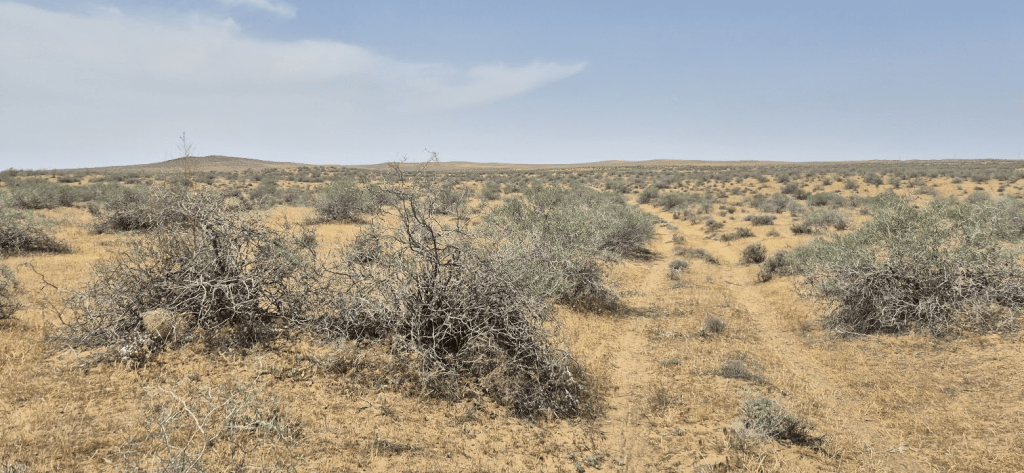
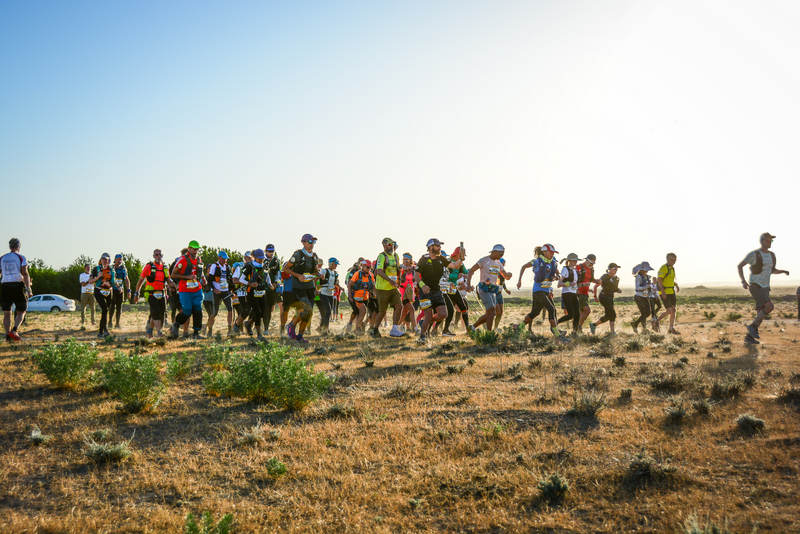
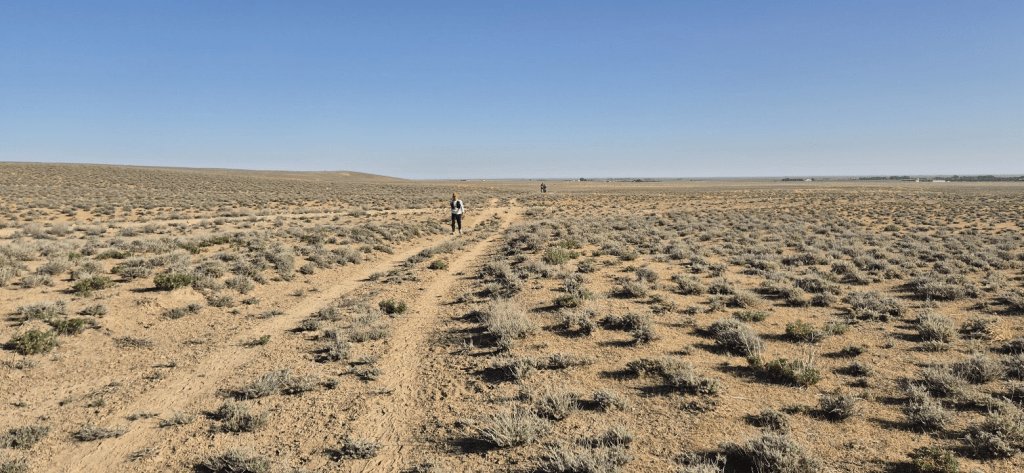
We all set off across the dusty plain one last time.

Quite similar to the last two days really

As we closed in on the cemetery I caught up with Chris. He had recovered from his episode on the long day and was running the last day with everyone else.

We are approaching something…

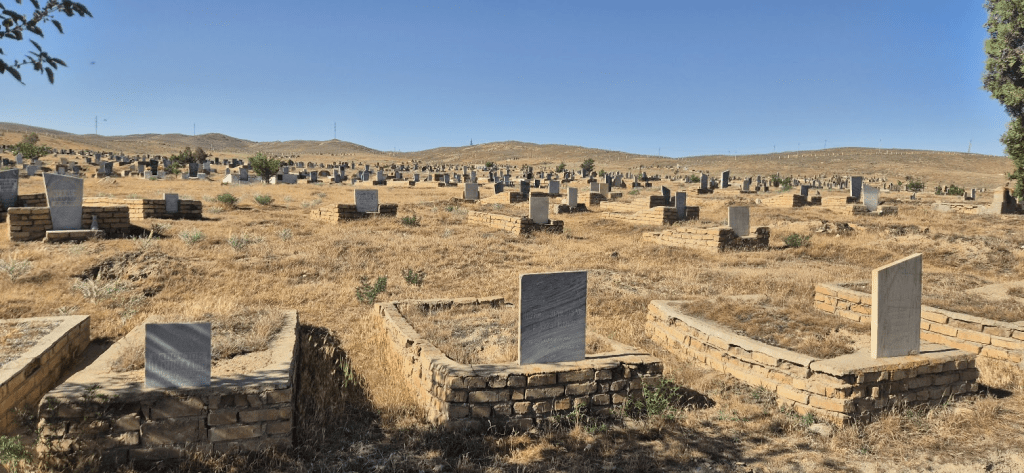
Stefan had told us that the cemetery was huge with a worryingly large amount of ‘room for expansion’ – he wasn’t wrong.

Looking in to the cemetery
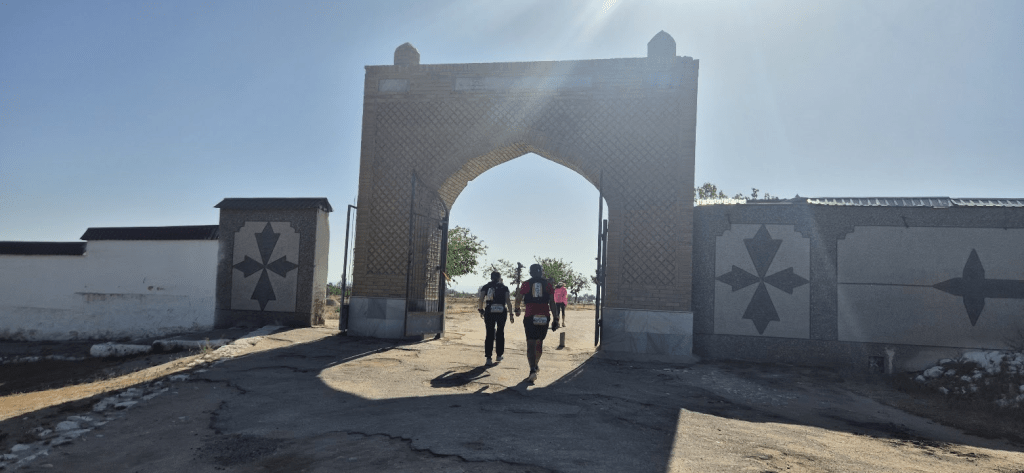
A truly terrible picture of the entrance to the cemetery but it’s the only one I’ve got
Walking through
Many, many graves

As many of you know, I like exploring graveyards but as I was still technically in a race, I restricted myself to a few photos. Whilst longer clothing was required in the cemetery we had been told it was OK to take photographs.

After the cemetery we were allowed to run again and soon something sort of familiar appeared – the gate into the fortress complex. The reason it was sort of familiar was that it was the background for our race name bibs.

The entrance to Nur

As I came towards the last few hundred metres I passed a few of the earlier starters. I quite like a bit of a sprint finish so I hope they weren’t too annoyed as I flew past them.

There was a banner at the finish line – I wasn’t sure whether to go through it or jump it so I sort of fell over it – however, I was a finisher of the first ever Uzbekistan Ultra!

Ready for a spectacular leap? (photo credit Global limits)
No, lets sort of stumble over it instead (photo credit Global limits)

Sharon was already at the finish when I arrived – she had a much more stylish finish line technique apparently.

That’s how you do it! (photo credit Global limits)
Better second attempt under supervision
The Class of ’25
My worthy opponent Peter

We had a small amount of time before lunch and the bus back so we had a quick look round the fortress.

The finish line with the fortress in the background
View from the fortress
We didn’t go up there

After a lunch we had a long coach journey with a driver who was surprisingly reluctant to make toilet stops until we arrived at Bukhara. Our hotel was in the old town so we had to walk the last 100m while our bags were transported on small buggies.

The final leg to the hotel
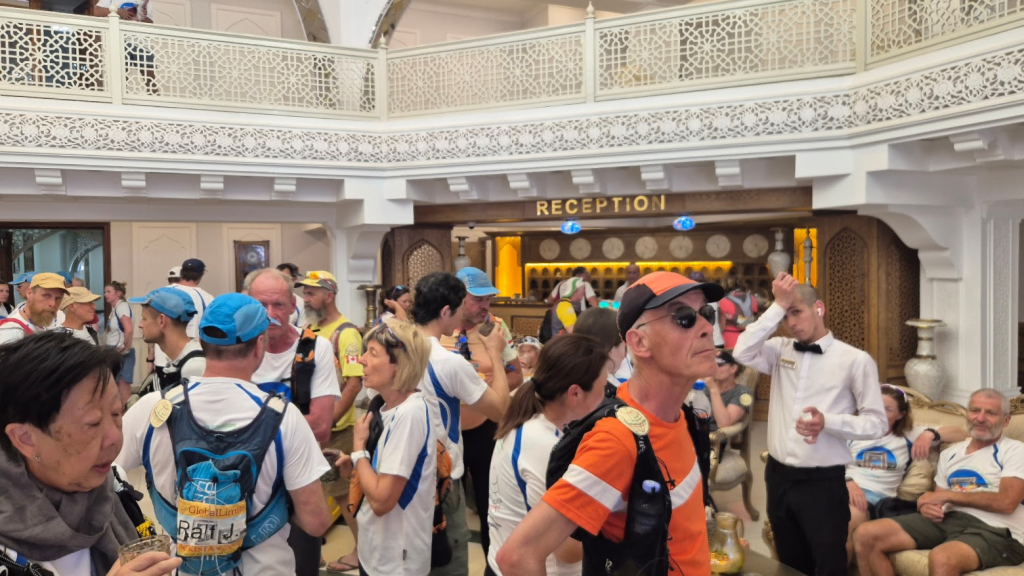
The hotel was slightly overwhelmed by over 100 people all trying to check in at once!

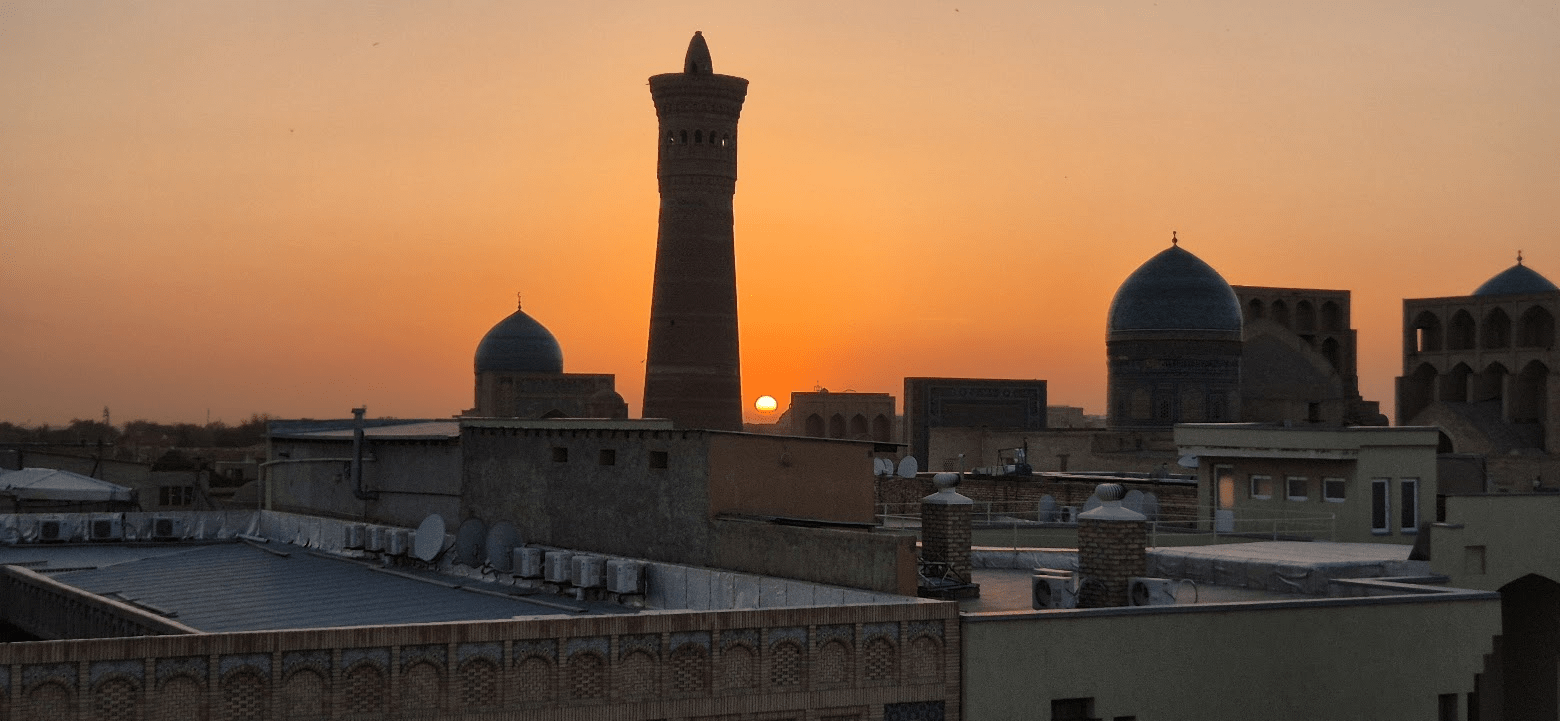
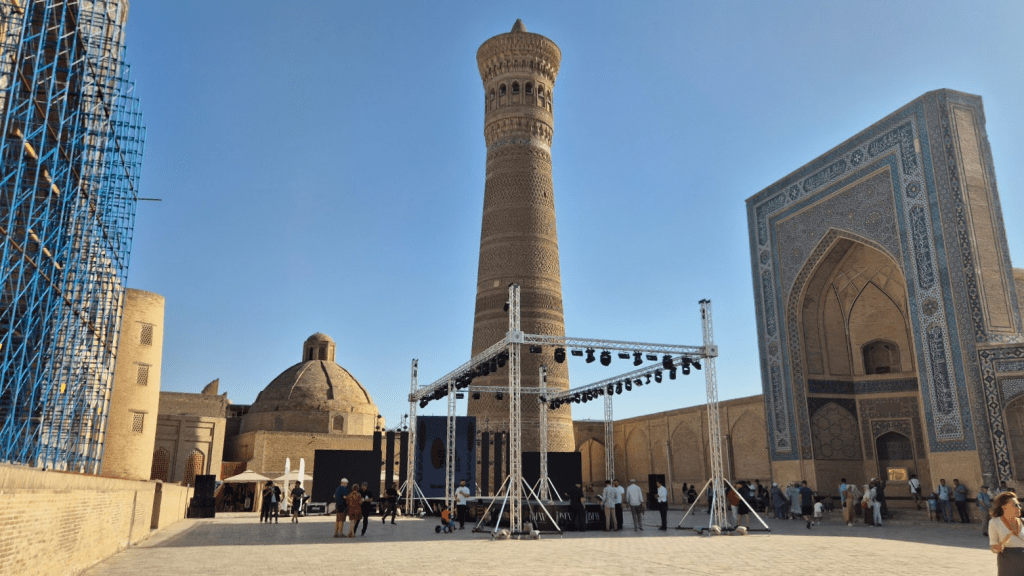
After about four changes to our return flight, we were having to leave Uzbekistan the very next day so we went out for a quick look around Bukhara. I took some photos, not entirely sure what some of them were of but it all looked very nice.

A nice building
Interesting rooves!
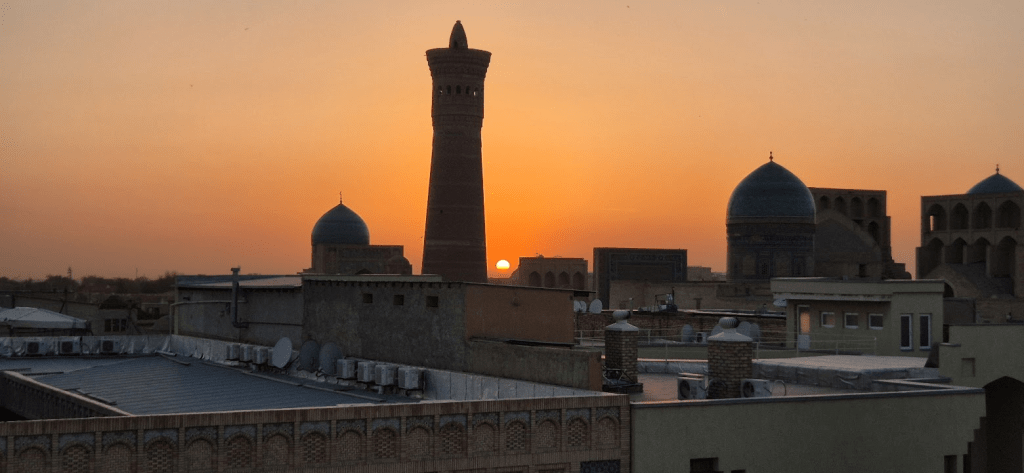
A big tower – minaret?
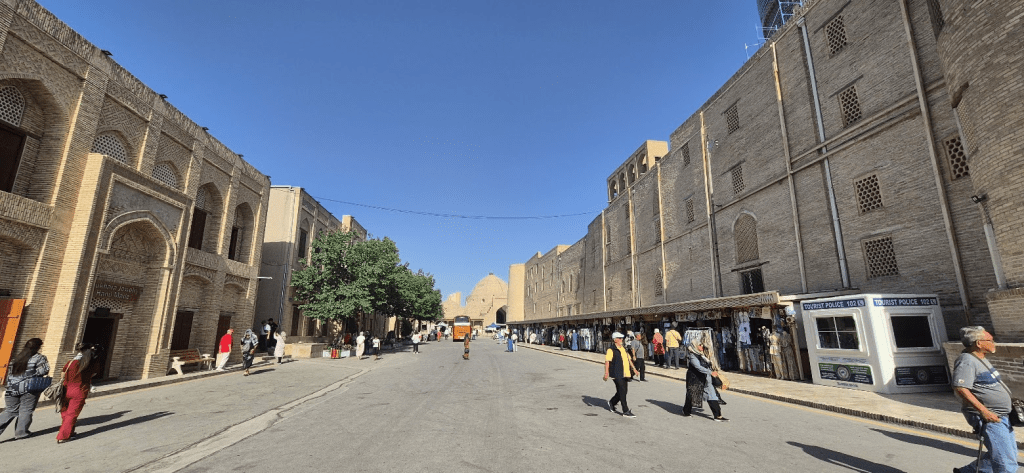
Street in the old town

All that was left was the final dinner and prize giving. This didn’t occur in quite the order it was supposed to but – apart from Stefan berating the bar staff for not having enough beer in the fridge – it all seemed to work.

The final dinner

After the meal we went outside for the prize giving. Normally everyone is given their medal individually but due to the numbers of people only overall and category winners had presentations. I had kept my fifth place and my male over 60 prize so I had a presentation.

First MV60 (photo credit Global Limits)

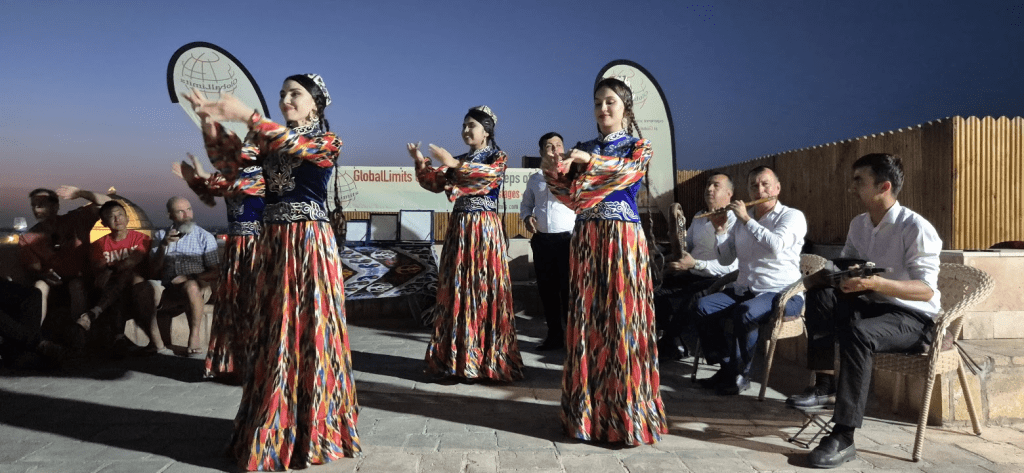
We also got to see some local dancing and a great sunset.

Uzbek entertainment
Not a bad sunset

This is the bit where I give my thoughts on the race…

Am I happy I did it? Yes, Uzbekistan was amazing, it was great to be part of the first ultra race in the country and the people were so friendly. The mountain scenery was stunning, the plains were impressive for there sheer size, although, it has to be said, a little repetitive to run across.

The race was hard. I don’t do that many big stage races these days, and when I do I seem to end up racing. This race gave me something extra to race for in term of an age group prize. Not everyone understood why I was pleased that I had genuine competition in my age group. It means I feel I earned my prize. Although I beat Peter in the end it is interesting to note that on the two hardest stages, the first and the fourth, he beat me.

Would I recommend the race? Yes, provided you have the mental capacity to deal with the plains – and the physical capacity to deal with the heat of the plains. The country is a wonderful place with fantastic architecture and mountains. The people are friendly and welcoming and, I think, find us quite novelty once you leave the cities. The organisation is excellent and the local team very efficient. I would say do it sooner rather than later while Uzbekistan isn’t a major tourist destination – it has everything to make it a ‘must see’ country.

Obviously a big thank you to everyone involved in putting this race on. A special thank you to Dr. Ryan, I really thought it was game over after what I did to me feet on the second day. I should also give Sharon a mention. We worked well together in camp and looked after each other. It was very sad she became ill on the fourth day or she too could have won her age group – she was on course to do so after the first three days. However she is tough and didn’t give up and finished in a very respectable 37th place overall and 12th female.

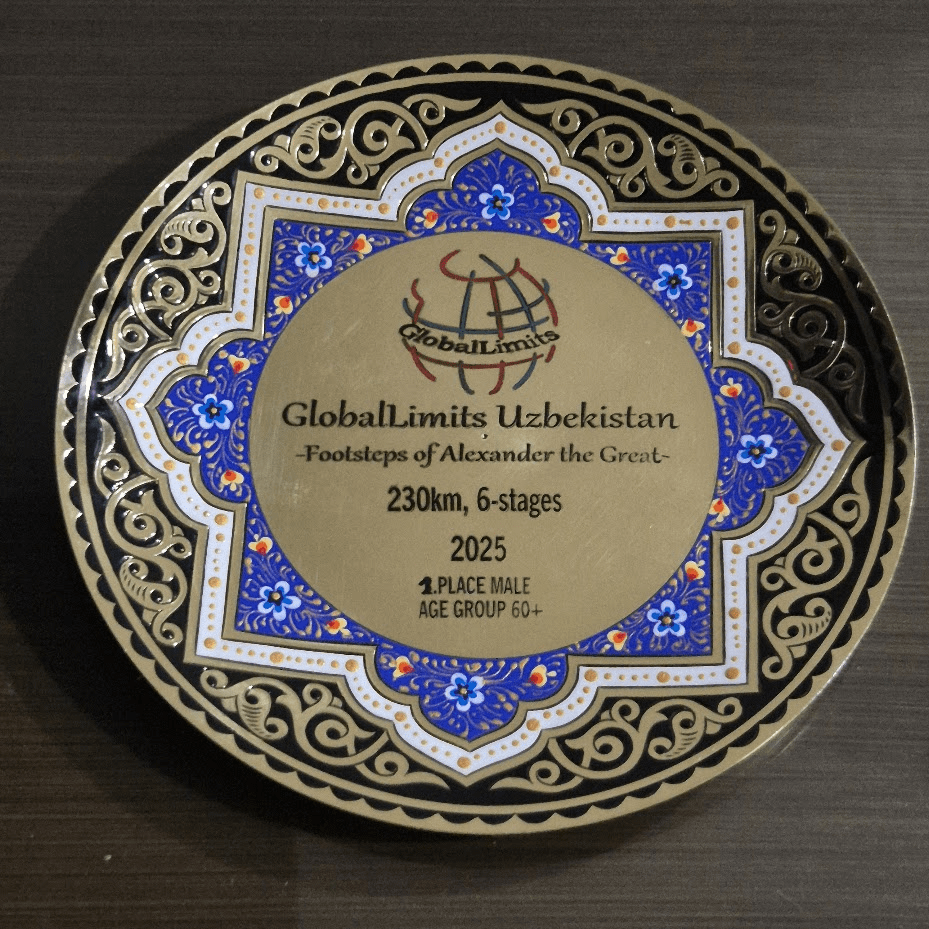
Beautiful trophy – hard earned!

The reason this episode of my blog has been delayed is because last weekend I was back on the Pennine Way with Sharon. We did a little recce from Middleton-in-Teesdale to Dufton. In a little over two weeks time we will be back for the Spine Summer challenger North. I suspect there will be a blog entry about it – once again the Only Way will be Pennine!

In the Footsteps of Alexander the Great – in the Mountains

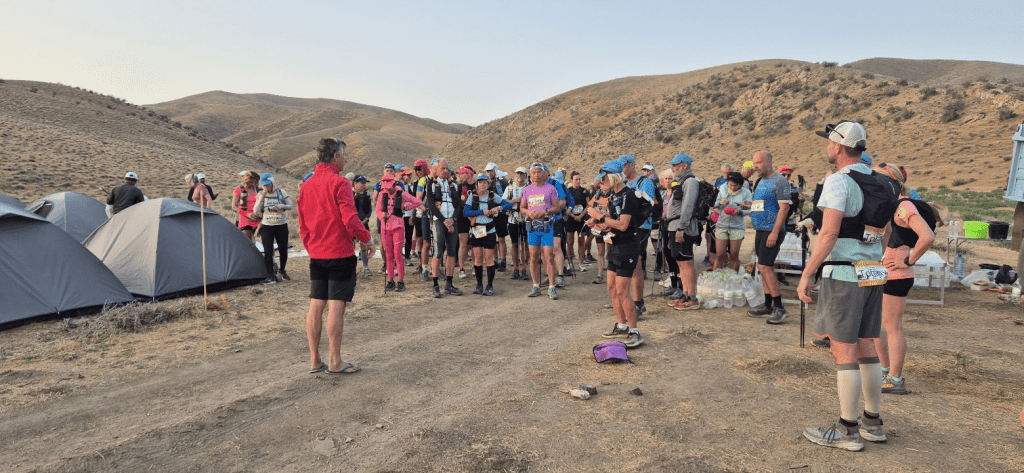
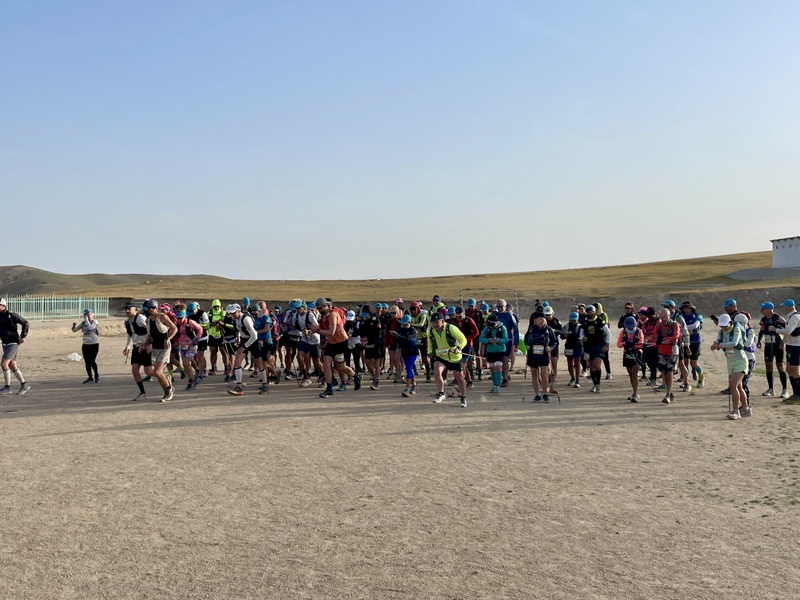
Now everyone knows more about Uzbekistan than they probably wanted too, its time to talk about the race! We all assembled on the start line at 6:45am for the final briefing and Uzbekistan National Anthem, and at 7:00am the first Global Limits ‘Uzbekistan – In the Footsteps of Alexander the Great’ race started!

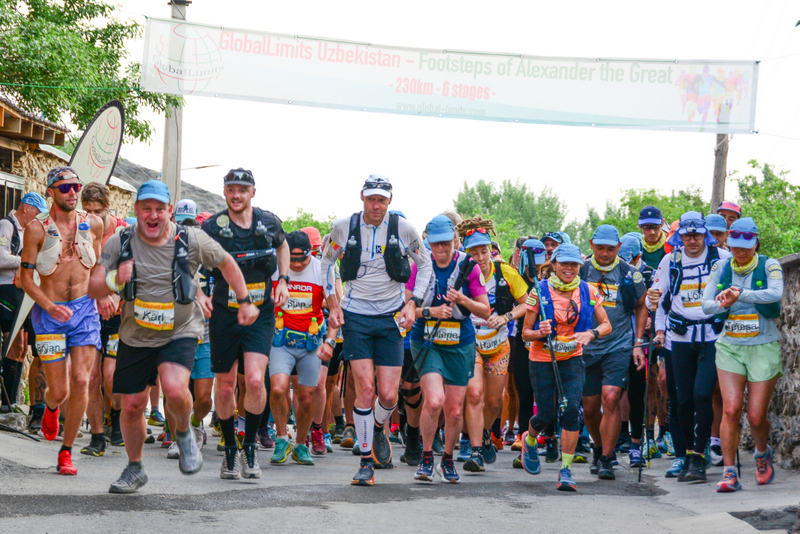
And we are off! Very enthusiastically in Karl’s case (Photo Credit Global Limits)

Stage One was 32km with 1790m of climb and 900m of descent according to the roadbook. I tried not to start too far forward but ended up towards the front anyway as the race soon settled down. I was trying not to go too mad at the start but after a few hundred metres Peter came trotting past me. I wasn’t expecting to be able to stay with him all day but I thought maybe I should wake up and not let him get too far ahead.

More or less cleared the water jump (Photo Credit Global Limits)

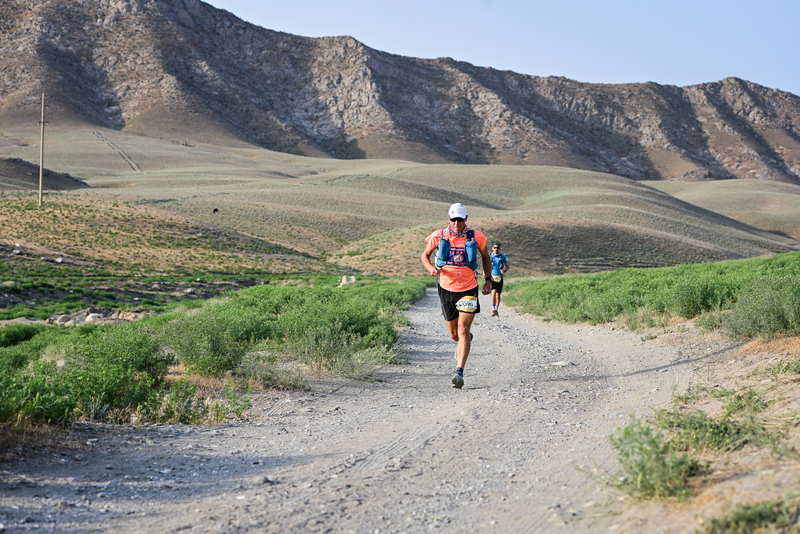
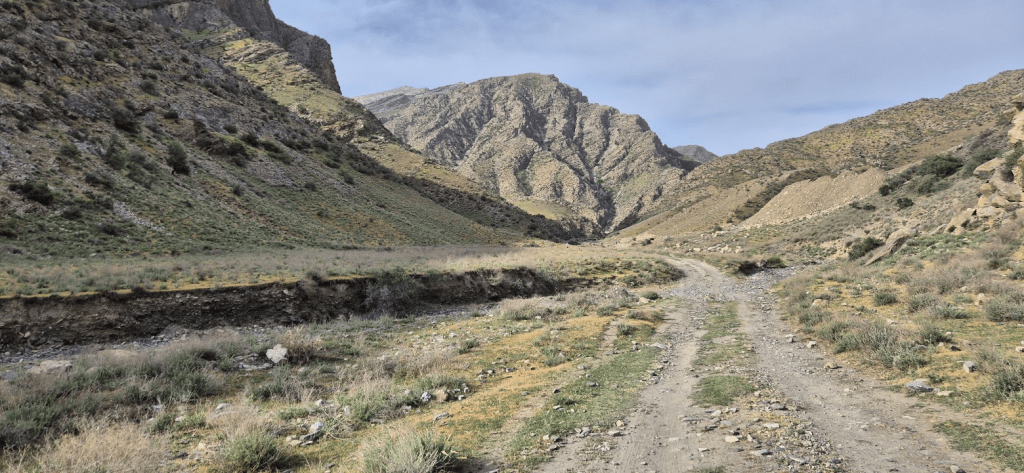
The mountains of Uzbekistan were very pretty and quite unlike others I’d run in. The paths were also very runnable. Obviously I couldn’t simply follow the clear and obvious marking and after about four and a half miles I managed to miss a very large arrow pointing me from one trail to another. Fortunately I noticed the lack of markings and quickly doubled pack to pick up the correct route again.

Great mountains and runnable paths – what’s not to like?

I was pretty happy all in all. Although the scenery was very different to Fuerteventura (there was a lot more greenery for a start) the trails were not dissimilar. As many of you will know, I have been running on Fuerteventura for nearly 12 years and have done, I would guess, about at least 2000 miles out there so although I’d never been to Uzbekistan before, much less run there, it felt kind of familiar.

Such a nice place to run!

By the first checkpoint the long uphill section had started. I had brought my poles along specifically for this stage and after about nine miles I deployed them. They definitely helped as I was now keeping pace with Kurt Dhont, a great runner and winner of the Paris – Roubaix Espoirs in 1994. This is the ‘Under-23’ version of the Monument classic Paris–Roubaix bike race. Fortunately the fact he won in 1994 meant he was now 54 and so I wasn’t racing him for my age group trophy. I did occasionally spot the person I was racing, Peter, up ahead but I couldn’t get any closer to him, indeed he was gradually increasing his lead over me.

Clearer skies would have been nice but still a great view

After about 14 miles I was a little confused to see another runner ahead of me in a blue shirt. Kurt was in white, Peter was in black, so who was in blue? After several miles I caught up with the mystery runner and found it to be Valentin Mayr, a young Austrian. He had be quite away ahead when he missed a turn. He re-joined the course not far from where I first saw him, hence his sudden appearance.

Unspoilt countryside

With less than two miles to go I caught up with Valentin and passed him. With less than a mile to go I could see the camp by a lake – the only question was how far round would I have to run before the course would turn towards the camp.

The first camp is just visible on the far side of the lake

Suddenly Valentin was behind me telling me to get a move on as we could get in in under four hours. I had kind of realised this was vaguely possible a while ago but since I thought anything under five hours would be good for the day I had settled for ‘around four hours’. However with Valentin’s encouragement we did indeed get in in under four hours, 03 hours 58 minutes and 22 seconds officially. This was good enough for a surprising joint fifth place with Valentin. Bryan Gensits of the USA was first in 03:32:10, Benjamin Rodgers of Great Britain was about 5 minutes behind him, Kurt was about 15 minutes behind him, a couple of seconds ahead of Peter. The good news for me was that Peter was only 5 minutes and 16 seconds ahead of me, reasonable damage limitation I felt. Michael Traub was next 17 minutes later.

The only ‘village’ for miles around! (Photo Credit Global Limits)

I took advantage of the lake to clean the dust off my legs. Other’s went somewhat further and had a complete bath/swim.

Stephan seemed to enjoy his dip in the lake (Photo Credit Global Limits)

Sharon finished about an hour and a quarter after me in an excellent 23rd place overall and 8th female.

Our accommodation

The lakeside setting was beautiful and fairly insect free. This may have been due to the fact that it appeared to be home to approximately three million frogs, every single one of which had much to say for itself. I didn’t see any but I heard loads. In Bhutan Karl and Aaron had had an incident which involved evicting a frog from their tent. I did suggest they could put their knowledge of frog eviction to good use but we came to the conclusion that by the time they’d evicted the last frog then a) the first ones would have come back and b) they would still be there when the camp became the first finishing point of next years race.

The following day I got up with my Garmin telling me I’d had an excellent nights sleep. to be fair it wasn’t bad, the earplugs reduced the sound of the frogs to something similar to a dodgy air conditioner in a slightly run-down hotel, but I wasn’t sure it had been as good as Garmin thought.

We had been briefed about the stage the previous night. I had also checked the route profile and it was overall quite a lot of down. According the road book Stage Two was 38km long, 830m of ascent and 1650m of descent. I was hopeful of doing fairly well as I felt good and, whilst technical descents tend to slightly terrify me, I’m OK at running fast downhill on any sort of reasonable track, another legacy of the miles spent running on Fuerteventura.

Day Two start – I started a bit nearer the front today

After leaving the lake the course was almost straight into a very long steady downhill section.

Early morning downhill

I wasn’t as fast as Bryan and Benjamin but I was holding my own with Kurt and Valentin. By my standards I was positively flying – I saw four miles go by in 29 minutes, according to Strava my third mile went past in 6:51 minutes! The underfoot conditions were good but there was a layer of very small gravel over most of the tracks, which caused a tiny bit of shoe slip. This meant my heels were getting a bit sore but I was sure it would be fine and carried on as fast as I could…

Third place at this point and loving life! (Photo Credit Global Limits)
My best side (Photo Credit Global Limits)
Just awesome!

The day also had some not inconsequential climbs. I had decided to leave my poles behind to have the minimum of encumbrance on the downhill sections. I still think this was the right choice but it did make the uphill sections a little more challenging.

One of the villages we passed

The route passed through a few villages and so I passed quite a few Uzbek people. Although I couldn’t really talk to them I smiled and waved, and they all smiled and waved back. As these villages were well outside the normal tourist spots, we may have been the first foreigners some of the people had seen, certainly I noticed that many of them took photos and videos on their phone.

I finished in fifth place in a time of 3 hours 47 minutes and 43 seconds, less than half an hour behind the stage winner Bryan. Benjamin was second, Valentin third and Kurt fourth. Michael was sixth and Peter seventh. I had finished fourteen minutes ahead of Peter and was so leading the MV60 category. The stage had been 6km longer than Day One but had taken me just under 11 minutes less time to complete. I had been fast – but at what cost?

This was revealed when I took my shoes off. My heels were very sore. The skin on my right heel had split and was hanging off. My left foot was better – the skin hadn’t actually split- but not much.

Sharon finished about an hour and a half later, 24th overall and 6th female. As I couldn’t really see the base of my own heel (and I didn’t have the nerve to try and take a picture) I asked her to have a look and see if she could tape it up for me. The look on her face suggested my feet were a bit grim and whilst she agreed to tape them up, she called Dr. Ryan over first to get some advice. At the race briefing we were told it wasn’t the job of the medics to fix our feet but they would advise us how to do it ourselves. We had got our selection of tapes and wipes out but after surveying the damage Dr. Ryan offered to patch me up himself. I cleaned my feet as much as I could with some antiseptic wipes and sat with my feet up for an hour while the raw flesh dried out a bit.

Dr. Ryan returned to our tent with his medical bag and set about cutting the obviously loose skin off my heels. Although we had a fairly decent set of medical stuff, he had two vital ingredients we didn’t have. One of those was a pre-tape spray to make the tape stick better. The other, and the most important was Second Skin, hydrogel squares to protect and cushion the damaged areas. I’ve looked up this product since I came home, it’s 95% water. The other 5% is pure magic. Dr. Ryan stuck the squares over my heel and then taped them in place. He then put a layer of KT Tape over the top to provide more protection for the damaged area.

After he had treated both feet, I put a pair of socks over the tape and put my sandals on (socks and sandals, at that moment I was truly a Brit abroad). I stood up. I walked around. There was no pain. Not almost none, not a little bit, if I didn’t know what state my feet were in I would have assumed they were uninjured! Note I hadn’t taken any pain relief, the repairs were genuinely that good!

The village we were in – I don’t know its name

Our camp that night was on the sports ‘field’ of a village school. The school children found us very interesting and, like all small children, slightly funny.

The campsite at the end of the second day (Photo Credit Global Limits)

The next morning was quite chilly. Because the only way to get to most of our camp grounds was along a similar route to the one we were running, our bags had to be dropped quite early and we had to be out of the tents, in order to give them a chance of arriving before us. I went and stood by the stove that provided our hot water in the morning to try an keep warm until it was time to start.

Day Three start

The third stage was 41km with 1430m of climb and 2020m of descent. Looking at the profile, it was hard to believe there was that much climb but Stefan assured us it was so – however I think most of us recorded less climb. Ordinarily I would have looked forward to another day of down, but would my heels?

5 minutes in and all is well (Photo Credit Global Limits)

The day followed a similar pattern to yesterday. Bryan and Benjamin took off and I managed to stick with Kurt and Valentin for the first hour or so until they pulled away from me.

Looking back at the chasing pack
Dropping back
All alone

The first 17 miles was undulating, no really big climbs or drops.

Very alone

After around 17 or 18 miles, the days big descent started into the valley we would be camping in that night.

Into the valley

Dr. Ryan was at a checkpoint in the valley. He commented I was running well but he noticed I was more on my forefoot. He was absolutely right. Whilst my heels were OK, in order to try and protect them I had altered my downhill running gait slightly to try and land a bit more on the ball of my foot and reduce the impact on my heels.

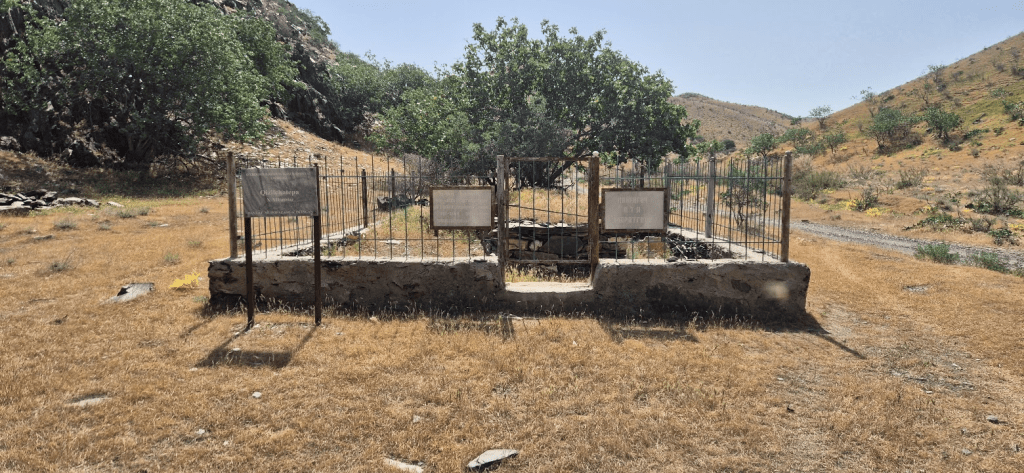
Either some sort of shrine or a killer tree

Quite surprisingly I passed a small enclosed area on an otherwise seemingly remote track. It seems to translate as Redhill 10th – 12th century. I’m guessing it was some kind of shrine.

Deep in the valley

I was on track for my third sub-4 hour day. However some things are more important than times. We had been told the tortoise was a native wild creature in Uzbekistan. Up to now I hadn’t seen one. however I almost tripped over one trying to cross the road so I just had to stop and photograph it.

My first tortoise!

Despite the tortoise, I still finished in just under four hours and again in fifth place, 35 minutes behind Bryan in first. Benjamin was second, Valentin third and Kurt fourth. Michael was only five minutes behind me in sixth, and Peter a further two minutes back. Sharon was still going well, 20th overall on the day and fourth female! Our campsite tonight was quite compact but was the only flat piece of ground in the vicinity apparently. It did feel very secluded as we were in the valley.

The campsite at the end of the third day

I had spoken to Dr. Ryan about my feet. He told me to take the dressings off and wash them and he’d see how they were doing. I used a trick I learned on the MDS. You take a water bottle and cut it in half length ways. This makes two ‘baths’ you can put your feet in and fill with water to get your feet clean. Global Limits use a ‘three bucket system’ to try and minimise the spread of germs. After using the toilets or before touching any communal things like the hot water flasks, you wash your hands with soap in the first bucket, rinse in the second, and then rinse again in the third, which contains a small amount of disinfectant. Sharon borrowed the soap for me and so I was able to present Dr. Ryan with some very clean feet to work his magic on.

At the end of Stage Three – a bit battered!

Reassuringly, Dr. Ryan didn’t think my feet had deteriorated at all compared to the previous day. They had been a slightly uncomfortable by the end of the day but nothing to painful. My slight concern was that my calves were very tight due to my attempts to run more forefoot, but nothing felt actually broken.

With my feet rebuilt and dinner eaten, there was nothing to do but try and sleep ready for Day Four, the big one, 40 miles across the plains of Uzbekistan. This promised to be a very different experience to the one I’d had so far…

In the Footsteps of Alexander the Great – Uzbekistan, a brief introduction..

Sometimes I find myself running a very long way away from the Pennine Way. Not at all Spine related but as I was privileged enough to find myself running the first ever ultra race to be staged in Uzbekistan I thought it was worth a few words…however I don’t really do a few words so we are starting with an introduction to Uzbekistan…

When global Limits announced a race in Uzbekistan, it raised a lot of questions. The first one being, where is Uzbekistan? Central Asia, it was part of the Soviet Union until independence in 1991. It is also one of only two double-landlocked countries in the world (i.e. you have to pass through at least two other countries to reach the sea in any direction). For future pub quizzes, the other is Lichtenstein. Uzbekistan has a population of 36 million, of whom 96% are Muslim.

Location of Uzbekistan

In 327 BC, Macedonian ruler Alexander the Great conquered the Persian Empire provinces of Sogdiana and Bactria, which contained the territories of modern Uzbekistan. He built (well, had built, it’s unlikely he did all the work himself) the Fortress of Nur, located in Nurota, Uzbekistan, around 2300 years ago. The fortress was built to defend the settled lands from nomadic invaders to the north. This would be the finish line of the race.

Samarkand (our first destination in Uzbekistan) was on the Silk Road, a network of Asian trade routes active from the second century BCE until the mid-15th century, and grew rich from trade.

Timur, also known as Tamerlane ), was a Turco-Mongol conqueror who founded the Timurid Empire in the 14th Century. Its capital was Samarkand, which became a centre of science under the rule of Ulugh Beg, giving birth to the Timurid Renaissance.

As it says – Amir Temur

The first question everyone asked when I said I was going to Uzbekistan was, is it safe? There is a slight tendency to assume that any country that ends in -stan is a bit dodgy. We were assured it was by Global Limits, and as they had actually been there to plan the race, we took their word for it. How do we get there? Fly with Turkish airlines via Istanbul. Actually, getting there wasn’t too much of a problem, getting back was more challenging due to several flight cancellations and changes. There were other issues with leaving the country too but more on those much later.
So anyway, we signed up. Then Sharon noticed one of the days was 40 miles and possibly wished she hadn’t. This race was slightly different to other Global Limits adventures in that there were about 100 people signed up for it, compared to the 50 or so the races usually had. This was due to the speed people were signing up, 100 places were booked in 100 hours!

As is usual with these kinds of adventures, I signed up first and then had a look to see what it was I’d actually signed up for. I knew the headlines, 230km over six days, but what about elevation, and how was the distance divided across the six days?
It looked like it would be a race of two halves. The first three days were to be spent in the mountains, with some serious elevation gain on the first day, followed by two days that were predominantly downhill. The fourth day was the previously mentioned 40-mile stage, which would see us leave the mountains and move onto the hot and dusty plains of Uzbekistan. Day five looked similar but a bit shorter, and the last day was the traditional ‘short’ (~11 miles) leg to the finish – the previously mentioned fortress of Alexander the Great at Nur.

Getting to Uzbekistan was fairly straightforward, we flew from Gatwick and changed at Istanbul. We met Marilena – a multi-day legend from Venezuela – at Istanbul. For any future travellers do NOT simply ask for a glass of wine at the airport – unless you think the equivalent of £75 for three glasses of wine and a bottle of water is reasonable!

Immigration and customs went without a hitch, and we were met by Stefan, the race director, outside the airport and put on a coach to transfer to the hotel. Due to the time shift and flight times, we had kind of missed a night and arrived at the hotel at about 8:30am, too early to check in but in plenty of time for our 9 ‘o’ clock city tour. We met various people we knew and that were on the tour with us, having lost a night’s sleep at this point I find it hard to remember who was on the tour with us. One I definitely remember was Hannisze. She is the partner of Argy, a super-talented Greek runner I notionally raced against at the Way of Legends, and a brilliant photographer, so I knew we would have some great race photos.

I won’t go into details of the city tour, just to say it was really worth doing and Uzbekistan has some stunning architecture, I’ll let the pictures do the talking. Whilst the Mosques, Madrassas and Mausoleums were very impressive, possibly the most significant site for me, as an engineer was the observatory of Ulugh Beg, built in 1428.

Registan Square
One of the ornate ceilings in a Mosque
Hard to photograph but the interiors are very ornate
Ulugh Beg Madrassa
The entrance to the Bazaar
Inside the Bazaar
Water powered Paper Factory
Ulugh Beg
The remains of the Sextant

Lacking telescopes to work with, he built a huge sextant, the so-called Fakhri sextant. It had a radius of about 36 meters and the optical separability of 180″ (seconds of arc). The Fakhri sextant was the largest instrument at the observatory. There were many other astronomical instruments located at the observatory, but the Fakhri sextant is the most well-known instrument there. The purpose of the Fakhri sextant was to measure the transit altitudes of the stars. This was a measurement of the maximum altitude above the horizon of the stars. Unfortunately only the lower portion remains. The observatory was the most pervasive and well-known observatory throughout the Islamic world. With the instruments located in the observatory in Samarkand, Ulugh Beg composed a star catalogue consisting of 1018 stars. In 1437, Ulugh Beg determined the length of the sidereal year as 365.2570370 days or 365days 6hours 10minutes 8seconds (an error of +58 seconds).

Later it had to offer ridiculously cheap food, and a stunning light show projected on the Mosque and Madrassas of Registan, which probably explained the history of Samarkand – the commentary was in Uzbek, so I wasn’t sure, I just recognised some of the pictures from the city tour. Anyway, we got to bed not to late considering we’d been up for nearly 36 hours.

Kebabs!
A lot of kebabs!
The start of the light show
Not sure who this is
The Silk Road (probably)
Ulugh Beg (?)

Finally, we get to some race related stuff, almost, we did fail to visit a vineyard and drink a bottle of Uzbek wine, with some cheese, courtesy of a very nice man called Chocolate (not quite, but nearly) who had trained as a chef in London and hence loved English (and Scottish) people.

I hadn’t even started running and I already appeared to be lost..
I would have liked to have spent a lot longer here

After that we had race check-in and kit check. We’ve gone through Spine Race kit check (several times) so no other kit check holds any fear. The kit list was fairly minimal and mostly sensible (although I’m not sure what use the compass would be, given we didn’t have a map) so there wasn’t much to trip up on. Geert did my kit check, a volunteer I knew from previous races. I think he knew that, contrary to appearances, I knew what I was doing and so kit check went very smoothly. My camp bag weighed in at 10kg so that was OK. My only slight issue was it was VERY tightly packed but I expected this to become less of a problem as the race went on and I ate the food, which filled at least half the bag. Sharon had sensibly opted for a slightly larger camp bag and had no such problems. We were slightly worried about the medical forms though. In the UK it has become very difficult to get a medical form signed to declare you fit to race without spending several hundred pounds. We had seen our doctors, had all the relevant jabs, and been counselled about the hazards of the country. However to get the form signed we had had to resort to an online medical service. Fortunately by the time we got to see the Doctors it appeared a few other Brits had been through and so they were aware of the difficulties of getting things signed and accepted our online declarations without comment. This just left us to pick up our bibs, caps and other goodies and then to do the most painful part of the whole process, pay for our trip and extra hotel night. Actually this wasn’t too bad considering, but not a cheap as the previous night’s dinner.

Tonight’s dinner was the welcome event for the race. It started with a drink on the hotel rooftop bar – which we eventually found, followed by an open air buffet complete with a string quartet.

Very sophisiticated

Sunday morning we had breakfast, checked out, left our bag of stuff we wouldn’t need on the race in the right pile, and boarded the coach for the three hour transfer to the first camp. The journey was fairly uneventful apart from an unscheduled toilet stop with free toilets (almost all toilets in Samarkand coat 3000 Soms to use – but as this was only about 18p it wasn’t a big deal). At midday we stopped for lunch, which was nice and invested 3000 Soms to make the remaining part of the coach journey more pleasant.

Lunch

The first camp was in guest houses in the Sentob Valley, our group had taken over three of them. The last few kilometres of the journey were unsuitable for our coaches and so Stefan had arranged for a fleet of ten mini-buses to transport us. This seemed to have got lost in translation as there were only six or seven but after some shouting and organisation we were crammed into a very small vehicle and taken to our accommodation – the ‘New Building’. It certainly smelt very new although it looked much like the other buildings in style. There appeared to be some cosmetic work required to totally finish it off but everything worked and was functionally complete. From pictures I had looked at online, all the guest houses in the area appeared to have very similar rooms with four single beds in them, two on each side of the door. We were sharing with Mark and Frances, an English couple we had the very cheap dinner with on the first night so that was all good.

Our guest house at dusk

Stefan very generously provided Plov, a traditional Uzbek dish of rice, meat and vegetables. This was much better than the freeze dried meal we had planned – although it did mean my camp bag didn’t get any smaller that night.

First proper look at Uzbek mountains

The first race briefing took place that evening. The highlight was Stefan assuring us there were no dogs in Uzbekistan – just as something that looked very much like a dog emerged from the undergrowth behind him. We were also told that the first stage was the hardest, as it included a significant amount of ‘up’.

Some of the team that would be looking after us

For the first time in Global Limits history, there were to be age group prizes. Presumably this was possible due to the larger than usual number of runners. With prizes for the top three overall plus the first three in each of three age groups, for male and female, the usual field of 40 to 50 would end up with as many people with prizes as without. I was slightly interested as this possibly gave me something to aim for. I’d looked through the entry list and there appeared to be too many young people in the race for me to realistically hope for a top three finish, indeed I wasn’t totally sure that top ten was possible. Even in my age group I knew that Peter Osterwalder at least had the potential to beat me, plus of course there could be some fast 60+ men I wasn’t aware of. From previous races I expected Peter to beat me on the first day as he is extremely good at ‘up’. However he had had knee surgery about a year ago and it apparently didn’t affect him going up but he had to be more careful on the ‘down’.

Anyway the time for speculation was over – tomorrow we would start running!

The Summer Spine Challenger South – Soggy, boggy and foggy!

As those that have followed my Pennine journey from the start will know, I initially entered the Spine Race without any research or real knowledge of the race, started it in the same state and ended with a DNF and a desire to return with the knowledge I gained (plus a bit more) and complete the event. This I managed and in the process I became totally obsessed with the Spine Race. As Sharon had supported me so completely and unquestioningly I persuaded her to run the 2023 Summer Sprint with me so she could see what it was like to run a Spine race. She didn’t totally hate it and was somehow persuaded to take the next step up and run the 2024 Spine Summer Challenger South and this is where this story starts…

Well, sort of, this is me so nothing is every that simple if it can be a lot more complicated and long winded. We actually started at the finish of the Challenger South, in the Green Dragon pub in Hardraw, a lovely old pub with some fabulous rooms almost on the Challenger South finish line.

The bar at the Green Dragon – apparently used for the current series of ‘All Creatures Great and Small’

The plan was simple(ish). Spend Thursday night at the Green Dragon, leave the car there and take the train to Edale, do kit check and registration, get to Castleton, spend Friday night there, back to Edale on Saturday for the race and run back to the car – what could possibly go wrong?

The first challenge was getting from Hardraw to Garsdale railway station – except that was easy. There is a wonderful community run ‘Little White Bus’ service which connected Hardraw to Garsdale in time for the (fairly infrequent) trains. I was slightly worried about the capacity of the bus in case any more Spiners were doing a similar thing but but Tasha was the only other Spine racer on the bus, along with a few locals.

The Little White Bus Stop – also almost the end point of the Challenger South

The journey was Garsdale to Leeds, Leeds to Sheffield, Sheffield to Edale. Trains from Sheffield to Edale run once an hour so there was a choice of train from Leeds to Sheffield. By taking a faster, later, train to Sheffield we had over an hour on Leeds station to improvise lunch from the various food outlets.

We were met at the station by a volunteer to make sure we didn’t get lost on our way to kit check. This was at the Village Hall for the Summer events, rather than the Peak Centre where I was kit checked in January.

Last year Sharon was chosen for a full kit check, this year as we both had the same items checked – I can’t quite remember what they were but we passed without any problem and got the all important stamp.

My kit was checked and it was pronounced satisfactory – I was given the mark of Lindley

The Mark of Lindley (and some ID) was enough to get us issued with numbers.

Still not smiling – Sharon does it for both of us

Sharon talked nicely to John, one of the shuttle drivers, and secured us a lift to Castleton. All that was left was to attend the briefing. This was organised particularly well as it was a ‘rolling brief’ – instead of waiting for the start you could join at any point and leave after it got back to where you came in.

We got our lift to Castleton but was warned there was no shuttle service in the morning. Living in a city, we take taxis for granted, however in rural Derbyshire… We eventually managed to secure a taxi for the following morning. it was a little on the expensive side as it was coming from Buxton but after all the hard work thus far we weren’t going to be listed as DNF because we couldn’t get to the start! (As I understand it we would have been a DNF (Did Not Finish) rather than DNS (Did Not Start) as we had registered). We sorted our kit, ate our last meal in the hotel restaurant and went to bed.

Although our taxi was expensive at least it was on time so we arrived at Edale in plenty of time for tracker fitting and last minute toilet visits. Gary and Gill from our running club came to see us off – their son, Dan, was doing the full Spine the next day so they were in the area. I was hoping Dan would do well, mainly for Gary and Gill, but also because I had given him much ‘advice’ and so I was hoping it would be helpful.

Last minute pep talk from Kevin McCann – ‘Be bothered!’

The weather was lovely on the start line but no-one was fooled – the forecast was for quite a lot of rain over the next few days. Kevin McCann (Deputy Race Director) told us as much before he set us off. He also told us to ‘be bothered’, a great piece of advice. What he meant was that we should sort problems out as soon as we notice them. If you’ve got a ‘hot spot’, be bothered and treat it before it becomes a blister. If you are cold, ‘be bothered’ and get an extra layer on before it becomes hypothermia. you get the idea. Anyway at exactly 8am we were sent on our way out onto Edale’s Mary’s Lane to join the Pennine Way.

The first couple of miles are a fairly pleasant trot to Upper Booth. Gary and Gill had cycled round from the start to give us a wave. It is also the location of the second phone box on the Spine (the first is in Edale) and the first actually on the Pennine Way. I have photographed it before but, well, you know what’s coming…

The next mile is the last ‘easy’ one for a while as it leads to the bottom of Jacob’s Ladder. After the second biggest climb on the Pennine Way we were at Kinder Low and our first trig point.

Reaching Kinder Low (Photo credit Nick Jones)

Clouds were gathering but there were still some good views from the plateau.

Kinder Reservoir
Passing Kinder Downfall

Just over a mile after the sharp turn at Kinder Downfall the Pennine Way drops sharply off the plateau.

Looking back to the plateau

The sgn at the footpath junction gives a choice of a pub or Bleaklow. The pub sounds more appealing but the Pennine Way is towards Bleaklow. Neither Sharon nor I were looking forward to this bit. The ground so far had been quite wet and we knew from our original recce, after crossing the A57, Devils Dyke, Hearn Clough, Bleaklow were likely to be a muddy, messy mix of mud and rock. It also started raining. It was at this point I decided to twist my ankle. It was more a shock than a real injury but my yelp of pain caused the two guys that had just passed us to stop and ask if I was OK. I had noted from their numbers that they were part of the MRT (Mountain Rescue Team) race. They got me to rotate my ankle and point my toes to make sure I wasn’t seriously injured. I thanked them for stopping and commented they were off duty – I was told MRTs are never ‘off duty’.

I was able to run/walk the pain in my ankle off and we continued on our way to Torside. There is a point where the path splits and the signage is slightly ambiguous. If the ground is dry it doesn’t matter which path you take, if it isn’t you really want to be on the ‘correct’ path as the other one will be boggy. Fortunately I remembered sliding down the hillside from one path to the other in January and therefore knew that the ‘correct’ path was the lower one.

Even the correct path was rocky, wet and slippery. It was narrow and with a bit of a drop off the side. it wasn’t a nice place to be. Sharon had a bit of a ‘moment’ along here, we were less than 15 miles in and she was concerned about how she would cope if this was the standard of path she would have to negotiate for another 93 miles. Fortunately the path improved a little and we made our way down to the Torside reservoir.

It would be entirely incorrect to even suggest that the climb up to Laddow Rocks is the last climb before the first checkpoint of the Spine Race – not even close. however it is the last steep climb before the climb up from the Rochdale Canal in Hebden Bridge.

Looking back along Crowden Great Brook

The path drops a little to follow Crowden Great Brook for about a mile, a very muddy mile as it turned out – worse I think than it had been in January.

Lovely!

The author Alfred Wainwright described Black Hill as ‘a brute in any weather’ and advised walkers to be prepared for a tough and gruelling trek. ‘Nothing can grow in this acid waste, There is no root-hold in this sea of ooze. In the flutings and ripplings of the surface of the dunes caused by the action of rain and wind, a certain strange beauty, a patterned sculpturing beyond the skill of man, must, however, be conceded. But it is a frightening place in bad weather, a dangerous place after heavy rain. It is not a place to visit unaccompanied.’ It was certainly not the greatest place to be after heavy rain and I was quite happy to have company but it’s fair to say it has been improved since Wainwright’s time. He also said ‘The broad top really is black. It is not the only fell with a summit of peat, but no other shows such a desolate and hopeless quagmire to the sky. This is peat naked and unashamed.’ However since he wrote that the Pennine Way has been (mostly) slabbed across it and regeneration projects have made it a little less black and bare.

After Black Hill it’s a mostly downhill slabbed path with Dean Clough being the last significant obstacle before the A635 road crossing at Wessenden Head. I think this was probably the most water I’d ever seen in Dean Clough but it was far from the raging torrent it can apparently become at times.

Dean Clough

I was hopeful that the food van at Wessenden Head would be there and we were in luck. Coffee (tea for Sharon) and a bacon sandwich went down very well at this point, about half way through the first leg.

After crossing the A635 and turning off Wessenden Head Road, it was two miles of gentle downhill on a nice easy path. We took Kevin McCann’s advice and decided to ‘be bothered’ and sort Sharon’s hotspot before it became a blister. Soon I could see the new path which would take us up to Black Moss. In January this path was being built so we had a diversion. The path stood out quite starkly on the hillside, probably because it was so new.

The new path
Still quite daunting but not as slippery as before

Hopefully the stone will weather and stand out less, however I was grateful it had been done as this would have been a very muddy climb before – now it was just hard.

The only point of real note was a large wooden ‘road’ alongside the Black Moss reservoir. We weren’t sure if we were meant to take it or the original path. We chose the ‘road’ as it looked more inviting. In fact it was quite slippery, we would probably have been better off on the original path, but as we were only on it for less than 200m and it was parallel to the path I don’t think it could have been considered any sort of advantage anyway.

After crossing the A62 we were on Standedge. We did the obligatory selfie at the trig point but didn’t linger for long as the next significant point of interest was Nicky’s Food Bar!

Standedge trig point looking South-ish

Nicky’s Food Bar was a delight as always. Sharon was struggling a bit with eating (I wasn’t) but she sort of had some cuppa soup and a roll. I had the obligatory bacon sandwich and a cup of coffee, and some flat coke, and various sugary things.

We have a friend from the running club from that part of the country and he always asks me if I’ve seen the red rose of Lancashire from the bridge over the M62. I always say no, because I haven’t. We had a really good look this time. The only thing we could see that might have been it was a small obelisk some way from the bridge – turns out this was it, not the huge monument I’d been lead to expect.

The other thing our friend has mentioned is a Roman Road called The Old Packhorse Road. This is a thing and I was slightly concerned about it as it’s cobbled in part and I thought it might be slippery. As it was it was fine and we followed it to the Broad Head Drain, which lead to the A58, our last major road crossing of the first leg.

The Old Packhorse Road

We passed the White House pub and a friendly (they all are) SST and started the relatively easy section through the reservoirs.

Random stonework

Soon we were rewarded with our first sight of Stoodley Pike.

Stoodley Pike

By the time we reached the Pike, the sun had set.

Stoodley Pike

Stoodley Pike to Hebden Bridge is fairly easy to navigate. This was the point where the Sprint route diverged from the Pennine Way. Sharon hadn’t been this way before but I had as recently as January so I should have no problem right?

Thank you so much to the runners that pointed out the bridge at Colden Water before I tried to wade across. Thank you again for calling us back before I took us to Heptonstall.

Eventually we were at Slack Top and all that remained was the slightly muddy and slippery path to the Scout centre. I almost made it, I was that close. I had warned Sharon about the slippery descent, it was actually far worse than it had been in January, I should have warned me, as about 5 metres from the courtyard my legs went from under me and I landed flat on my back. it jarred my knee a bit but on major damage was done. The amusing part was that my watch decided I’d had an accident and tried to phone Sharon. There is no phone signal at Hebden Hey (not on the 3 network anyway) and also Sharon had had a ringside view of my fall so didn’t need a phone call to tell her her husband was an idiot.

One of the reasons I wanted Sharon to do the Spine Challenger South was so she could experience a Spine checkpoint. I have been lucky enough to run in some amazingly well organised events but the spine really is another level. The trackers aren’t simply used to make sure we follow the correct route, they are an integral part of keeping the race moving smoothly. The volunteers at the checkpoints use the trackers to know who is coming in and when. That way they can have a space for you and your bag ready, even if a large number of people are arriving at the same time. From a competitors point of view it all looks very simple but that’s the clever part – no matter how stressed the volunteers might get at times, that stress is never transferred to the runners. Checkpoint One was quite busy so we were taken to a different room to the one I got sorted in in January. Actually it was better as it was in the same building as all the other facilities. We were sat down, given tea and set about sorting ourselves out. Feet, as ever, were the main priority. There is nothing better for feet during a race than being out of shoes and socks and getting some air.

In January I only changed my socks at CP1. As we only had one checkpoint we were both planning on showering and changing here. When I next do the full summer spine I may well still change at CP1 as CP2 and CP3 are camping fields in summer and don’t have showers. if I do, I’ll remember there are two showers in the shower room, not one, and not sit outside for 10 minutes waiting for the shower to become available…

Checkpoint One is different to all the other Spine checkpoints in that it has a separate dining room. I’ve got quite good at eating on the spine Race so when faced with a choice between vegan bolognaise or chicken and rice the answer was clear, a portion of each. I also accidentally ate a bowlful of Iced Ring biscuits for ‘dessert’, just because they were there.

As I mentioned before, the checkpoint volunteers are brilliant at adapting. The checkpoint had three dormitories, two for men and one for women. As there were a significant number of women wishing to get some rest, one of the ‘male’ dormitories was reallocated as ‘mixed’. Sharon and I took advantage of this to get some rest together. I should point out we had no energy for anything ‘untoward’, and a dormitory in a Spine checkpoint was hardly the place if we had, it just meant we could could keep an eye on each other and get up at the same time. We set our alarms to give us a full 2 hours rest. I slept for about an hour, Sharon apparently didn’t sleep at all.

After ‘sleeping’ we went back to the dining room. I had beans on toast with cheese on top, Sharon doesn’t like beans so she just had the cheese and the toast. I was surprised I was struggling to eat it all (obviously I did though) until Sharon pointed out I’d had basically two full meals and a packet of biscuits only two hours earlier!

We returned to our drop bags so Sharon could sort her feet and we could get ourselves ready for the next leg of the race. Before leaving the checkpoint there was a kit check to be done. This was standard for the full event so was also part of the Challenger. It happens at every checkpoint, a small selection (five?) of items are checked. We had to have our drop bags packed so that we weren’t tempted to put things in there after kit check (We wouldn’t be as I feel that all the kit is there for a reason and I wouldn’t be confident enough to be certain there was any item I might not need in the next 62 miles. However in the past some people have). We weren’t however expected to be ready to leave immediately, we would be allowed to repack properly before going out of the door. Personally I wouldn’t like to be right on the time limit and have to rush out straight away so I always try and be ready well before the six hours is up.

We retraced our steps (without me falling over this time) until we rejoined the Pennine Way.

Stoodley Pike just visible in the distance

After a few miles of moorland the scenery we passed along Graining Water and the path became familiar to Sharon again, we were on the route of the Haworth Hobble.

Bridge over Graining Water – which didn’t look at all troubled

The Hobble runs in the opposite direction so although the section past Walshaw Dean reservoirs was easy enough, it was a bit of a shock to discover how much harder it was going up to Top Withens rather than running down from it!

Top Withens

Although I’ve passed by Top Withens several times I’d never actually had much of a look at it. As it was a nice morning (that would change) I thought I’d have a quick nosey ‘inside’ (can you go ‘inside’ a building that doesn’t have a roof?)

That’s cleared that up then
The ‘interior’ of Top Withens

Not long after leaving Top Withens, various motivational messages started appearing on gates…

True

Soon we found ourselves on Ickornshaw Moor. Yeuckornshaw Moor would have been a more appropriate name as it was a boggy slippery mess, which neither of us enjoyed. To make things worse I was soon being accused of leaving my wife behind. Actually this was a good thing (not leaving Sharon behind obviously. Anyway I wasn’t, not deliberately, I’d just crossed the bog, sorry moor, a little ahead of her) as the person making the accusation was Spine Legend Gary Chapman. He was also behind the Craven Energy Triathlon Club’s unofficial but most welcome checkpoint. Gary escorted us to the tent and helpfully pointed out the least boggy way to get there. I don’t know if its deliberate, but the location of the tent means it only becomes visible once you are almost on top of it – the complete opposite to Stoodley Pike, which is visible long before you reach it!

Happy Spiners at the Cowling Feed Station (Photo credit Gary Chapman)

I’m not sure when this unofficial oasis first appeared but up until 2021 (my Summer Spine DNF year) it was entirely unregulated and people would sleep at it. In Summer 2022 (my Summer Spine finish year) it didn’t happen as it was recognised it was being used as rather more than just a refreshment stop. However the following year (Summer Spine Sprint, didn’t come this far) it reappeared but with a 30 minute time limit, the same as the official ‘.5’ checkpoints.

We arrived just as it started to hail. 30 minutes, one bacon sandwich and a cuppa later the hail stopped, Perfect timing! Before we left Gary checked the weather forecast for us. As we expected, it was due to be raining heavily as we crossed Fountains Fell. Gary suggested we should spend a couple of hours in a pub in Malham to let it pass. When a Spine Legend gives you advice you are wise to at least think about it. We did, but decided against it as we weren’t entirely sure we would be able to get going again if we spent a couple of hours in a nice warm pub.

Trying to be artist and frame the landscape with the trees – I’ll stick to running…

After a few miles we were at Lothersdale, the location of the Craven Energy Triathlon Club checkpoint on the Winter Spine and where I’d enjoyed a bacon sandwich in January. Speaking of bacon sandwiches, although Sharon hadn’t been able to keep her breakfast down the bacon sarnie she had at the Tri Club CP went down and stayed down without too much effort, which was a good thing. As we were running towards Pinhaw Beacon, I could see two runners in the distance coming towards us. As they got nearer they resolved into my Spine Angel Rachel and her boyfriend, who I hadn’t met before, Clive.

The Spine Race has a rule that you should only be met by friends and family once in the event, and of course they can’t give you anything (unless they are willing to stand there and give the same to every other runner). Technically you could argue we had already had our support meeting as we saw Gill and Gary at Nether Booth. However given that, at that point, we were less than two miles into the race and we only stopped for long enough for Gary to take a picture of me by the phone box, I don’t feel we were violating the unsupported nature of the Spine by seeing a couple more friends.

It was great to see Rachel and finally meet Clive but we had to say goodbye and get on with it. The weather was currently OK so we were keen to make progress before it changed. There was also something else on my mind…

View from Pinhaw Beacon

Less than a mile outside Thornton-in-Craven, we came to it – the Cam End Tuck Shop.

The new improved Cam End Tuck Shop

I had seen on Facebook that this had been significantly expanded from the small grey shed I had visited in the winter, which was great but…

Amazing!

…would there be pork pies?

Possibly the best pork pies in the World

Oh yes! And milkshakes. Sharon was very happy with the crisps. I had a sausage roll to go with the pork pie. We chatted to an Australian couple who had come over to walk the Pennine Way and had also found the tuck shop. They were taking a far more sensible amount of time to walk the Pennine Way than us.

After crossing some fields we arrived at the Leeds and Liverpool Canal. Despite it being a water course it was still uphill from the last field to the canal – but then the general rule for the Spine Race is if you don’t know which way to go, it’s probably the uphill route you want. Anyway the canal at least was flat and a nice easy towpath to run on. At East Marton we passed under the double arch bridge. I took a picture despite having much better pictures from previous races.

Double arch bridge

On both my Spine finishes we had been diverted via Bank Newton between East Marton and Gargrave due to the Pennine Way being in a fairly bad state along that section. I was therefore a bit concerned as generally the underfoot conditions were worse than they had been in January (when we were diverted) so how bad would this be? As it turned out it was fine and we soon found ourselves in Gargrave and obviously, as I was trying to give Sharon the full Spine experience, we had to visit the legendary Co-op.

We bothy bought a drink and a packet of sandwiches. Well, we tried to. When we went to pay we were told if we added a snack it would be a meal deal and therefore cheaper than the drink and sandwiches alone. I’m not sure how that works economically but being paid to have a piece of Millionaire’s Shortbread sounded great so we didn’t argue.

We had recced Gargrave to Horton-in-Ribbledale in December so Sharon was back on part of the Pennine Way she had seen before. We left Gargrave and crossed a few fields until we met the River Aire, which we followed to Malham. I celebrated by photographing it’s phone box.

The phone box at Malham

By now the weather was getting decidedly grey and miserable. It was also about 7:30 in the evening. I had feared that we would be dodging through crowds at Malham Cove, but the time of day and the weather meant there were less people there than there had been in January.

Malham cove

There are a lot of steps from the bottom of the Cove to the limestone pavement at the top so we both set off at our own pace and would regroup at the top.

Am I at the top yet? Almost

The Pennine Way officially goes right through the limestone pavement. Looking at the trackers from January, the elite runners definitely don’t. Due to the rain the limestone was extremely slippery so I took us on a route that didn’t cut the corner quite as much as the elites but avoided most of the pavement as it was even more hazardous than usual.

Looking out over the pavement

It wasn’t possibly to avoid all the slippery limestone as there is over a mile of path and climb over limestone before the terrain opens out and becomes more grassy.

Looking back along the path from the pavement

We negotiated the limestone without incident and headed towards Malham Tarn and Checkpoint 1.5.

By now the promised rain had very much set in and so we were very pleased to get indoors at the checkpoint. I was surprised how many people were there. We had been fairly much on our own for some time and so it was surprising to see were weren’t that far behind several other runners.

As I expected the legendary John Bamber was in charge of CP1.5. Last time I saw John I got noodles. This time there were no noodles but there was tea and coffee. Officially there is only water at intermediate checkpoints but I was fairly confident that John would have tea and coffee as that’s the sort of person he is, one who will do his best to make sure people get what they need to carry on. I also had some water added to my freeze dried meal. A bit too much really so it was more like soup than spaghetti carbonara but extra liquid wasn’t a bad thing.

John was also strongly advising us to stay in groups or at least pairs to cross Fountains Fell and Pen-y-Ghent. Obviously this was the plan for Sharon and me anyway but most of the others at the CP seemed to be taking his advice too. We put on a warm layer and full waterproofs and headed out towards Fountains Fell.

Despite having run this section twice in the last 6 months, I still manage to get confused at a couple of points. The first is where the Pennine Way meets a small road. I know not to take the road but the correct route is up the farm track, not the barely discernible path on the grass. Shortly after the path goes through a group of farm buildings. You go right to the buildings before turning up toward Fountains Fell. I turned a bit early, although I didn’t feel there was any need for Sharon to tell the runner that caught us up we were lost.

Anyway we were soon on the path up to Fountains Fell. By now it was properly dark, miserable and quite misty. I kept stopping to ensure I didn’t leave Sharon behind. I had my mandatory red rear light so she could see me but it was raining and I had my hood up so if I got too far ahead I may not have heard her had she tried to call me back.

There wasn’t much opportunity for photos on Fountains Fell but I’m always pleased to see the ‘DANGER Mine Shafts’ sign as it means the climb is almost over.

Fortunately I have so far avoided the mine shafts

It’s not much over a mile from the top of Fountains Fell to the road that leads to the turn off for Pen-y-Ghent, but the dark, the rain and the mist combined with slippery underfoot conditions made it seem much further but eventually we were on the road and heading to the track up to Pen-y-Ghent. I think it was the runner that Sharon had told we were lost who asked if we would mind if he followed us up Pen-y-Ghent as he had never been over it before – obviously my failure to get lost again had reassured him that I might actually have some idea where I was going.

I guess I have always had the good fortune to go over Pen-y-Ghent in not too bad weather. This was about the worst I’d experienced on it but I was still fairly confident. There is actually only about half a mile of steep and tricky climbing to do. It is steep and tricky as a couple of places involve scrambling but that just takes my mind off how long it would take me to stop moving if I fell off.

As we approached the top there was a group of three runners in front of me. ‘Are you familiar with this mountain?’ I was asked. ‘Yes, just keep going up’ was my reply. I had learnt in January that if you just kept going up you would reach the top and all would be well. I diverted slightly right to avoid being right underneath them if something did go wrong and soon found myself on the slightly bizarre quarter of a mile long slabbed path that very gently climbs to the actual top pf Pen-y-Ghent. I looked behind me and Sharon and our new friend soon joined me.

The wet weather had brought the frogs out on Fountains Fell and Pen-y-Ghent so obviously I had to photograph one.

Pen-y-Ghent frog

I’m blaming the mist and the dark but initially I couldn’t find the marker for the top.

There it is

We were about to attempt our usual mountain to selfie when our fellow runner kindly offered to help.

At the top of Pen-y-Ghent in the mist

You can see in the photo that the left lens of Sharon’s glasses is completely covered in condensation. Unfortunately she didn’t realise this and assumed it was just the mist, which made getting down the mountain a little more challenging than it already was.

We went through the gate at the top and found the steps down followed by the track to Horton-in- Ribblesdale. Fortunately although the visibility was poor, it was good enough that when I followed a side path – presumably to a view point when it was light and not foggy – I could see ahead enough not to simply walk off the side of the mountain. It was soon clear that our mountain companion was much quicker than us so we told him to leave us and go at his own pace. He thanked us for our help and disappeared into the mist.

Horton-in-Ribblesdale was the last water refill point before Hardraw. This is probably not strictly true as I’m sure water is available in Hawes but there were no other water stops for the next 13 miles. We filled our bottles at the toilets. I had had a half a plan to have stop there but it was cold and wet outside and the toilets were quite busy with another group trying to warm up so we pressed on.

As we headed towards the dreaded Cam High Road the sun rose. Well, it got lighter anyway. The clouds were just a solid impenetrable grey which made it almost impossible to pick out which direction the sun was in, much less see it. I’d never been on the Cam High Road in daylight before but I wasn’t hopeful that this miserable version of daylight would make it any more pleasant.

And so it begins – The Cam High Road

After about twenty minutes, Sharon commented that she didn’t understand my intense dislike of the Cam High Road. Indeed it did have one or two points of interest I’d not seen in the dark.

Never noticed this in the dark

However most of the Cam High Road was exactly as I assumed it to look – only worse, I could see just how far it stretched in the daylight.

The Cam High Road, grey as far as the eye can see

After an hour or so Sharon commented that she completely understood my intense dislike of the Cam High Road! She now also agreed with my comment that, when she threw up on it earlier, that was the the best thing to do with the Cam High Road, vomit on it. The only highlight was being passed by the leader and eventual winner of the full Summer Spine, Chris Cope. Chris was very friendly and positive and commented on how bad the underfoot conditions were – at least the fast guys were finding it a challenge too!

I was really struggling to stay awake Sharon kept having to wait while I tried to ‘micro-nap’ hanging off my poles. After a while I remembered I was still carrying a sachet of caffeinated Tailwind – I’d just filled my bottles with water at Horton-in-Ribblesdale. I tipped it into my bottle and the effect was startlingly rapid. I had a good drink from the now caffeinated bottle and almost immediately perked up. The Cam High Road was still very boring but at least now I wasn’t falling asleep.

The only good thing was that I had overestimated how far along we went before we reached Ten End and so we turned off half a mile before I expected. Gaudy Lane was the final downhill section into Gayle and Hawes, from there is was a couple of fairly easy miles to Hardraw.

For most of its length Gaudy Lane is an extremely misleading name for a muddy moorland path. However it isn’t terribly hard to follow – keep going downhill and head for Hawes is the general gist of it – and after the Cam High Road it’s a nice downhill run. Apart form this time. It was the muddiest and slipperiest I have ever know it. Had we tried to run at any great speed we would undoubtedly arrived in Hawes caked in mud. As it was I had a few near misses but just about managed to stay upright until we reached the road.

Because this is the Pennine Way and nothing makes sense with regard to its route, it leaves the road and crosses a few more fields on the way to Gayle. The GPS route cut the corner between the road and the field a bit so it took a few seconds to find the gate into the fields. Fortunately these weren’t too muddy and overgrown as we had started running by now. My plan had been to get to Hawes and strip off our waterproofs there but we were getting quite hot so we stopped at the edge of a field and did it. As we were only a couple of miles from the finish and there were no more exposed or high sections, I wasn’t too bothered about how everything went into my pack as I wasn’t planning on opening it again before we finished.

We followed the GPS route through Hawes without incident until we reached the back of St. Margret’s Church. The footpath split and the Pennine Way marker appeared to be sending us to the left of the church so we went that way. I soon realised this wasn’t correct but we cut through the churchyard to get back onto our route with only a few bonus yards added. My (retrospective, having looked at the routes) excuse for getting it wrong is that in January, because the checkpoint is at Hawes Youth Hostel, the correct route was to the left of the church.

As this was the Summer Spine, we had another mile and a half to do to get to Hardraw. I remembered this bit correctly and we had no issues. There was much less sheep poo in fields to Hardraw than I remembered from my Summer Spine race too.

Our euphoria at being so close to the finish (and the fact I was full of sugar and caffeine) meant that we ran through the fields and over the bridge to cross the finish line had in hand. It had taken 49 hours and 22 minutes but we were 2024 Summer Spine Challenger South Finishers!

We were given medals, congratulations, t-shirts, certificates and food. The first thing we both wanted to do was get our shoes off though. Then we thought perhaps we should get a picture of us at the finish (there would be official photos but they take a while to come through). This is why we are wearing sandals in the photo!

Finishers!

As I’ve said earlier, Spine checkpoints are brilliantly organised. We had told the checkpoint manager we were in the Green Dragon pub so after we had recovered a bit she asked if we would mind going to the pub to free up space at the checkpoint if she found people to carry our bags for us – sounded like a great deal to us!

I’m sure that some of you are thinking that this must have been easy for me, given I did the full Winter event in January. Wrong. This was a tough event. The drop out rate was high, out of 157 starters , 59 did not finish. In the full Spine only 49 finished out of 109 starters, 47 of the 60 DNFs had pulled out by or at CP2, our finish line. I have no where near as much experience on the Pennine Way as many people but these were some of the worst underfoot conditions I’ve experienced on it. I’d be immensely proud of Sharon for having completed a 100+ mile race for the first time regardless but but to have completed that particular 100+ mile race is exceptional.

When I completed the Summer Spine my reward was a trip to the National Telephone Kiosk collection. This time we are in Wensleydale so really the only proper reward was a trip to the Wensleydale Creamery to see Wallace and Gromit.

More tea Gromit?

The obvious next step for Sharon is Challenger North. She hasn’t said no yet, we are just waiting to hear about the date of another event which may unfortunately clash before deciding. Hopefully we will be back on the Pennine Way next year but if not I’m toying with the idea of me doing a Winter-Summer double full Spine in 2026…

The Way of Legends – The Golden Edition

I ran the Way of Legends in 2018. I came second to someone much quicker than me and had a bit of a tussle for my place with a quick Frenchman. It was a brilliantly organised race and one I considered doing again but then Covid happened, the race didn’t and it looked like the Way of Legends would become a legend in its own right and vanish into history. Except…

The Way of Legends is the creation of Manu Pastor. He is supported by an amazing team, which is part of what makes the race so great. It was also certain members of that team (the medical section I believe) that harangued, pestered and probably bullied Manu until he agreed to run one last edition of the Way of Legends. As past entrants, Sharon and I received advanced notification of the race and immediately said yes. Later in the year we met Kim and Ali at Druids. They asked us about recommendations for overseas multiday events. ‘Well, there is this absolutely brilliant race in Spain…’

…And here we all are in Madrid!

Getting from Madrid to Burgos is straightforward, just take the bus. We had learnt from our previous experience to book the bus in advance though. We did have a slight moment of confusion when we had the same seat numbers as Kim and Ali but it turns out there were two buses going to Burgos, both at the same time, and we were in the same seats, but on different buses.

BURGOS!!!

We were picked up from the coach station and taken to the new race HQ in the very pretty village of Ros.

Ros village centre

Once we arrived at Race HQ, it was just like one huge reunion party! The fact we hadn’t seen many of the people there for six years was irrelevant, we all remembered each other and spent the next quarter of an hour or so exchanging hugs and introducing ourselves to all the people we hadn’t met before (in Kim and Ali’s case that was everyone but they quickly had a lot of new friends).

The new Race HQ had a pool but no-one (apart from Manu’s son) had been brave enough to get in it.

Lovely pool and outdoor area at Race HQ, just needed slightly warmer weather (Photo credit Run and Races)

I think it would be fair to describe our room as ‘cosy’ but it was perfectly fine for our three night stay.

Compact but comfortable enough

The following day was race check-in. This consisted of kit check and being issued with a race number and various Way of Legends goodies. The kit check was very short compared to what I’ve grown used to from ‘grim Northern’ races in the UK. The only items I had previously questioned with Manu were the head torch and red rear light – not because I didn’t have them, they were both mandatory for the Spine Race – but because it appeared there should be absolutely no chance of us having to run in the dark. The reply I got was that this was true, however if things did go horribly wrong and I did end up totally lost and it got dark, being able to see and be seen might be quite useful. This seemed fair enough so I didn’t question it further. Everything else was as you would expect for a mountain race. I suspect the absence of waterproof trousers from the kit list was an oversight. I’m so used to having them I packed them anyway.

I was tickled until I smiled

Kim and Ali both have the same birthday – although Kim does like to remind everyone she is three years younger. This was on the registration day. Just because they were new to the Way of Legends family, this doesn’t mean the occasion wasn’t going to be marked by the Way of Legends team and so they both got birthday cakes with candles.

Happy Birthday to You….

After everyone was registered we had our ‘Welcome to the Race’ and first race briefing. I hindsight should have paid more attention…

Introduction to WoL and the first race briefing (Photo credit Run and Races)

The race briefing wasn’t the last item on the agenda, we were all to go to the village church at 6pm – but why?…

At the church Manu talked about the passing of Hans Schmidt, a veteran ultra-runner and friend of Manu’s, who had celebrated his 80th birthday by climbing Aconcagua, the highest mountain in South America. Manu had created a one-off ‘Hans Schmidt Trophy’ to be voted on by competitors and volunteers. The winner would be the person most considered to personify the spirit of Hans, selflessness, determination and just generally being a good person.

This was great but there was another reason we were in the church, and a reason for there being a number of local people there too. We were to have a quite brilliant performance from an incredibly talented individual. I later found out the name of the individual was Silberius de Ura and this was his neønymus project.

Silberius de Ura (Photo credit Run and Races)

I can’t really describe the performance so I will quote from his website:

A man alone, on stage, with his voice, some small unusual instruments and a loop station, constructing melodies that suggest scenes from prehistory and the current era. Different vocal lines created live, which weave and intertwine, sometimes raising chords, sometimes small phrases in counterpoint.

Sound landscapes that begin with the knocking of a bone inside a cave, a rhythm punctuated by the man’s breathing and the drops of water that fall from the stone vault. The shaman’s diphonic song invoking the spirits of the animals, while he hits the stalactites, comes from the depths of the grotto.

After the performance we were invited by the local people of Ros to join them at their community hall/bar for some meat and potato stew, which was delicious.

It was time to start running -however this is the Way of Legends so we needed an opening ceremony and blessing for the race. apparently the Shaman was busy but the Witch did a wonderful job of being mysterious and giving out our lucky laurel leaves.

All races should be blessed by a witch

A quick team photo and it was time to start running!

The Class of 2024 (Photo credit Run and Races)

The first stage was a 42km loop through the countryside surrounding Ros with 1100m of climb. There’s no easy introductory stage on the Way of Legends! The stage had three checkpoints and two control points. Control points are generally at road crossings, points where one could go wrong or at the last bar of the day for those that wanted refreshment before they got to the finish. According to Manu, his Mother was usually responsible for any controls or checkpoints at a bar… Checkpoints supplied water but nothing else – apart from encouragement, which was welcome.

My aspiration was a top five finish. I had been told by Manu the hot favourite was a Greek runner called Argyrios Papathanasopoulos. I had never met or spoken to him but it sounded like I had no chance of winning. My hope for top five was based on the runners I knew or knew about – for all I knew there could be several international standard athletes on the roster I’d never heard of. My immediate concerns were Rob, a past Way of legends winner, Jean, the person I’d raced for second place last time, and Felix. I’d never met or raced against Felix but he was 24. Compared to me this made him a foetus but I suspected he’d be a fit and fast one. From the female side, I was certainly prepared to be racing Harri at least but as the male and female races are categorised separately on Way of Legends, I wasn’t going to be racing any women for podium spots.

As it turned out, Rob had some Achilles/bone spur problems and was planning on a relatively sedate run with his wife. This made a podium finish more possible but see previous comments about me not really having a clue. One of the things I quickly learned to accept about running is that there are a lot of people quicker than me. There is no point getting hung up about absolute finishing position, my ambition is to do the best I can. That performance could get me first or it could get me tenth place but if I’ve done my best, I’m happy. Anyway after all this pointless overthinking I decided to start in the pack and see who went for it and how things unfolded.

Great view of the race (Photo credit Run and Races)

I gradually moved up the pack until I was third. Argy had vanished into the distance and I found myself racing Felix, the 24 year old. I was generally quicker downhill but he would overtake me on the uphill. As there was more uphill than downhill in the first 10km, he soon built up a lead over me. Actually the first checkpoint was at a similar height to the start but the last descent was steep, technical and involved much faffing about on a log to avoid getting my feet wet crossing a small ditch. Felix seemed to tackle this much better than me as I could hear the cheers from the checkpoint staff announcing his arrival as I was slithering down the hill.

Although the weather wasn’t wonderful, there will still some good views

From Checkpoint One the overall theme was up. There was the odd bit of down but that was only so you could do a bit more up. At about 18km there was a sharp turn – with a marshal to make sure no-one missed it – and I caught a glimpse of Felix before he disappeared from view in some trees.

After the trees the path crossed a road before the final climb up to the day’s highest point. There was a volunteer at the crossing point, not because there was any traffic but simply to make sure we went the right way. I could see Felix on the climb and was exhorted to ‘Keep him in sight!’ by the marshal. As the climb steepened I could see I was gaining on him and eventually caught him up. He very sportingly stepped aside to let me pass. I asked how he was and he said he was struggling a bit with his knees, especially on the downhill. He lives in Berlin and hadn’t been able do much mountain training. I sympathised, I had similar problems on my first Way of Legends with some long downhill sections. Since then I’ve done quite bit of mountain running, including on my many trips to Fuerteventura and of course the ‘grim Northern’ races, but I know what a battering your knees and quads take the first time you run downhill for any length of time. I continued up the trail and reached Checkpoint Two.

The top was somewhat shrouded in mist so I didn’t hang around for too long.

Not the view I was hoping for!

After the peak there was a lot of fast downhill on easy tracks and roads. I pushed as hard as I could on these sections as I knew that Felix would struggle and so I wanted to try and open as much of a lead as I could. As I said, my aim is always to do as well as I can. I was in second place, I would have to work hard if I wanted to stay there.

I passed through the last checkpoint of the day fairly quickly. It was less than 11km to the finish and I had topped my bottles up at Checkpoint Two so I was confident I had enough water to get me to the finish.

On the way to the last control point at Los Tremellos I passed some stone crosses. I assumed they were to mark the fall of brave competitors in previous races, but apparently they mark the Stations of the Cross on the path.

Not commemorating fallen runners

I was on a seemingly endless white path and was a little confused. As I said, I didn’t pay enough attention to the race briefing and remembered a big road crossing being mentioned. I was getting close to the end and I couldn’t see a big road. Thinking about it, the course was a loop and as I hadn’t crossed a big road previously, why would I be crossing one now? The big road crossing was on a later day and had been mentioned only in passing. However I was now slightly losing confidence and when I didn’t see a marker for what seemed like a while, I doubled back to make sure I hadn’t missed a turn. The next marker was about 20m beyond where I lost confidence… Anyway I continued along the endless track until it ended and I was back in Ros. I was a very long way behind Argy (45.5 minutes) but how far would I be ahead of Felix? 31 minutes later Stephan arrived. Felix had slowed quite a bit and was another 18.5 minutes behind Stephan – I had a new person to worry about!

Stage 1 results

I chatted to Argy at the finish whilst we refuelled. He was very modest about his achievements but Leadville, Western States, Badwater, Spartathlon – he was clearly in a different league to me. Don’t get me wrong, I would put completing the Winter spine on a par with any of those races as an achievement but that’s only one race, Argy’s running CV is more like a list of the biggest and most iconic races in the World. I would love to be able to say he is a conceited, arrogant, pain in the backside but he is also one of the nicest and most supportive guys I’ve ever met.

Manu came and spoke to me after dinner and asked if I would be OK with starting Stage Two an hour later with Argy. It seemed a bit of a stretch to me to suggest we were in the same league but equally starting later should give me a chance to see a few more people as I (hopefully) caught the steadier runners.

Stage Two was slightly shorter at 38km but it had 1600m of climb. It was more or less a steady climb for about 22km, a steeper climb for 9km to the top of Trigaza Sur, then downhill to the finish. There were again three checkpoints but only one control, on the peak.

The start was at San Juan Ortega, about an hour from Ros. Everyone else got on a coach but the ‘elites’ were driven to the start by car an hour later.

The start – everyone else was long gone

I can only describe the start as a Formula One car lining up beside a tractor (I wasn’t the F1 car).

The ‘Elite’ start (Photo credit Run and Races)

The first 5km was along the Camino de Santiago. I saw a few pilgrims but it wasn’t a great day for a pilgrimage, grey and drizzly. I struggled with the gradual uphill and was happy when I eventually started to catch a few people and could at least exchange a few words. I was happy to see Bluebells though.

Spanish Bluebells!

There was a kit check at the final checkpoint to ensure we had our foil blanket and fleece as we were heading into some fairly inhospitable conditions. I was actually quite happy to start ‘proper’ climbing, unfortunately the low cloud obscured most of the views, although the occasional break gave glimpses of what might have been.

Almost a view

The peak is 2085m high and still had a little snow on it. I won’t post the selfie I took here – I just look miserable with a grey background.

Trigaza Sur

I don’t remember much about running down so I guess it was OK. We were spending one night at a mountain lodge in Pineda de la Sierra. It was cosy but the top three men were given the comparative luxury of a separate room with single beds rather than bunks and its own bathroom! It also had a two bed room off the main room which was given to Felix and his Dad, Dirk. Dirk had badly torn a muscle and was out of the race so Argy felt they might need a bit of comfort so we gave them the room. Gary had got wet and hypothermic and so was also out of the race, the second stage had taken its toll.

Stage 2 results

Stage Three was a kind of a loop. It returned to the village of Pineda de la Sierra but then went out of the village in an uphill kind of direction to what had been a ski lodge called Refugio Valle del Sol. The stage was ‘only’ 30km long but had 1700m of climb. Today’s high point was San Millan at 2130m. There were the usual three checkpoints as well as two controls.

Argy was to start an hour later than the main start again. I had been given a choice of start time and went for 8:30. I hoped this would mean I would get to see around 30 of the other runners during the course of the day. It also meant I could see how far I could get before Argy caught me. Despite starting later, both myself and Argy went out for the group photo at the very picturesque Church of Saint Juliana.

Happy runners!

It was slightly strange starting alone. I don’t remember exactly when I started to overtake people but by the first checkpoint I was working my way up. I passed Felix on the way into the first checkpoint and caught Sharon on the start of the climb up from the checkpoint to the mountain peak. On my way up I looked round and saw that Felix had passed Sharon and was hot on my tail. I pushed harder and managed to remain ahead but it was a reminder that I couldn’t take my second place for granted.

At the top – look at that….ah, sorry

The mountain top was again shrouded in mist but the run down was great fun, especially as the mist cleared a little.

Starting to get some views

I really enjoyed the run down.

Loved this track

Even the water crossing!

Trying not to make too much of a splash (Photo credit Run and Races)

All was good until I was back in Pineda de la Sierra and the final climb. As it was it wasn’t anywhere near as bad as it was for someone else but I did start to struggle. The climb was quite hard but the struggle was more of a mental one. The path steadily climbed through a forest. According to my watch I thought I should have only around 500m to go, however all I could see were apparently unending trees. Had I miscalculated? Was the road book wrong and the stage longer? To be fair the distances given each day were fairly spot on but these are the doubts that can creep in. Fortunately the trees started to thin out and I could just see the top of a roof – I was now desperately hoping that was the finish and not just a random building. Fortunately it was, Stage Three was complete!

I mentioned that someone else had a significantly tougher final section than me. That someone was Stefan. He didn’t realise you had to go through a wire gate, ran along another path instead, unfortunately eventually found tape left from another event two weeks previously and followed that, adding 11km to his day. This dropped him to fourth male and, in a repeat of 2018, moved Jean up to third.

Stage 3 results

The fourth stage was a loop from the lodge. It was similar to the previous stage in that it was 31km with 1700m of climb but today the climb came in the form of two ‘short sharp shocks’. The first was straight up, what had been the ski slope back to the lodge, to a ridge. This was a climb of 400m in a distance of 1.2km, quite a steep climb. The second was back up onto the ridge from the other side. We were warned this would seem never-ending. It was actually about a 600m climb over a distance of about 4.5km. In between we followed the ridge for a while before dropping down on the opposite side to the lodge – hence the climb back up. As before there we three checkpoints along with three controls.

As on the previous stage, I started at 8:30am. This seemed about right as on Stage Three I had caught most of the other runners but not all. It also meant I got to watch everyone as they set of up the ski slope.

Heading to the first climb of the day

I went out slightly early for my start so I could get a picture of the runners still on the slope – which was most of them. I went to take my phone out of my pack, ran back into the lodge to get it, quickly took a photo and set of in hot pursuit of the main pack.

Climbing the ski slope

The climb up was tough. Not only was it steep, the forest track gave way to loose rocks. It wasn’t dangerous but it did require care. I think it took me about 25 minutes to get to the top. I think I passed Megan and Sam just before the top and Kate as I reached the summit. I loved catching up with these wonderful people because they were always so positive and supportive as I passed them. Sam and Megan were from Australia. Megan had done these kind of event before but I think it was Sam’s first time. Whatever, they always had friendly encouraging words for me. Kate was at the Way of legends the last time I’d done it. She DNFed that time but was determined to succeed this time. She was also very supportive and had a hug and a kiss for me as I passed her each day. Ultra races are a different challenge for different people, some of us are looking to run as fast as we can, others take more time and probably see a lot more of the scenery.

Speaking of the scenery, I was hoping for less cloud than on the previous days and it looked like my wish was being granted, at the top of the ridge I could just see back down to the lodge.

Looking down to the lodge

The mist soon cleared some more and I was starting to get views along and off the ridge. Running along the ridge was great, easy track and overall downhill. I should have enjoyed it, I am a Ridge Runner after all!

Looking along the ridge – nice path!
Today’s selfie at the top of somewhere – much less mist but still no smile

The path descended through some forests and was very easy to run.

Flying through the forest! (Photo credit Run and Races)

The path continued to descend and passed through what seemed to be farmland. At some point Argy cheerily passed me and ran off up a hill I had every intention walking up.

Weather definitely improving!
The track was still quite wet in places

The path seemed to be undulating with the odd climb and I was starting to wonder if Manu had been exaggerating when he claimed we’d have a ‘never ending’ climb to the ridge. Sadly he wasn’t. The climb was everything we had been lead to believe. Fortunately over the course of events such as the Spine Race, Lakeland 100 and the Cheviot Goat, I’ve had a lot of experience of endless climbs, however this one was definitely right up there with anything I’d done before.

Looking back from the top of the ‘endless climb’

I was slightly reminded of Cross Fell on the Pennine Way. Not only was it a very long climb up but once I’d got back onto the ridge I had a further undulating climb up until I reached the checkpoint. Fortunately from there I could leave the ridge at the final checkpoint of the day and drop back down towards the lodge. The path required some care as it was steep and rocky in places. After the steep and rocky bits it was just a case of carefully following the markers onto the road to the lodge. I started to rain a little but as I was within a mile of the finish and sheltered by trees I didn’t feel the need to put my waterproof on.

Stage 4 results

For me, the day had gone quite well, the weather had been better and I’d increased my lead over Jean by 15 minutes. However for others it hadn’t been quite as plain sailing.

When passed Kim and Ali I had seen they were walking but hadn’t notice Kim was limping quite badly. She had fallen and pulled her hamstring. Actually she had torn two of the three muscles that make up the hamstring off the bone and the third was hanging on by a thread. This was obviously not good news and meant that not only was her defence of third place female over, her entire race could be over.

While I was dozing after finishing, the rain got heavier and developed into a thunderstorm. Three people, Megan, Sam and Kate were still on the mountain. Obviously this was far too dangerous a place to leave them so Manu deployed some of the resources he had put in place, in the form of two four wheel drive buggies, to get them off the mountain and down to safety.

Safety buggies

Stage Five was much more like the ‘old’ Way of Legends. It was 43km with 600m of climb but also 1100m of descent so finally we were going downhill! It also finished at the monastery of San Pedro de Cardeña, a place I was familiar with from my previous Way of Legends experience. For the last time I would be starting 30 minutes after the main pack, with Argy starting 30 minutes later. As usual there were three checkpoints. This stage also had two control points.

The best news of the day was that Kim was going to continue. Ali would run on his own and she was going to walk a full marathon with a torn hamstring just to keep her Way of Legends alive – a true Legend if ever there was one.

The first tracks down from the lodge were through some woods and actually reminded me very much of the woods of Little Baddow, surely a good omen for the day?

Look a lot like Little Baddow!

This morning when I passed Megan and Sam they held their walking poles aloft to form an arch for me to run through and were singing ‘By the Rivers of Babylon’ for reasons which made sense at the time but which I won’t try and explain. I also passed Kim quite early on. She wasn’t exactly moving easily but she was smiling and being very positive.

A significant part of the stage was along a path built along the route of an old railway line. It was quite easy running and we finally had some nice weather.

Blue Skies!
Smiling! (Photo credit Run and Races)

After the disused railway, the underfoot conditions became slightly more challenging. The mud was mostly avoidable but there were a lot of large puddles and slippery sections to be negotiated.

Very pretty countryside

Some of the latter parts of the stage had some very slippery and very sticky mud which was impossible to avoid – once again I was reminded of Little Baddow, this time the fields in winter rather than the woods. This gave way to a solid track which I was able to run along until I reached the monastery and the finish of the stage.

The Monastery of San Pedro de Cardeña

Unfortunately the amazing Way of Legends kitchen team aren’t allowed to use the kitchens at the monastery so Manu arranged for the delivery of a couple of small paellas for us…

Dinner!

Ali had made the most of running on his own and finished second overall to Argy. Kim’s strength and determination saw her through to the finish a few hours later for a touching reunion on the finish line.

Well done Kim (Photo credit Run and Races)

One of the optional activities at the monastery is to go to evensong. I’m not even remotely religious but there is still something very uplifting about watching and listening to the monks so I went.

Evensong
Stage 5 results

The final leg was exactly the same as the 2018 Way of Legends, in fact I believe every edition of the Way of Legends has finished with a 13km trot from the monastery to Burgos cathedral. There was to be 200m of climb and 300m of descent, trivial compared to what had come before.

13km to becoming Legends! (Photo credit Run and Races)

Unless something went badly wrong, the men’s podium was settled. I would need to beat Argy by four hours to get first, Jean would have to beat me by two to get second and Stefan would have to beat Jean by two hours to deprive him of third place.

Two, One, Three, Go!

The women’s race wasn’t quite so settled. First and second looked fairly decided but Lynn was only 5 minutes behind Christine, who was third. Lynn let it be known she was up to the challenge and would be racing for third place on the last leg.

On the last day everyone starts together and the volunteers can also run (or cycle). The photo sequence is courtesy of Run and Races – well the photos are, the silly captions are entirely my own work.

Surely this is cheating?
‘What do you mean someone’s on a bike?’
Blatant!
‘You can take your bike but you’ve got to push it’

Argy blazed of into the distance in pursuit of the course record. I started further back but soon found myself running alone in second place. As I didn’t need to race I took a few photos on the way.

Into the trees
All the ducks are swimming in the water…
…but the geese aren’t

I also managed to pose and even smile for the camera on the way.

I’m flying! (and smiling, which is more strange) (Photo credit Run and Races)

As Burgos cathedral came into view, Jena and one of the volunteers, Matt, caught up with me. We ran together towards Burgos with the plan we would all cross the line together. However…

As we crossed the final bridge, Jean suddenly accelerated, I wasn’t having that so I accelerated (and nearly took out a mobility scooter apparently). The net result was I went flying straight through the finish barrier and completely ruined the finish photos.

Sprint finish (Photo credit Run and Races)

Sharon finished about ten minutes after me at a much more sensible pace. We posed for a finish line photo in our Ridge Runner shirts.

Ridge Runner Legends

As is traditional everyone stayed at the finish until everyone had finished. One advantage of having a Frenchman on the podium is that champagne will appear from somewhere.

This is how you celebrate finishing an Ultra! (Photo credit Run and Races)

Lynn missed out on third place by an agonising two seconds. Despite only having one working leg, Kim completed the last stage to become a very definite Legend. Our last classified finisher was Kate, this was the first time she had managed to complete a multi-day ultra so it was a huge achievement, especially as she was out in some much worse weather than I had to deal with.

The Class of ’24
Final Results

The penultimate ‘stage’ of the Way of Legends is the prize giving. This involved food, wine, and medals. The position of the Way of Legends as one of the best and most unique races I have ever done is cemented by the medal. It isn’t a medal, it is a micro-sculpture, totally unique and the only medal I wear as an item of jewellery.

The Fenix

It is made by a very talented local artist called Oscar Martin de Burgos. It’s called the Fenix and is solid silver. For the Golden Edition of the Way of Legends it was plated with gold. This made me very happy as I have a silver and a gold version. I was very honoured to receive mine from it’s creator.

Getting my medal (photo credit Run and Races)

As I had finished second I also got a trophy and some rather nice hand crocheted flowers from Manu’s daughter.

My winnings

I said the meal was the penultimate stage – the final stage was the party. What happens in Burgos stays in Burgos but there was some alcohol, a conga line, and some dancing on a shelf just to give you an idea…

Anyway….
Shelf dancing with only three working legs between us!
Everyone loves a Conga!

The evening finished with a rousing chorus of ‘We are the Champions’ and we all staggered off back to the hotel – which fortunately wasn’t very far away.

This is the bit where I get to all the thank yous – except that this time it’s easy, every single person involved either as a competitor or volunteer made my experience better, so thank you all. If I have to pick out anyone the Laura and Helen for bullying Manu into running the race; Maria, because she is lovely and never objected to my sweaty hugs at the end of each day; and of course Manu for doing as he was told and putting on just the best race. I would also like to thank Hannisze Xuanyi Yong for her wonderful photos (all the Run and Races credited photos in this blog are from her).

The last word as ever is saved for Sharon. I haven’t mentioned her much but she had a great race and finished fifth female. She also of course got me to the start and did all the logistics so I could just turn up and run. Our next adventure is back on the Pennine Way for the 2024 Summer spine Challenger South, 108 miles for which the only way will again be Pennine!

The Fellsman Three 60

Sometimes I run a race and it’s so hard that at some point during the event I declare it a ‘one and done’ and vow that I will never do it again as long as I finish this time. My first Lakeland 100 was definitely a ‘one and done’ – I’m going back for my fourth this year and am intending to get my slate by doing number five next year.

I thought the Fellsman might have been in the ‘one and done’ category too – except that the 60th Fellsman was exactly four weeks after my 60th birthday and it was about 60 miles (hence the title of this blog, three 60(s)). As a result there was a certain inevitability to me heading up to Threshfield on Friday afternoon for the race on Saturday.

Carb loading on the way up – noodles and katsu curry

Anyway the Fellsman is a bit different to most races I’ve done. It’s old, very old, older than me even, it started in 1962. Due to Foot and Mouth causing 2001 to be postponed and the 2020 and 2021 events being cancelled due to Covid, 2024 would be, as previously mentioned, the 60th time it had happened. It’s also not run by a running club or an events company, it’s run by the Keighley Scout Service Network. I also doesn’t have a fixed route. As a result I had spent a certain amount of time looking at where I meant to go last year, where I actually went, and where I thought I might want to go this year. I also had a new running watch compared to last year, with a battery that, in theory, would last over twice as long as the race. I tweaked my route to try and ensure I could make a whole new set of errors this year rather than simply repeat last years, and uploaded it to my watch.

I don’t know if anyone involved with the Fellsman read my blog from last year but the kit list did have a few changes for the better. Five tops were still required. I was slightly concerned as to how a ‘fleece’ might be defined at kit check. I know from the Spine that the OMM Core Jacket provides incredible warmth but even I would admit the fact that you can see daylight through it doesn’t make it look that warm! Some races specify a minimum weight of fleece. I don’t agree with that either – a cheap fleece made of poor materials will almost certainly be quite heavy but not a lot of use on Buckden Pike in the middle of the night in a storm. There is no doubt the development of ever lighter, higher performing more technical materials makes it harder and harder for event organisers trying to ensure people have kit which meets the spirit of the kit requirement and not simply the letter.

All my compulsory kit – plus a few bits that weren’t

Last year I ran in Inov8 X-talons and whilst I loved the grip they did batter my feet somewhat. This year I had considered the new Inov8 Mud Talons but they had rubbed my ankle a bit on a trail marathon a couple of weeks previously. Although little of this was actually on the Pennine Way (those that know can guess which bit of the Pennine Way I did find myself on at one point…) it was classic Spine territory. As a result I took the sensible option of Roclite G320s, Hemy waterproof socks and Runderwear anti-blister socks as liners – exactly the set-up that had carried me through the winter Spine Race with relatively little damage to my feet.

Some other random stuff I thought might be useful – I didn’t take the hula hoops though

The food requirement was now an amount of calories rather than simply a weight, which I felt was far more sensible. I carried 80 grams of peanut butter buttons to meet the 500 calorie requirement – a vast improvement on the 300 grams of food I had to carry the previous year! There was also now a requirement to carry water.

Kit check – it got MUCH busier later!

Last year I used my 20l Fastpack and everything fitted easily. however I had noticed that many people were using significantly smaller and lighter packs so this year I was using my Adventure Vest. All my kit fitted, it was more of a squeeze but with a bit of thought I managed to arrange it all quite sensibly, with anything I might need in a hurry reasonably accessible. I then carefully unpacked it all into a black holdall ready for kit check. Last year I had arrived at kit check with my pack carefully prepared and then had to empty it all over the floor so the contents could be checked. This year I could empty the holdall and refill it as each item was checked. This seemed to work, my fleece and other long sleeved top collection wasn’t questioned. I got my kit check paper and went back to the hall I would be sleeping in to try and remember how I had packed my pack, and why it seemed to be only half the size it had been at home.

My bed for the night – no gym mats this year though

I got a little sleep but not as much as I would have liked. I don’t know if it was the lack of a gym mat under my mattress this year, or simply the fact that a screwed up down jacket makes a fairly lousy pillow, but sleep was slightly elusive.

The next morning I was up at 5:45 in time to hunt down a bacon roll before it was time to catch the 6:30 bus. Another lessoned learned was to make my toilet trip a bit earlier this year – I nearly missed the bus last year.

Bacon figures heavily in my ultra-running nutrition plan

Despite my improved scheduling, it was still standing room only on the bus. I sat on the floor at the back and gained an interesting perspective on life for the trip.

Standing room only – so I sat on the floor

Once I got to the start there was a bit of queue so I joined the back of it. Then someone told us this was the queue for kit check so a few of us tried to join the queue for registration. Turned out that the first queue was actually the queue for registration so I joined the back of it again. Apparently if anyone had entered a group of people it had given them all the same name and so much manual processing was having to be done to correct this – hence the long queue.

Eventually I was at the front and got given a number, a plastic disc, a fake wristwatch in orange and a GPS tracker. The plastic disc was my tally. Back in the day this would have been the only way my journey would have been recorded, the disc has 25 sections around the side and is clipped at each checkpoint. The 25 holes indicate that you have visited all 25 checkpoints. The clippers create different shaped holes at different checkpoints so you can’t cheat and make holes yourself. The ‘wristwatch’ is actually a transponder which is swiped over a box at each checkpoint to record your visit. The GPS tracker is a GPS tracker and allows people to occasionally see where you are on a web page. I say ‘occasionally’ as, probably due to poor phone coverage, I was told afterwards that tracking updates were a bit sporadic to say the least.

The issues with the entry system meant that the race started at 8:55 instead of 8:30. It is still the only race I’ve ever been part of where on the word ‘GO!’ everyone runs in different directions. Terry and I had positioned ourselves near the bank leading to the same gate as we’d used last year. It wasn’t that I felt I had to be near the front, it was simply to avoid any queue to get through the gate.

I appear to have a large flag attached to me…

Although the weather forecast wasn’t great, and it was a very cold morning, at least it was clear and I was rewarded with some great views as I made my way up Ingleborough.

Great views
Fairly sure that’s the Ribblehead Viaduct in the distance

Last year was my first ever trip over Ingleborough and I found if fairly terrifying, I caused a huge traffic jam with my nervous descent. This time it was better. I still wasn’t exactly fast off the top but at least I didn’t have quite such a steady stream of people overtaking me. For reasons I’m not totally sure of but that probably have a lot to do with incompetence on my part, I had marked Checkpoint Two (Hill Inn) in the wrong place on my route. Had I followed my route to the letter, I would have missed it altogether. However this was still near the start of the race and there were a lot of runners around me so I was really just following rather than looking too much at my route and so I did actually visit the checkpoint, get checked in at have some food and drink.

Heading towards Whernside
Still getting nice views but the cloud is building…

After Whernside it was all the way back down to the Kingsdale checkpoint for more drinks and biscuits in preparation for the climb up to Gragareth. Gragareth is by no means one of the highest points on the route and on paper the climb up doesn’t look so bad but I remembered it from the previous year as being particularly tough and it didn’t disappoint. I took a photo but it doesn’t really show just how hard work this climb is.

Climbing up to Gragareth

Gragareth is slightly ‘out and back’ so I did my good deed for the day by preventing a couple of runners from turning right at the stile and missing it altogether.

After Gragareth the route follows a wall towards Great Coum. It’s one of the boggier sections and last year I managed to fall in a bog. Just to prove it was no fluke, I fell in one this year as well. After Great Coum it’s on to Flinter’s Gill and ultimately the ‘Track of Doom’ into Dent. The ‘Track of Doom’ is a particularly unpleasant ankle twisting rocky downhill path which no-one enjoys. Terry apparently found a way to avoid it completely, which was nice. If I do this again next year I may have to ask how he did it.

At Dent, I got my tally clipped, swiped my Felltracker and waited. One of the marshals inquired what I was waiting for. ‘Where’s kit check?’, ‘Can’t tell you, it’s a secret, its not here though’, ‘Well it was last year’, ‘We wouldn’t put it in the same place two years in a row would we?’, ‘I don’t know, this is only my second time’. Anyway a nice man made me some coffee, I ate some beige food, stuffed a sausage roll in my pocket for later and left.

Phone box at Dent – somewhere between 1952 and 1955 vintage

After Dent it was a few miles along the Dales High Way and possibly the Craven Way too until I reached the ruin that marked the start of the first of what I had called last year, the ‘Brave and Bold’ sections – those parts with no marked path on the map. I mainly managed to follow a ‘trod’ – a path made simply by a general consensus of previous walkers that this was the route they would follow – and reached Blea Moor without incident. After Blea Moor I took a slightly more direct route back to the Bleamoor Tunnel footpath that I had the previous year. The ‘trod’ came and went but even where I lost the path it was still fairly easy to cross. The Bleamoor Tunnel path went through some fairly ugly plantations and dropped down around the tunnel entrance.

It was at this point that the highest point of the event occurred. Better than finishing, even better than a phone box. Well OK, perhaps not quite but I saw smoke and steam in the distance and decided the race could go on hold for a minute or two.

What a sight!

It was ‘Tangmere’, a ‘Battle of Britain’ class locomotive, hauling the ‘Northern Belle’, a train of luxurious Pullman carriages in which a fine dining experience was happening.

Quite pleased with this considering it was a ‘point and hope’ kind of photo

As I grew up with model railways and a Dad obsessed by steam trains it brought back a lot of memories. The ‘Battle of Britain’ class was designed by Oliver Bulleid for the Southern Railway and this particularly fine example was built by the Brighton Railway Works 1947. She was a long way from home but a magnificent sight nonetheless.

I continued on to Stonehouse, more food and drink, and, as it turned out, the location of this year’s kit check. I would like to take this opportunity to say that the lady that did my kit check was amazing. She was happy to simply see enough to convince herself that I had the kit and kept telling me not to completely unpack things. The result was a quick and efficient check and I wasn’t left with a pile of kit to try and squash back into my pack.

After Leaving Stonehouse I walked up the road, went back to the checkpoint, picked up my poles, walked back up the road and started the two and a half mile climb to Great Knoutberry Hill, which is roughly the halfway point of the Fellsman.

The climb involved going through the Arten Gill Viaduct. Last year I did this section in the sunshine, this year it started raining. I had been wearing my waterproof from the start so it didn’t make much difference to me but most of the runners around me stopped to put jackets on. I don’t know if it was simply an advantage conferred by using poles (not many of the people around me seemed to have poles) or whether I’ve got quite good at hills, but I overtook many people on the trek up (most of whom promptly overtook me on the next downhill section).

Arten gill Viaduct

After Great Knoutberry Hill, I was fairly convinced I would retrace my steps to the Pennine Bridleway rather than take a slightly more direct path to the checkpoint at Redshaw. Last year I’d tried the direct path and seemed to veer off course a bit and took quite long loop round. However everyone in front of me went straight onto the trod and so I just followed. I did have more idea of where I was heading this year so I did manage to follow a fairly reasonable line to the checkpoint. After more food and drink I carried on for a mile to the checkpoint at Snaizeholme and then on to Dodd Fell. Getting to Dodd Fell involved being on a short section of the Pennine Way. Sadly it was the Cam High Road, easily my least favourite path in the UK and possibly the world. However unlike the Spine Race, I only had to follow it for just under a mile, not about eight.

Coming down from Dodd Fell was another ‘Brave and Bold’ section. It was the last one I had a significant concern about as I knew that ideally I wanted to cross the wall I walked all the way round last year to save time. There were several of us on the fell and I quickly realised that few of them really had much more of an idea than I did as to the way to go. Fortunately I saw a group of three female runners (at least one of whom hated the Cam High Road as much as I did when I spoke to them earlier) heading purposefully to a point in the wall. The wall had slightly collapsed and it was fairly easy to duck through. I crossed the Cam High Road and continued to the Fleet Moss checkpoint and more food and drink.

Due to access issues, the next three miles were on tarmac and downhill. This isn’t great on legs that have already covered 36 miles of up and down, and it adds around a thousand feet to the overall climb on the event. It’s not all bad, it did mean I got to pass the rather sorry looking phone box at Oughtershaw.

This could do with being taken to a good home for some care and attention – my back garden would do.

The sun was starting to go down so it didn’t look like I’d get much of a sunset as I would be quite low down. However it was quite a pretty valley.

The River Wharfe

After leaving the Deepdale checkpoint the setting sun lit up the ground ahead of me quite beautifully.

Evening sunlight

I saw several runners on the way up to Chapel Moor. It was a very arduous climb and there didn’t seem to be much of a consensus on the best route. Looking back at my GPS trace, I appear to have taken a fairly direct route, possibly more by luck than judgement. The route to the next checkpoint at Hell Gap (not as awful as it sounds) was straightforward as it simply involved following a wall. From there it was a wide track downhill to Cray and yet more food and drink.

It was more or less dark by the time I got to Cray so I had my head torch out when I left. The next section was up to Buckden Pike, the penultimate big climb of the Fellsman. It involved passing Cray Gill, or Cow Close Gill, depending on which map you look at. Either way the choice was to go North or go South. Last year I meant to go South, went North, tried to go South and ended up in the Gill with a steep and tricky climb out. This year I’d decided to go South again, although I’d heard people discussing this on the bus and North seemed to have a lot of support.

As it was I kind of followed some people and ended up going North anyway. It was a fairly straightforward and direct route so if I go back next year I’ll probably go that way deliberately. At least this year I resisted the temptation to climb down into the gill. After you get to the end of the gill and hit the wall, there is absolutely no necessity to cross the wall, even if there is a gate (or it may have been a stile). As I was now the wrong side of the wall I ended up climbing it at the top of the slope. As I climbed the wrong wall I arrived at the checkpoint looking over the wall at the marshal – who kindly directed me to a nearby stile. I went back and got myself logged in at the top of Buckden Pike, the darkness mostly hiding my red face.

By now it was quite misty. I was using the Fenix head torch I had used on the Spine Race so I had no worries about how long the battery would last. The mist also gave me the opportunity to try a feature on my torch I’d never used before, the ‘warm white’ LED light. Mine was the latest version of the HM65R. The previous version had two conventional ‘white’ LEDs, one as a spotlight and one as a wider beam. I almost bought the older version as I couldn’t see the point of the ‘warm white’ LED. However I felt the if Fenix thought it was an upgrade I should give it a go – even if I didn’t know why. I was later told the ‘warm white’ was to give better visibility in mist and fog, well now I had a chance to find out. The visibility was only a few metres so I switched to the ‘warm’ light and yes, it was better than the ‘white’ light. It was a bit weird to start with but I soon got used to the different colour and appreciated the reduction in backscatter from the mist.

I’m blaming the mist for my failure to see the War Memorial again, I was entirely focussed on following the path. This was easy as it was a line of gritstone slabs – until it wasn’t. Despite this I found my way to Top Mere without any great drama (although I think I may have fallen in another bog – I definitely fell in bog somewhere in the dark but it may have been later on), although after my errors on the way up Buckden Pike I was constantly checking my route and questioning which side I should be on of every wall I came across.

After Top Mere I came into Park Rash, the penultimate ‘food’ checkpoint and the last one at which I intended to eat and drink. I had been slightly cold on the way and so, as the last major event was a climb up Great Whernside and hypothermia would be embarrassing at this stage of the event, I put on my woolly hat, warm gloves and OMM fleece.

I occasionally found the path up to Great Whernside but also spent quite a lot of time just trudging through grass and rocks, however so long as I was going up I felt I was kind of going the right way. I was also slightly regretting dressing so warmly as it wasn’t as cold as I’d expected it to be. Eventually I reached the Great Whernside checkpoint, which I believe was manned by a solitary marshal with a faulty radio. At Park Rash we had been asked to report that he was OK at the next checkpoint at Capplestone Gate, something I immediately forgot about.

From here it very much felt like the home straight, there was one more checkpoint and no more big climbs. Also some of the route was actually marked with flags and beacons. From the last checkpoint at Yarnbury it was only a couple of miles on a road to the finish.

I’d been checking my watch for a while and a sub-18 hour finish definitely looked to be a strong possibility. I ended up running the last couple of miles with another runner also looking for a sub-18 hour finish. I didn’t get his name (well, I might have done, but if so I was too knackered to remember) but from the results I would guess it was Ashley Ward. We dragged each other along and so this was one of very few ultras where one of my fastest miles was at the end. I can’t remember if I told him about my three 60 reasons for doing the race or if he noticed my badge but he asked me how I was still running like I was at the age of 60 as he was 44 and hoped to do the same at my age. I told him that the main thing is don’t stop. Also, anyone that says you are too old or you ought to slow down is not your friend. Unless someone can medically prove to me that I’m going to have a significantly poorer quality of life if I keep running then I’m going to keep going. Would I live longer if I stopped running? I’ve no idea but I do know it would feel one heck of a lot longer!

Anyway we made it to Threshfield without any incident. My official time was 17 hours 46 minutes and 52 seconds, over 90 minutes quicker than last year! Some of that was due to experience of the race and a slightly better choice of route in places. I don’t think any of it was due to the course conditions. It was just as wet as the pervious year, much colder and with poorer visibility after dark. I would like to think I’m getting better at ‘grim’ races as my friends call them.

Happy!

Terry had finished just over two hours before me but was awake when I went to find my bed. Sadly our other Ridge Runners had both retired, one at Dent and one at Stonehouse. It is a very tough race for those of us that live in Essex, there are simply no hills big enough and long enough to really subject your muscles to the load (both up and down) that they get running in the Yorkshire Dales. I’m lucky in that I spend several weeks a year running in Fuerteventura. Whilst the weather is quite different to the Yorkshire Dales, I do have the opportunity to run mountains of a comparable size and steepness. Obviously I have also gained a lot of experience of ‘grim’ races in the UK, two Summer Spines (one complete, one DNF), Summer Spine Sprint, Winter Spine, two Cheviot Goats, three Lakeland Hundreds and of course last years Fellsman. Considering I only started doing these kind of slower hillier races in 2021 I seem to have done a few!

Obviously I have to say thank you to the race organisers. A bit less queueing would have been nice but I do accept that at least some of it was due to circumstances outside the organisers control. The race is certainly friendly and has a great atmosphere. I do really feel for the marshals that are on the hilltops in a tent – especially those at Buckden Pike and Great Whernside as they are going to be out all night. However they were all still very upbeat and encouraging (and quite understanding when I was on the wrong side of the wall) so a big thanks to them for their dedication. Also all the ‘roadside’ (food) checkpoints are amazing. I mainly stuck to cake, biscuits and squash with the occasional coke and coffee thrown in but the variety of food available was unbelievable. While on the subject of coke, big thank you to the organisers, I mentioned it would be a good option in my blog last year and this year it appeared so thank you for that! I did even get a mention at the prize giving! Although the gentleman didn’t know my name or number he was aware I’d run with my 60th Birthday badge on and mentioned my three 60 rationale for running and I got a round of applause – which was nice.

Will I go back again, bearing in mind there is no ‘three 60’ justification next year? Probably. Why? I don’t in anyway feel I’ve ‘cracked’ this race yet. Yes, I have two finishes and yes, this year was quicker but I feel I’m still learning. This is why I started doing these races. I would never say an undulating 50km race on a marked route is easy but I know how they go now. I can still make mistakes but generally I know what I’m doing. The ‘grim’ races test me and they teach me. I still love Debbie Martin Consani’s comment about the Spine, you don’t train for it, you learn on the job. I’m still learning about these races and so I’m going to keep doing them, repeating them. I’m not expecting to ever ‘crack’ them but that’s part of the fascination. I’ve had real trouble accepting I’m 60, I’m now old and I can’t claim to be ‘in my 50s’ any more. However I’m not stopping, I don’t know what the age of the oldest Spine finisher is but one day I hope it will be me.

Anyway I need to stop writing and start packing. In a little over a weeks time I will be on a plane to Spain to take part in the Way of Legends, a 6 day stage race in the mountains of Spain! After that it will be the Summer Spine Challenger with Sharon, back to the only way being Pennine!

The Winter Spine Race 2024 – some random thoughts

This is the post I probably shouldn’t publish as its really just me trying to organise my thoughts and make some notes before it all becomes a blur. However it might be useful or interesting to someone so I will.

Where to start? Lets start with kit – what worked and what didn’t. Overall my kit was good. The issues were more down to my inexperience and lack of relevant practice than the actual kit. What do I mean by ‘relevant practice’? Well, for instance, I’d practiced putting my Yaktrax on and off – mainly while sitting in a nice warm house, not tired and not wearing 5 layers. By the time I needed them I was well into the race, it was very cold, I had a lot of clothes on and generally at best I had a rock to sit on. Under these conditions it was a very different story, I could barely reach my feet, much less stretch bits of rubber over them! I think this was why my micro-crampons were destroyed – I didn’t position the wires correctly on the shoe and they got worn through by rocks.

Mangled!

Obviously running 200 miles to practice putting spikes on is a bit excessive but if I do it again I would certainly practice doing everything with all my kit on, probably outside, until I was absolutely confident I could do it without thinking.

Just to go on for longer than necessary about ice spikes, I’m not sure whether I would take more sets of Yaktrax and treat them as disposable, or whether I’d persevere with the micro-crampons (which did seem to offer better security) or go for the heavier micro-crampons with chains rather than wires. Winter spine 2025 has sold out so I’ve got at least nearly 2 years to decide.

Another item I hadn’t practiced with enough was ‘the big coat’. It was awesome, totally kept the wind out and was a great piece of kit. However one of the attractions was the pit zips for ventilation – which I discovered I had no idea how to open or close the first time I tried. The hood is very protective but fortunately I didn’t need to cinch it down too much as I had never tried to put it up while wearing a head torch.

The full 30l pack sat slightly lower than the 20l one I was more familiar with. This pushed the water bottles on the front higher which made getting a drink harder. The Lhotse jacket then got in the way making it even harder. As it was winter I wasn’t drinking that much so it was an annoyance but not too much. However this is another thing I really should have thought about and checked before the event.

When I first packed my drop bag it was about 15kg. My biggest fear before the race was that I would get cold. I don’t mean a bit chilly, I was worried about hypothermia. My nightmare scenario was this: My hands get really cold. When my hands get cold they don’t really work. I can’t operate the zips and clips on my jacket and pack. I can’t get my spare layers on and so I get really cold. Race ends wrapped like a turkey in foil blankets. Because of this fear I stuffed every warm layer I could find in my drop bag. I also bought an OMM Core fleece. My starting clothing was a Gore Thermal vest, LBRR long sleeve top, ME Switch gilet, NE Firefly jacket, OMM winter tights, Runderwear pants (too much information?), Runderwear socks and Hemy waterproof socks on top. I also had a LBRR buff and a Dexshell waterproof woolly hat. I had taken advice from Lindley Chambers about gloves and had a pair of waterproof Montane Prism gloves which I wore all race. I also had Buffalo Mitts and liners in case it got really cold but I never used them. Nathan Montague pointed out to me that if I wanted to keep my hands warm I needed to keep my core warm. He was, of course, absolutely right and I think my warm core was a significant contributor to my warm hands.

This saw me through the first leg. I think I might have added the OMM Core fleece for the second but the third leg was the one for which snow was predicted (and happened). I swapped the gilet for a Haglofs zip fleece which I’d bought about twenty years ago for skiing and put the OMM Core fleece over that. I swapped to the big coat (ME Lhotse jacket) a leg earlier than planned and that ensemble kept me plenty warm for the rest of the race. At CP4 I switched to Inov-8 winter tights as they were thicker. I wore my waterproof trousers (ME Zeno) when I needed more leg warmth. The full length zips were an absolute godsend when it came to getting them on and off.

Some of my kit worked absolutely perfectly – because I didn’t use it. My plan never included using my sleeping kit unless I was dropping out and waiting to be picked up. Now I know that the Pennine Way doesn’t really care what I planned but I went for the lightest sleeping bag (Nanga Minimarhythm Zero – no, I’d never heard of them either), The lightest mat (Thermarest NeoAir Uberlite short) and the second lightest bivvy bag (Mont Bell Breeze Dry-Tec – I couldn’t get the lightest, the Terra Nova Moonlite). These all sat in a dry bag long with my spare base layer top and bottoms at the bottom of my pack along with my poo kit – which I also didn’t use.

I didn’t use my stove either. I had practiced quite a lot with it but I never felt the need for something hot and as I was keeping warm by moving I felt stopping to make a drink or soup might be counter-productive. Anyway I had the Amicus stove (with built-in igniter) and a 650ml titanium cup, which held the stove and the gas canister. I also bought a titanium spork at the last minute which I added to the ensemble but I’ve no idea why as I also had a plastic one with each of my freeze dried meals (of which I ate one out of three at CP1.5)

My pack worked fairly well. I think going for 20l rather than 30l was a good call, but the 30l Fastpack does have some failings compared to the 20l version. The extra pockets are quite good but moving the access zip to be along the back panel is a retrograde step in my opinion – mainly because it is harder to close and (as I found) if you leave the zips in the wrong place they can come undone. However it was nice to not have to have everything perfectly placed just to get it done up – especially after checkpoint kit checks. The 1l waist pack worn backwards gave great access to my food, although sometimes getting my phone back in it was harder than it should have been. There may be better options than an old Montane Bite 1 pack but the two mesh pockets were great for short term storage, often my gloves but also litter. Whilst on this subject I would strongly recommend having an empty pocket or two that is easily accessible as you are likely to temporarily take stuff off, have empty cans or bottles etc. and its quite handy to be able to put them somewhere without having to take your pack off. My OMM winter tights had two decent thigh pockets, one of which was very useful when I bought a bottle of Coke from the Cam Lane tuck shop.

Starting kit
Big coat and more layers before leaving CP5
By the end, goggles, a balaclava and a bit of a lean had been added to the ensemble

One of the definitely not mandatory kit items (and possibly not allowed under a strict interpretation of the rules, although it remained sealed) was my hip flask. I took it on the Summer Spine full of Ballantine’s whisky in honour of my deceased Father-in-Law. I decided to do it again for the Winter Spine. I meant to drink it at the finish but forgot and drank it on Burn’s Night instead. I want to get the flask engraved with the Spine logo, just need to find a good engraver that can work on curved surfaces.

One of the interesting things I found was the difference between perception and reality. I’m not talking about hallucinations, I actually did fairly well at fending those of this time. I did see one or two people that turned out to be trees and bushes (I did also see a trig point that turned out to be a person) but generally I was remarkably hallucination free. What I’m talking about relates to my pace. I think its fairly usual that the first few miles of a run seem to pass quicker than the last ones. I think I did inevitably slow down towards the end of most legs but not as much as it felt like on some of them, along the river heading to CP3 I was shaking my watch to make sure it was still working as the miles seemed to pass so slowly. What was more surprising to me was the sections I thought I was ‘fast’ on. All things are relative so I knew I was unlikely to be doing more that 4 or 5 miles an hour but it was a bit of a surprise to find that my ‘dash’ down from Greg’s Hut was only about 3 miles an hour, average walking pace. Similarly, Gaudy Lane felt much quicker than the Cam High Road (it was downhill for a start) but looking at my GPS data there doesn’t seem to have been much in it. In reality it didn’t rally matter, the point was I hugely enjoyed my ‘fast’ bits and they seemed to pass quite quickly so ‘reality’ didn’t really matter. Personally I think reality is overrated anyway.

I’ve found it very hard to put into words why I went from ‘no, never, its pointless’ to entering the Winter Spine, its complicated and involves people, so lets skip to something more important – did I enjoy it? The answer is yes, definitely. It wasn’t even all Type 2 fun (the kind that isn’t fun at the time but is when you look back on it), much of it was genuinely fun at the time. Sunrises, sunsets, deep blue skies, being totally alone in the countryside, High Cup Nick, the Post Box Pantry, every Checkpoint, every marshal, friendly faces, reading peoples words of encouragement on my phone, I probably could go on but you get the idea. It wasn’t all great of course. I don’t need to mention the Cam High Road but the riverside from Middleton to Checkpoint Three was pretty awful. In many ways it was worse than the Cam High Road simply because in summer I love that bit and so to have it as an icy dark hell was doubly disappointing. I think also in my mind I’d decided I was almost at the CP at Middleton when in reality I still had 20% of the leg to go which didn’t help. The ‘grey road’ to Byrness wasn’t great but at least I had someone to talk to and it was light. However the euphoria of having crossed Cross Fell and eaten John Bamber’s legendary Chilliwack noodles meant I was in a very happy place going down to Garrigill. Garrigill to Alston wasn’t so good because of the diversion but equally I knew CP4, Rachel, Chris and lasagne were waiting, along with a bed and a shower and clean clothes so it was OK. One of the attractions for me of more ‘extreme’ races is the way you find out about yourself when things aren’t so much fun, you know these passages will pass but have you got what it takes to get through them?

So what does it take to do the Spine Race? Debbi Martin-Consani gave a brilliant interview on the Spine Facebook page before the full race started (if you watch it you can see me standing in the queue for kit check in the background). Apart from describing perfectly my feelings and activities in the lead up to the race she said ‘You can’t train for the Spine – you just learn on the job’ which I think is very true. On thing you don’t need to be is quick, from my Strava data my average moving pace was about 23 minutes per mile and I finished with over a day to spare so speed is not necessary. What is absolutely necessary is desire, I always tell people the main reason for not doing an ultra is because you don’t want to. In order to finish an ultra I believe that you really have to want to finish, it’s that desire that pulls you through the dark sections of the event. For the Spine Race you have to really, really want to finish it. In my view the answer to ‘what does it take to do the Spine Race?’ is the same things as to do any other ultra race, just with much more intensity. It is a really hard physical race but it’s your head that gets you to the finish line.

Will I be back? Well I’m already entered into the Southern Challenger with Sharon. I’ll probably have another go at the full Summer Spine. 2022 was redemption for 2021’s DNF but having now done the Winter one I feel I could improve on my Summer performance. This leads to another question which is always asked, which is harder, Summer or Winter? Generally the conditions will be better in Summer but it isn’t guaranteed, I would prefer a dry Winter event over a wet Summer one any day. However the one thing which is definitely different is the length of day and for that reason I’m going to say Winter is harder. Running in the dark can be a little harder than in daylight and seeing stiles across fields is harder but visibility can be reduced to zero by mist and rain in daylight so that isn’t the issue I have with less daylight. I left Checkpoint One at about twenty past one in the morning. If I’d done that in Summer I’d have had about two hours before it started to get light. In winter it was about six or seven hours of darkness. Daylight wakes me up and resets my body clock. By the time it was daylight I was flagging a bit, in Summer I don’t think that would have been the case. I think I did pretty well at making as much use of the daylight as I could but I do feel the lack of it adds an extra challenge to the Winter race, which is why I would say it is the harder of the two. When I first tried to do some pace calculations to come up with some sort of race plan, I allowed myself a fairly easy pace for the first leg. When I looked at my overall timing I seemed to be in checkpoints for most of the daylight hours. I rescheduled based on what I thought I should be able to achieve on the first leg if I pushed on a bit and all the subsequent timings improved greatly. How close were my predictions to reality? Well, I’m and engineer and stats geek so obviously I have a graph.

So Leg 1 was fairly spot on, Leg 2 I was quicker than predicted, Legs 3, 4 and 5 were about as predicted and Leg 5 was quicker, possibly spurred on by the impending bad weather.

Before I lose my audience by boring them with graphs and stats, I do need to say thank you. If you are reading this blog you may well have watched my dot, you may even has sent me a message before, during or after the race. Thank you, I said earlier you need more of everything for the Spine and one thing I’m very aware I have no lack of is support. The support I get doesn’t just mean a lot to me, it means everything. I think a lot about people watching my dot, I read messages when I can and I try and send out the odd update – thanks to Terry for taking and posting some videos of me too. At the end of the race I was handed a very long piece of paper, the man who gave it to ne said I appeared to be quite popular as it was a print out of my messages from the Open Tracking Trail Mail system.

My Trail Mail

Being an engineer and stats geek I’ve just measured it, its two and a half metres long! On top of that I had literally hundreds of comments on Facebook posts, WhatsApps, messages, texts, just simply huge and humbling support – thank you.

The very last word has to be saved for my biggest supporter, without Sharon I wouldn’t have even made it to the start line, and not just because she drove me there. She has put up with endless Spine talk (as have many others, sorry) and kit all over the house as I tried to go from panicked to packed. Kirk Yetholm had many things I wanted, the finish, the Wall even a phone box but as I said you have to really, really want to finish the Spine and I knew exactly what I really, really wanted.

More important than a medal

I think that’s the end of the blog for the 2024 Winter Spine Race. As I said I’m still doing Spine Races so, sadly, I expect the blog will continue. I may have finished the race but the Pennine Way is still there and as we all know, The Only Way is Pennine!
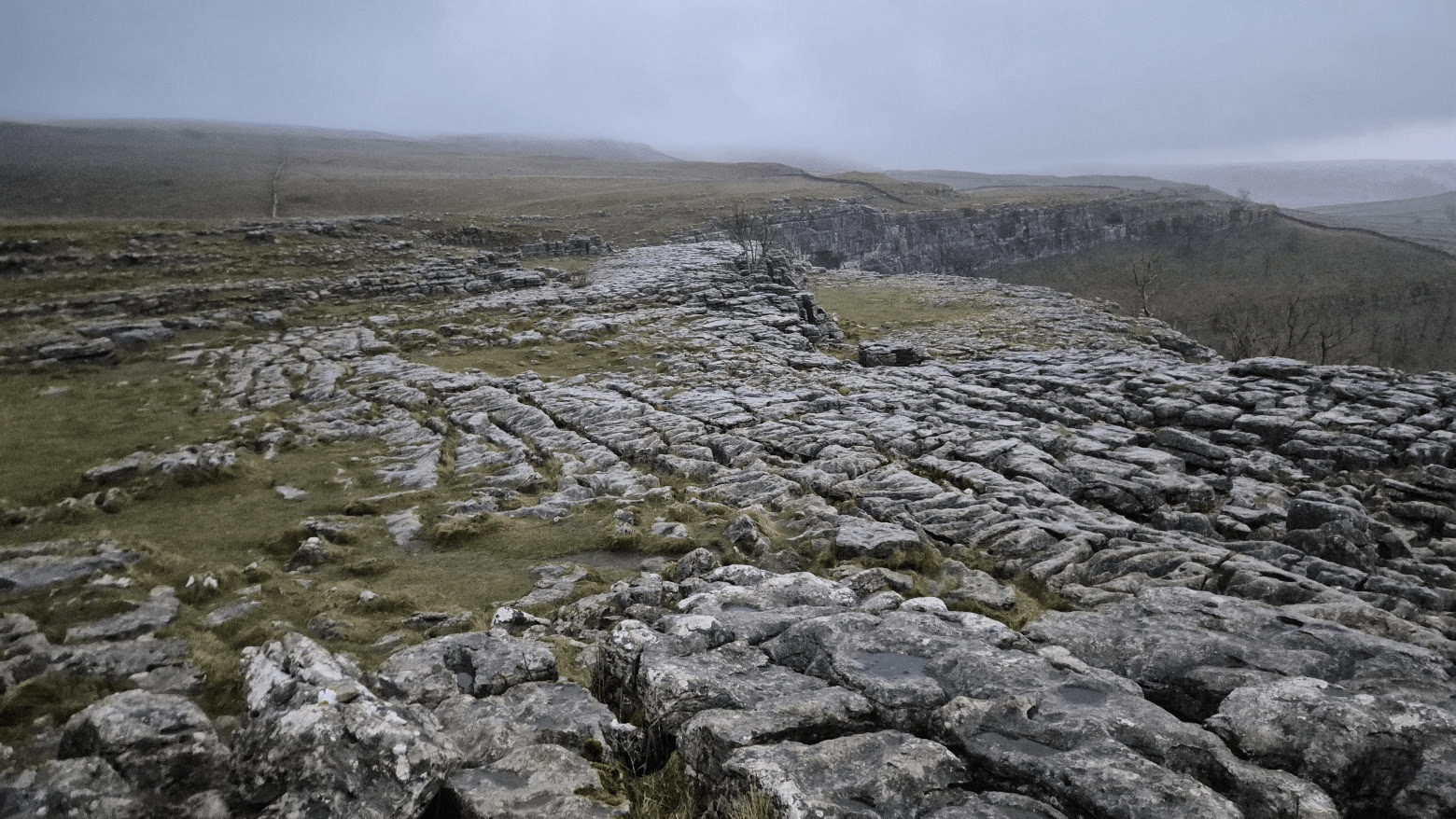
The Winter Spine Race 2024 – it’s cold outside…(Final part)

I attempted to get some sleep at the checkpoint but it didn’t work too well. Ironically the only place I was cold all week was in the sleeping area of CP5. I got up, got dressed and ate copious amounts of rice pudding with jam for breakfast. I was offered porridge but I felt rice pudding was easier to eat quickly and digest.

Before leaving every checkpoint there is a kit check. This is usually just a few items to ensure people are still carrying the kit and generally includes items which might be considered particularly necessary for the next leg. At Checkpoint Five the check is slightly more extensive as the final leg is the most remote and therefore things like sleeping kit, warm layers and GPS become even more important.

Soon I was ready to set off on the last leg of my epic journey. Strangely although this was probably the most challenging leg of the race – certainly after the previous 220+ miles – I was less worried about it than the previous ones. Why? Well firstly, on all the other legs I had to complete the leg I was on and try and finish in a state where I would be able to do the next leg. This was the last leg, it didn’t really matter if I couldn’t move for a month after I kissed the wall in Kirk Yetholm.

The second reason was that this was what I was there for. When we were all standing in the field in Edale I can’t imagine that anyone was thinking ‘I just want to get over Cross Fell’. If anyone was thinking ‘I just want to run along the Cam High Road’ then that person should get help, seriously, if that was you, get help. I would imagine that every person in that field had at some point visualised themselves kissing the wall of the border Hotel at the finish. There was still 42 miles between me and the wall, the last 26 of which were some of the toughest and most inhospitable on the entire Pennine Way but I hadn’t come this far to only come this far.

Ready to go – so tired I smiled

My plan for the day was to try and take it steady and look after my back. It would be nice to arrive in Kirk Yetholm upright for a change. I thought I could have a good stretch at Byrness and maybe at the huts and all would be well.

The first mile and a half involves navigating one’s way out of Bellingham. I got this mostly right and managed to leave Bellingham on the correct road until the turn off onto the farm track towards Blakelaw.

I mentioned previously that the GPS track was slightly approximated to a series of straight lines. This was one of those times when I perhaps should have looked at a map rather than just the GPS track but it was about twenty to seven in the morning, it was dark and I was tired. The Pennine Way simply follows the farm track. I’m fairly sure I knew that from the Summer race but the GPS track ‘cut the corner’ a bit and appeared to head into a field. It was unfortunate that at exactly the point it did this there was an open gate into a field. I did think I would have expected more evidence of a trail across the field than there seemed to be but I carried on anyway.

Fortunately at the opposite side of the field there was another open gate and I was able to make a left turn and re-join the track. Had there not been I could have had slightly frustrating return journey across the field. I don’t blame the GPS track, it was made very clear that these are a guide when we were given them. I blame me for only looking at my watch and not getting my Etrex GPS out. The watch does have a map on it and it almost certainly showed the track I should have followed but the handheld has a bigger screen and is easier to zoom in and out. If I’d looked at it when I headed off through the gate I would have seen the farm track re-join the GPS track and realised I didn’t need to turn off. As it was no harm was done but it was another wake-up call, as it were, regarding tired navigation.

The last sunrise I would see on the 2024 Winter Spine Race

After leaving Blakelaw I was fairly easily able to follow the rut that constituted the Pennine Way. I saw a safety team at one of the road crossing and they commented I looked strong. They didn’t mention a lean so I assumed I was still fairly upright.

As I was approaching Kielder Forest I was passed by Sauw-Yuh, a runner from the Netherlands I had spoken to a few times on the trail. My running pace is dictated entirely by how I feel at any given moment. I might run a 100 metres and the stop and walk or I might carry on running. As a result I tend to avoid running with people on big races. It’s not that I’m anti-social (much), it’s just that I have to do my own thing. I’m also quite comfortable being alone on the trail, I have imaginary conversations in my head with all kinds of random people about all kinds of random subjects, it passes the time anyway. Sauw-Yuh mentioned I was starting to lean. I wasn’t totally surprised, I’d had another ice induced fall and now one of my poles had a kind of s-bend in it, and whilst the trail wasn’t anywhere near as hard as it would become, it had its tricky moments.

Still in England but whoever lives here would appear to rather not be!
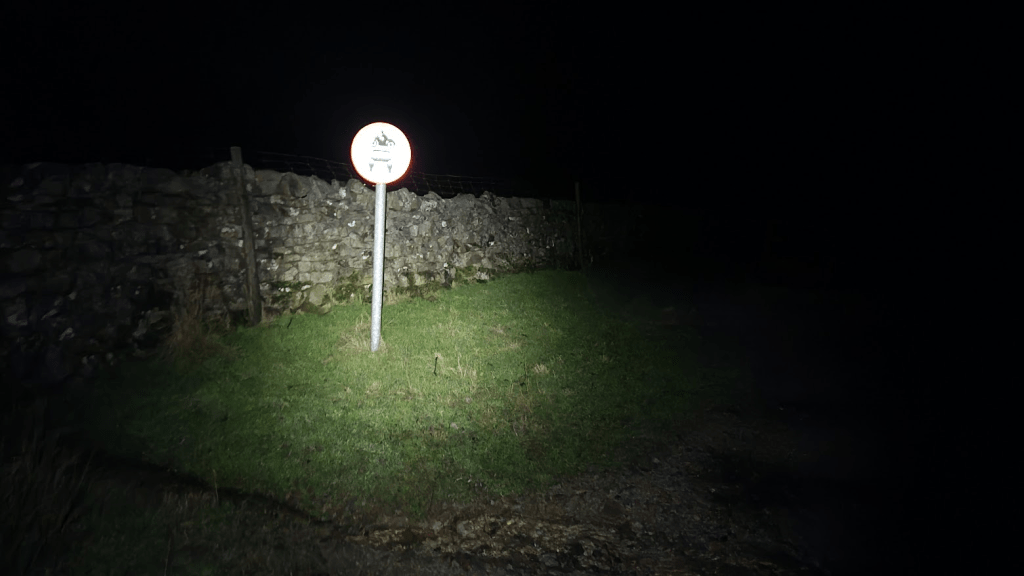
The last five miles or so to Byrness are along a very, very dull grey forestry road. Although Sauw-Yuh and I weren’t running together we stayed together for most of this section to alleviate the boredom and pull each other along to Byrness.

Byrness Church – I could have rested here but I wanted to get over the Cheviots ASAP

Byrness is Checkpoint 5.5. As an official ‘-.5’ checkpoint it has a maximum stay of 30 minutes. Unlike any other ‘-.5’ checkpoints it provides hot food. Mince and tatties were provided. I attempted two bowls but only had time for one and three quarters. I also had my obligatory coffee. I did manage a few back stretches and gained two important pieces of information. Oliver Hague – the proprietor of CP5.5 or ‘Forest view Inn’ as it is known the rest of the year – had just successfully completed the Spine Challenger North. He warned us there was a lot of sheet ice around Chew Green, a section of the Cheviots before Hut 1, and strongly recommended we used our ice spikes. The second piece of information was more worrying, 80 mile per hour winds and rain were forecast to hit the Cheviots. No one seemed to know exactly when but the suggestion was to get over them ASAP. This was part of the on the job training, what do you do when bad weather is forecast? Try and be somewhere else.

It may not look like anything special but it was much appreciated before I took on the Cheviots

I left CP5.5 and headed for Byrness Hill. As I was in a hurry, turning left and going the wrong way until my watch buzzed probably wasn’t a terribly smart move but I did it anyway. I was expecting the Hill to be slippery and hard to climb but it wasn’t, just a tiny amount of scrambling required on the rocky bits.

The wind was already fairly intense and I was now very sure I didn’t want to be up there when it got worse. As soon as I reached a sheltered spot I stopped to put my micro-crampons on. This took a while. It’s easy to ‘practice’ with kit at home and I could put my micro-crampons on quite easily when fresh and wearing indoor clothes. After 240+ miles and in my outdoor winter gear I don’t bend quite as easily!
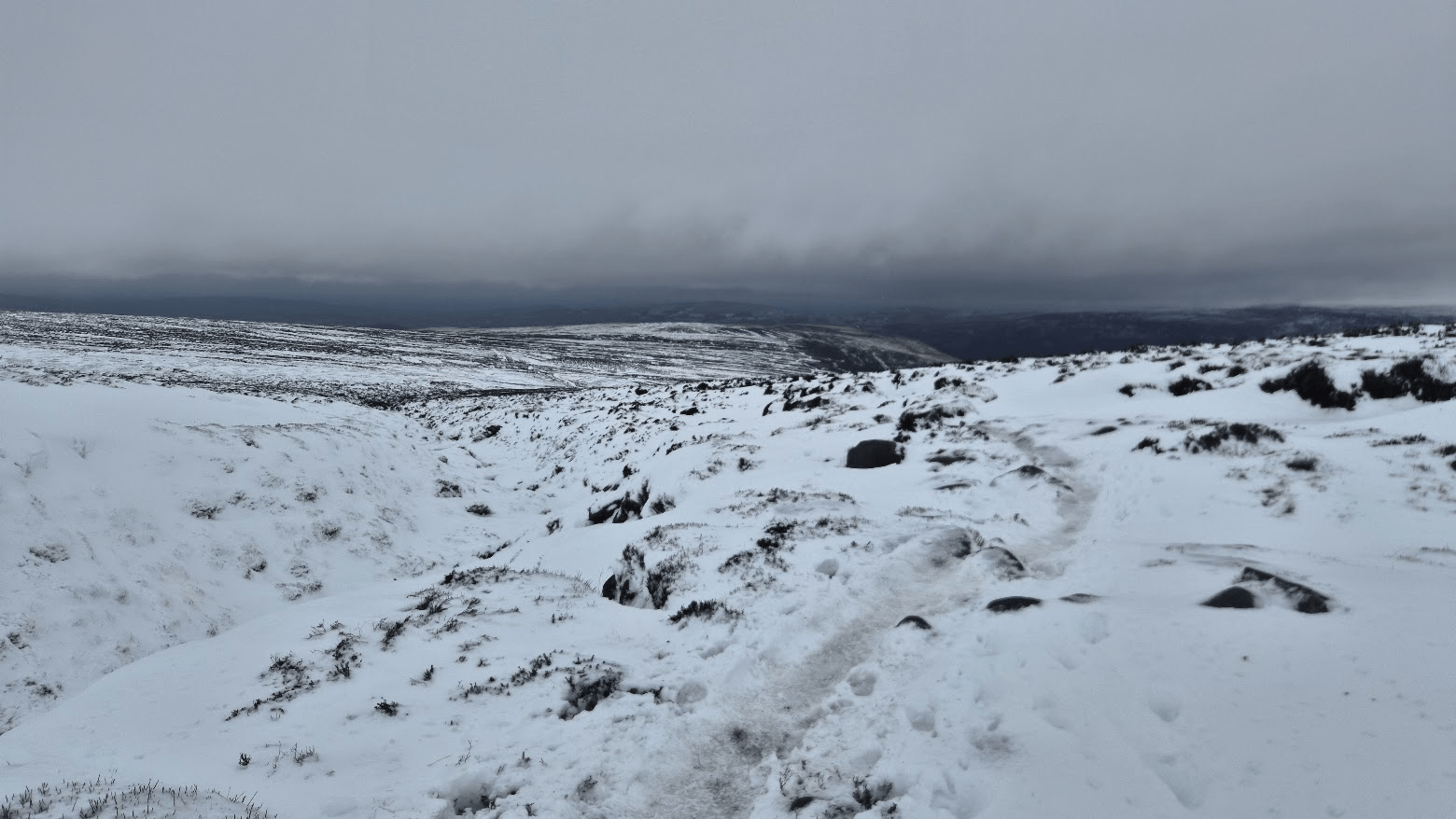
At Chew Green there was, in the past, a Roman fort, a roman road and the medieval village of Kemylpethe. I did notice a sign telling me I was at an archaeological site and I did see some signs for the Roman road but my general feeling was that this wasn’t somewhere anyone would choose to live. I imagined the conversation between the Romans that had been stationed there and the Emperor: “Yes Caesar, I know conquest and occupation is our thing but have you tried living in the Cheviots? Even the sheep are too smart to stay up here.” I wasn’t hallucinating but my mind was definitely starting to go out to play on its own.

I achieved my aim of getting to Hut 1 in daylight and ate plenty of my snacks along with the provided coffee. I had 9 miles to go to Hut 2 and then 7 miles to Kirk Yetholm. However it was getting dark and, it seemed, windier.

Perception is a strange thing. Coming down from Greg’s Hut, I would say I was flying. My GPS log says something different. Similarly I would say I raced away from Hut 1 but Strava says I got up to about three miles an hour tops – and some of that was with quite a strong wind behind me (weather, not caused by the mince and tatties). Whatever the reality was I thought I was making fast progress. I was a little surprised by how easily some of the others that left Hut 1 just after me overtook me at the time but seeing how fast I was really going explains it I guess.

After a while I could no longer see the lights of anyone in front of me and started to flag a bit. The caffeine and sugar fix from Hut 1 was wearing off and I was climbing the last part of the ridge – the highest point on this leg – before the drop to Hut 2. I just gritted my teeth and put one foot in front of the other and slowly climbed upwards. I was looking forward to descending as the strength of some of the gusts of wind had been quite worrying. I hadn’t been knocked of my feet but I had been made to stagger a few times and at one point I was very relieved the wind was blowing me into the hill and not off it. Ironically Windy Gyle had been one of the calmer places on the route – although I still got the navigation wrong somewhere and had to climb the border fence back into England – fortunately that isn’t very hard to do.

Finally I reached the left turn off the ridge and before long started to descend. There were a few flags and tape marking the route down, I think to stop people falling down into the Hen Hole. It’s a small climb back up to Hut 2 but soon I was being welcomed inside and supplied with a hot beverage. I’d carried an extra cup on the outside of my pack as in Summer I had to use my own cup for a hot drink at any intermediate point. This was the first time I’d used my own cup since the first leg on the Winter race. At least it made carrying it 268 miles seem worthwhile.

By now I was definitely leaning. I didn’t care, the impending weather meant all bets were off as far as taking it easy and looking after my back was concerned. There was a medic at the hut. I carefully rehearsed a short justification as to why I would like some pain relief but was still fine to carry on. “Could I have some codeine?”. “Yes”. No need for the speech although I was able to reassure her that I had had codeine before and I would be OK with it. She gave me the tablet and suggested I take a couple of my paracetamol too. I could probably have made it to Kirk Yetholm without any pain relief but apart from my back, my feet were sore, my knees were sore and I was prepared to take any help I could get within the rules of the race at this point.

It wasn’t exactly a party atmosphere in the Hut but there were about six of us in there and I was given cashew nuts, chocolate and Jammy Dodgers as people emptied out some of the treats they’d been carrying with them.

Soon it was time to leave and a marshal escorted us out past Red Cribs and told us to keep the fence on our left all the way over the Schil and to make sure we turned left on the low path after going over it. Again I set off fairly quickly and pulled ahead of the others I’d left the hut with. There were three reasons for this, 1 – the impending weather, I was off the high ground but still didn’t want to get rained on if I could avoid it. 2 – I wanted ‘my’ moment at the finish. I wasn’t bothered about beating anyone else as such, that would be very petty after 268 miles, but I did want solo finish photos. 3 – I’d sent out a message at Hut 2 that I’d be finishing around midnight, to make the last seven miles a little more interesting I set myself the target of a Friday finish.

It was on my way up the Schil I realised I’d wrecked yet another set of spikes. I think this time it was to do with my difficulties fitting them. The wires securing them should have gone between the lugs of my shoes. As I couldn’t see what I was doing I think some of them ended up such that they were on the lugs and being abraded by rocks. I kept them on as the back spikes still seemed to be in place and I couldn’t be bothered to stop by now anyway, I just wanted to finish.

The route down from the Shil goes from path to track to road. I was having to be careful as there was still a lot of ice around and my spikes had gone from being crampons to some kind of strange jingling collections of wire and metal, a bit like part of a Steampunk Morris Dancing outfit.

I kept checking my watch, the Friday finish was on! About a mile from the finish I passed John Boothman. He had a really bad lean to the right, I was leaning to the left, we must have looked a very strange sight as I passed him. I felt for him as I had been pretty much the same (but a mirror image) on the Summer spine Race. however there was nothing I could do for him, apart from wish him well.

I climbed the last small hill and got my first glimpse of the finish line. Of course nothing is entirely straightforward on the Spine Race, the finish line then disappears out of sight until you’ve gone downhill and turn to run straight towards it.

On the Summer Spine I collapsed dramatically and in pain under the arch and had to get up and drag myself to the wall of the Border Hotel. This time I was focussed and had a little celebration as I went under the arch but kept moving and ran over to kiss the Wall. I’d finished the 2024 Winter Spine Race – on Friday!

A bit leany but much more comfortable that last time!
Finished
None of this would happen without Sharon

After the photos I was taken inside, fed, given a certificate and a t-shirt and reunited with my drop bag. After a short while I was ready to leave. A lovely marshal picked up my drop bag and carried out to the car for me. I was delighted with Sharon’s choice of parking spot as it was directly opposite ‘my’ finish line.

My Finish Line photo

So how does it feel to be a Winter spine Race finisher? Mostly amazing, I had a bit of a plan as to how I’d like the race to go and it more or less worked. I’m not sure I could have done much better with my finish time and apart from a lean on the last leg my body held up well. I only had one blister, on my left heel, which I kept taped up and never became a major source of discomfort.

So why only mostly amazing? I suffer quite a lot from Imposter Syndrome. I feel I kind of got away with it from a weather perspective. Yes, it was very, very cold at times but I didn’t have (much) water or bogginess to contend with and I only got exposed to precipitation for one day of the event. Jack Scott took ten hours of the course record so conditions must have been pretty good. However 164 people started and 91 finished, a success rate of 55.5%, which I think is around average for the Winter Spine. If conditions had been that easy I would have expected that figure to be higher so perhaps I did OK after all.

The last word of my race reports is always reserved for the thank yous. The Spine Race is an incredibly well organised and run operation. However this is not at the expense of compassion and friendliness. Obviously I felt particularly close to the marshals and volunteers I know and have name-checked throughout this report but every single person I interacted with was supportive, friendly and made me fee like I was the most important thing in their life at that moment. I never intended to do the Winter spine Race. Objectively I would say I couldn’t do the Winter Spine Race but here I am, with a medal, a t-shirt and a certificate. I entered because the Spine Family made me want to and I finished because they supported me and got me to Kirk Yetholm. Thanks everyone.

I also need to say thank you to everyone that messaged me during the race or followed my dot or gave me any advice or words of encouragement anywhere on my journey. I couldn’t reply too much during the race but it was great to read the messages, they really gave me a lift during the race. I felt a bit emotional in Hut 2 when I read some messages for the last time before heading to Kirk Yetholm.

The very last word has to be reserved for Sharon. She delivered me to the start, lost sleep watching my dot, had to be ready to collect me at a moments notice during the week and had to drive several hundred miles to be there when I got to Kirk Yetholm. She’s also put up with endless Spine talk and a house littered with Spine kit for months. I don’t know if I’m the luckiest man in the world because I don’t know every man in the world but I do know I couldn’t want for a more supportive, tolerant and caring wife than the one I’ve got. I love you Sharon.

So is this the end of the blog? Well the next Pennine adventure is The Southern Challenger with Sharon, her first 100+ mile race and over twice as far as she’s ever been before, I think that might warrant a bit of a write up. I might also compare my Summer and Winter experiences and talk a bit more about my kit and what worked and what didn’t. however until then, the only way is still Pennine!